What Is Accountability?
Accountability means taking responsibility for your actions, decisions, commitments, and results.
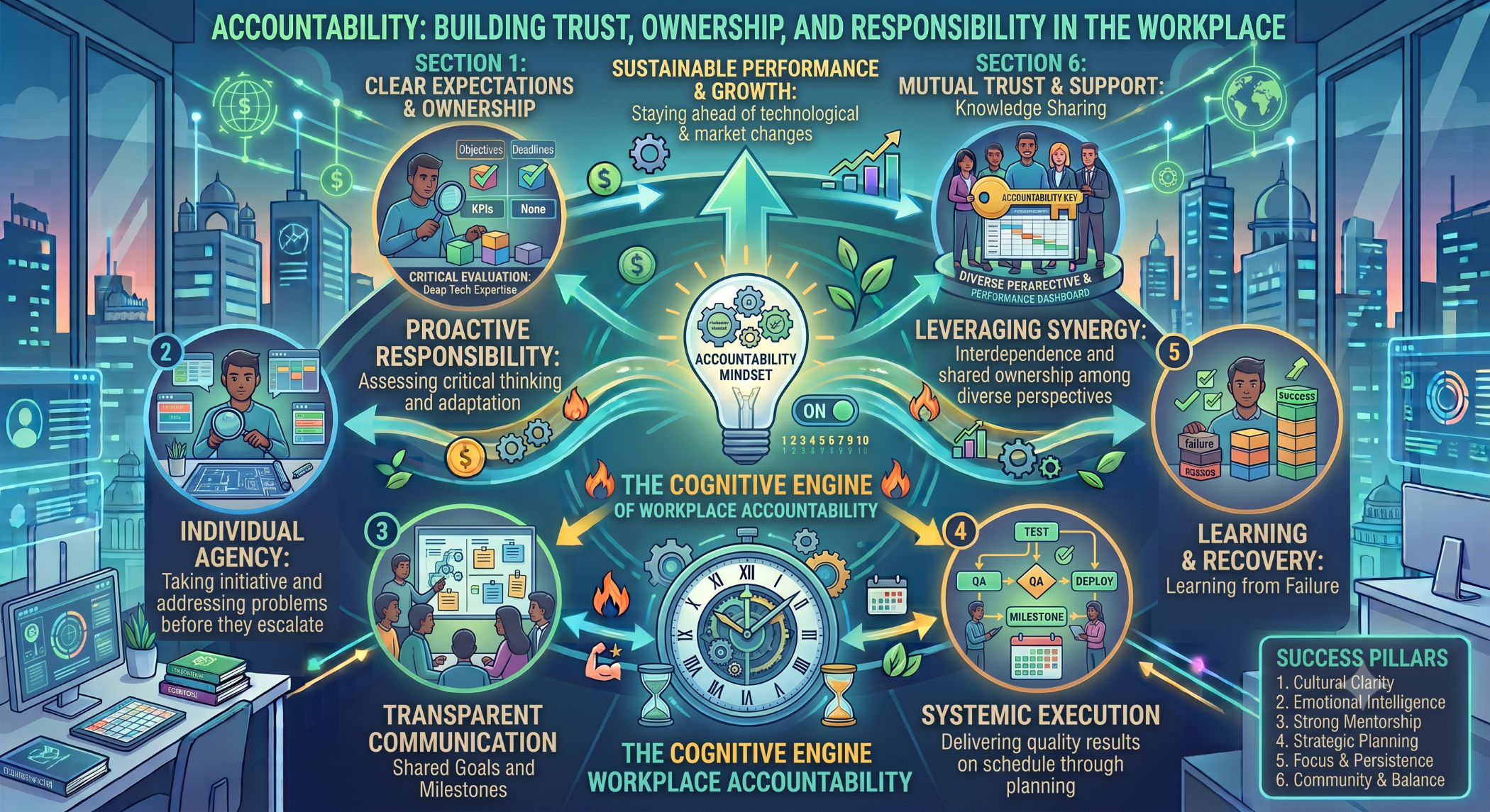
In a professional environment, accountability goes beyond simply completing assigned work. It means understanding what is expected, taking ownership of the outcome, communicating progress honestly, and addressing problems when they arise.
A strong culture of accountability helps organizations build trust and improve execution. Solace Infotech itself identifies “Accountability” as one of its core values, alongside ethics, collaboration, and nurturing people.
Why Accountability Matters
Every organization depends on people fulfilling their responsibilities.
When employees take ownership of their commitments, teams can plan more effectively and managers can rely on accurate information. When accountability is weak, delays, misunderstandings, blame, and repeated problems can become common.
Accountability helps create an environment where people understand that their work contributes to a larger objective.
It also encourages professionals to think beyond completing individual tasks and focus on the quality and outcome of their contribution.
Accountability vs Responsibility
Responsibility and accountability are closely related, but they are not exactly the same.
Responsibility generally refers to the duties or tasks assigned to a person.
Accountability means being answerable for the result.
For example, a developer may be responsible for implementing a feature. Accountability means ensuring that the feature works as expected, communicating any blockers, testing the implementation appropriately, and taking ownership when an issue is identified.
Responsibility tells us what we need to do. Accountability emphasizes owning the outcome.
Accountability Builds Trust
Trust is one of the foundations of successful teams.
People trust colleagues who keep commitments, communicate honestly, and take responsibility for mistakes.
Consider two situations. In the first, an employee notices that a task is going to be delayed but does not inform anyone until the deadline has passed. In the second, the employee identifies the risk early, explains the reason, and proposes a revised plan.
The second approach demonstrates accountability.
Even when the result is not perfect, transparency helps maintain trust.
Take Ownership of Your Work
Ownership means treating the outcome as something you are personally responsible for influencing.
An ownership-oriented professional does not stop at saying, “That was not my task.”
Instead, they look at the larger objective and ask whether there is something they can do to help move it forward.
This does not mean taking responsibility for everything. It means recognizing where your actions, communication, or decisions can influence the result.
Accountability in Software Development
Software development requires accountability at every stage.
Developers are accountable for the quality of their code. QA professionals are accountable for thorough validation. Project managers are accountable for planning, communication, and coordination. Technical leads are accountable for guiding architecture and technical decisions.
For example, when a production issue occurs, an accountable team does not immediately focus on determining who made the mistake.
It first focuses on restoring the service, understanding the root cause, communicating the impact, and preventing recurrence.
This creates a culture focused on solutions rather than blame.
Accountability and Deadlines
Meeting deadlines requires more than estimating a date and hoping the work will be completed.
Professionals should monitor their progress and identify risks early.
When circumstances change, accountability means communicating the situation before the deadline becomes a problem.
A proactive message such as “This dependency is delayed and may affect Friday's delivery; here is the revised plan” is far more useful than waiting until Friday and explaining why the commitment was missed.
Accountability Requires Transparency
Being accountable also means being honest about the current state of work.
Professionals should avoid reporting incomplete work as completed simply to appear successful.
Accurate reporting allows managers, clients, and teammates to make better decisions.
Transparency should cover progress, blockers, dependencies, risks, and changes in requirements.
In project-based environments, honest information is essential for effective planning.
Accountability and Problem Solving
Accountable professionals focus on solving problems rather than simply reporting them.
Identifying an issue is important, but asking what can be done about it is even more valuable.
For example, if an API integration is failing, an accountable team member can investigate the error, review logs, identify the dependency causing the failure, communicate the impact, and propose possible solutions.
Taking this additional step demonstrates ownership.
Accountability and Teamwork
A strong team consists of individuals who understand how their work affects others.
A missed development task may delay QA. A delayed design may block frontend implementation. A delayed client decision may prevent a release.
Accountability encourages people to recognize these dependencies and communicate accordingly.
When team members understand the impact of their actions on others, collaboration becomes more predictable and effective.
Leaders Must Demonstrate Accountability
Accountability begins with leadership.
Managers and leaders should model the behavior they expect from their teams.
When leaders openly acknowledge mistakes, communicate clearly, keep commitments, and take responsibility for decisions, employees are more likely to adopt the same behavior.
Conversely, leaders who blame others while avoiding responsibility can create a culture where employees hide problems instead of addressing them.
Accountability Without Blame
Accountability should not become a culture of fear.
There is an important difference between holding people accountable and blaming people.
Blame focuses primarily on who caused the problem.
Accountability focuses on what happened, what responsibility each person had, what can be corrected, and what should be done differently in the future.
A healthy organization can hold individuals accountable while still treating mistakes as opportunities for learning and improvement.
How to Improve Accountability
Accountability becomes easier when expectations are clear.
Every task should have a defined owner, expected outcome, priority, and deadline.
Communication should be consistent. Progress should be visible. Problems should be raised early.
After completing an important task or project, teams should also review what went well, what did not, and what can be improved.
These practices make accountability a normal part of the working process rather than something introduced only when a problem occurs.
Accountability and Performance
Accountability often improves individual and team performance because people have greater clarity about expectations.
When ownership is clearly defined, it becomes easier to identify priorities and measure progress.
Accountability also encourages professionals to think about quality rather than simply speed.
Completing a task quickly is not necessarily success if the result creates additional problems for the team or customer.
The ultimate objective is reliable and valuable delivery.
Accountability in Client Relationships
Client trust depends heavily on accountability.
Clients want to know that their requirements are understood, their concerns are being addressed, and commitments are taken seriously.
When a problem occurs, transparent communication is critical.
A professional response should explain the current situation, the impact, the corrective action, and the expected next step.
This creates confidence even when the situation itself is difficult.
The Business Value of Accountability
Accountability contributes directly to organizational effectiveness.
It can help reduce avoidable delays, improve communication, strengthen ownership, and make project execution more predictable.
It also supports a culture where people actively look for solutions rather than waiting for someone else to act.
Over time, this can improve employee development, customer relationships, operational efficiency, and overall business performance.
Building an Accountability Culture
Organizations can strengthen accountability through simple, consistent practices.
Set clear expectations from the beginning.
Assign ownership rather than leaving responsibilities ambiguous.
Encourage early communication of risks and blockers.
Measure outcomes rather than only activity.
Recognize employees who demonstrate ownership and reliability.
Treat mistakes as learning opportunities while still addressing repeated failures appropriately.
Most importantly, leadership should demonstrate accountability every day.
Conclusion
Accountability is about ownership.
It means taking responsibility for commitments, communicating honestly, addressing problems proactively, and focusing on outcomes rather than excuses.
In technology organizations, accountability is especially important because projects involve interconnected teams, dependencies, deadlines, and customer expectations.
A strong accountability culture does not mean creating fear or assigning blame. It means creating an environment where people can be trusted to do what they commit to, communicate when circumstances change, and work toward solutions when problems arise.
When accountability becomes part of everyday behavior, teams become stronger, communication improves, and organizations are better positioned to deliver consistent value