Customers and employees require a quick response, but many teams rely on shared inboxes, static FAQs, manual ticket prioritization, and lengthy explanations.
AI-powered chatbots for Business offer a solution by comprehending natural language queries, searching the company’s knowledge base, collecting required details, and guiding the user to the next step. Unlike simple scripted chatbots, an AI chatbot understands various formulations of the same query and leverages business-specific context to provide relevant answers.
It is essential to recognize that chatbots are not meant to replace all human interaction. A well-implemented chatbot for businesses handles routine requests, routes complex or sensitive issues to humans, and offers 24/7 support.
The Business Problem: Repetitive Questions and Delays
Support, sales, HR, operations, and customer success teams often encounter the same questions. In particular, customers frequently inquire about products, orders, billing, appointments, returns, documentation, and technical specifications. At the same time, employees may seek clarification on policies, onboarding procedures, IT support, and internal processes.
A company’s knowledge is distributed across various documents, websites, CRMs, emails, and portals. However, the information may be fragmented, difficult to navigate, or outdated. An enterprise-level chatbot for business serves as a unified interface that resolves frequent issues, collects relevant data, categorizes inquiries, and routes them to the R&D team or specialized departments.
How AI Chatbots for Businesses Work
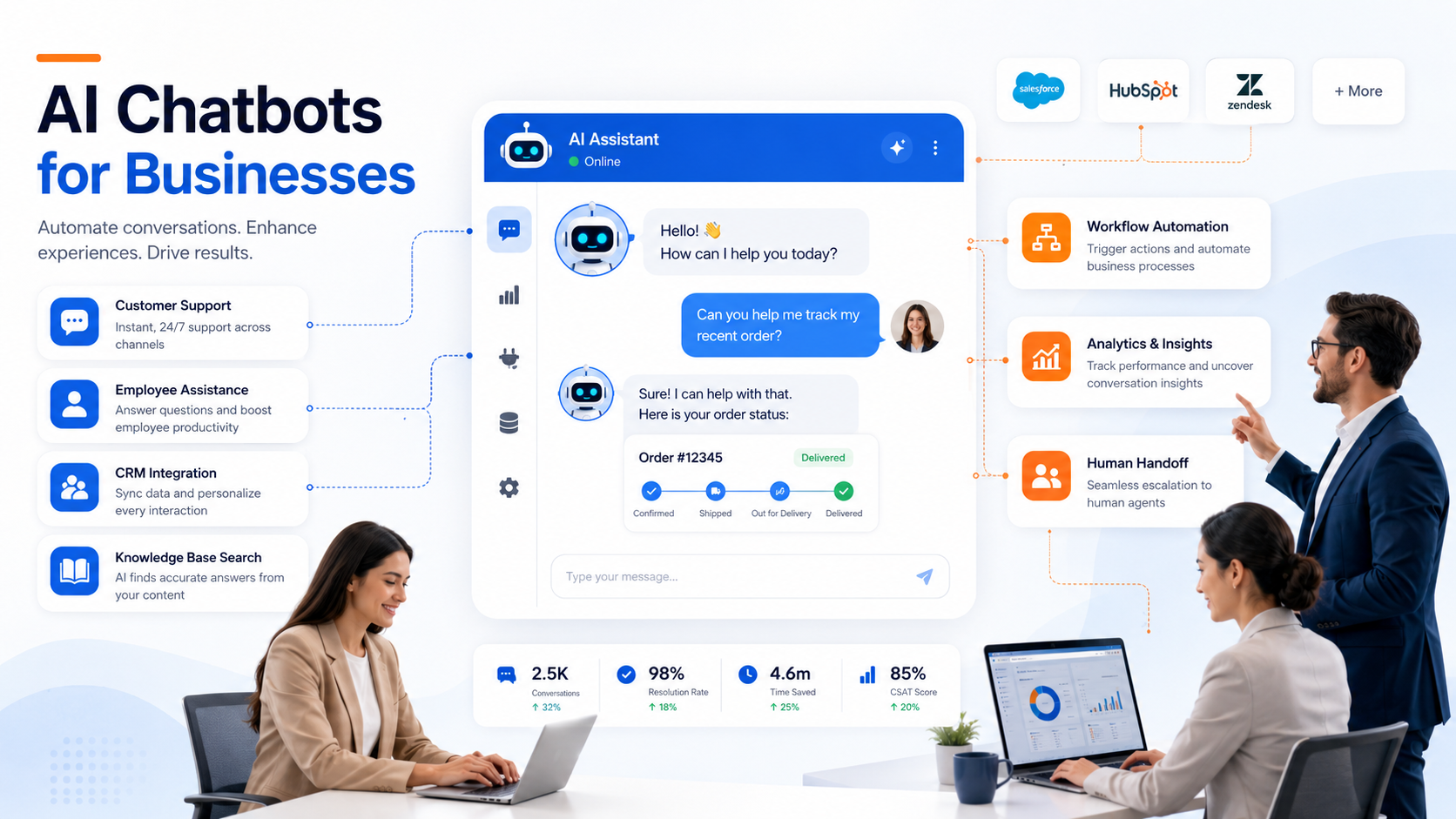
The user opens the chatbot interface via the website, mobile app, customer portal, WhatsApp, Microsoft Teams, Slack, or another messaging platform. Depending on a use case, the chatbot can perform several functions:
• Provide an answer based on the company’s knowledge base
• Ask clarifying questions to qualify the request
• Query a CRM database or ticket-supporting system
• Create a ticket or schedule a meeting
• Escalate the conversation to a human agent
• Store interaction data for analysis
Chatbots for Business usually operate in two modes: knowledge-intensive and human-centric. In the knowledge-intensive mode, an AI searches the company’s documents for relevant information and supplements it with general knowledge. It allows the chatbot to remain compliant with the business logic while delivering precise answers to common questions. In the human-centric mode, the chatbot escalates the request to an employee or manager and provides them with conversation context for a seamless handover.
Key Features and Capabilities
Business Knowledge Integration
A chatbot for business should be trained on the company’s documents, policies, procedures, product manuals, FAQs, service pages, technical specifications, and database entries.
Natural Language Understanding (NLU)
Users may phrase their questions in diverse ways. Unlike simple command-based interfaces, an AI chatbot understands synonyms and typos and recognizes the intent behind a customer’s message.
Lead Qualification
A business chatbot can collect information about the lead’s needs, budget, timelines, location, company size, etc. In particular, the lead qualification feature allows the chatbot to forward the details to a sales representative and set the next conversation stage.
Customer Support Automation
An AI-powered customer support chatbot can resolve frequently asked questions, collect the necessary details about the issue, suggest solutions, and escalate the request to a human agent if needed.
Human Handoff
A chatbot for business should allow users to communicate with a human representative when needed. It is essential, in particular, when the interaction requires empathy, personal judgment, legal, or regulatory expertise, or account-level access.
Analytics and Reporting
Questions that the chatbot cannot answer, user feedback, conversation transcripts, and escalation reasons can help optimize the chatbot’s performance and update the knowledge base.
Key Business Benefits :
An enterprise-level chatbot for business can deliver the following benefits depending on the use case:
• Reduce the number of recurring questions
• Accelerate first-response times
• Standardize communication and response policies
• Collect the required information before routing the request to an employee
• Escalate the conversation to the relevant department
• Increase employee productivity by reducing the number of routine tasks
• Improve the discoverability of the company’s knowledge base
• Spot gaps in the business knowledge and FAQ documentation
• Help optimize the support process
The benefits depend on the implementation and specific use cases. For instance, an AI chatbot for customer service can help deflect hundreds of low-complexity orders annually and reduce the response time for urgent requests by days or weeks. By contrast, a poorly configured chatbot for business may generate additional workload by requiring users to train the AI and verify its responses.
Industry Applications for AI Chatbots
The chatbot use case depends on the industry and departments that serve external customers or collaborate with other teams. For example, healthcare, finance, retail, education, real estate, and manufacturing sectors have varying requirements for an AI chatbot:
Healthcare
Chatbots for healthcare facilities can assist patients with scheduling, service-related inquiries, and administrative issues. However, critical matters such as diagnosis and emergency requests still require human assistance.
Finance
Companies in the financial sector can leverage chatbots for answering loan-application-related questions, qualifying borrowers, and collecting documents. At the same time, an AI chatbot can route specialized requests to relevant experts for further review.
Retail and E-commerce
Chatbots for retail businesses can help customers with product recommendations, tracking orders, reporting delivery issues, requesting a return or exchange, and self-checkout.
Education
Universities and colleges can implement educational institution chatbots to assist students with admissions, course enrollment, schedules, policies, document submission, and other campus-related issues.
Real Estate
A real estate chatbot can qualify leads, collect buyer requirements, provide information on listings, schedule showings, and connect prospects with real estate agents.
Manufacturing and Operations
An AI chatbot can collect employee requests regarding procedures, maintenance, specifications, quality control, or supplier guidelines. In particular, manufacturing chatbots can help operations teams access the relevant records and tickets directly in the interface.
When to Choose a Generic vs. Custom AI Chatbot
Generic chatbot platforms are suitable for simple use cases such as FAQs or a limited set of predefined questions and answers.
However, a custom AI chatbot development is required if it needs to:
• Leverage private documents or specialized knowledge
• Integrate with a CRM, ERP, database, ticketing system, or external API
• Follow specific privacy regulations or approval workflows
• Respect user roles and data permissions
• Provide answers based on the knowledge base
• Collect structured information about the request
• Operate in multiple channels
• Maintain audit trails
A custom chatbot for business typically utilizes a combination of existing NLP models, RAG, APIs, databases, authentication mechanisms, and interfaces.