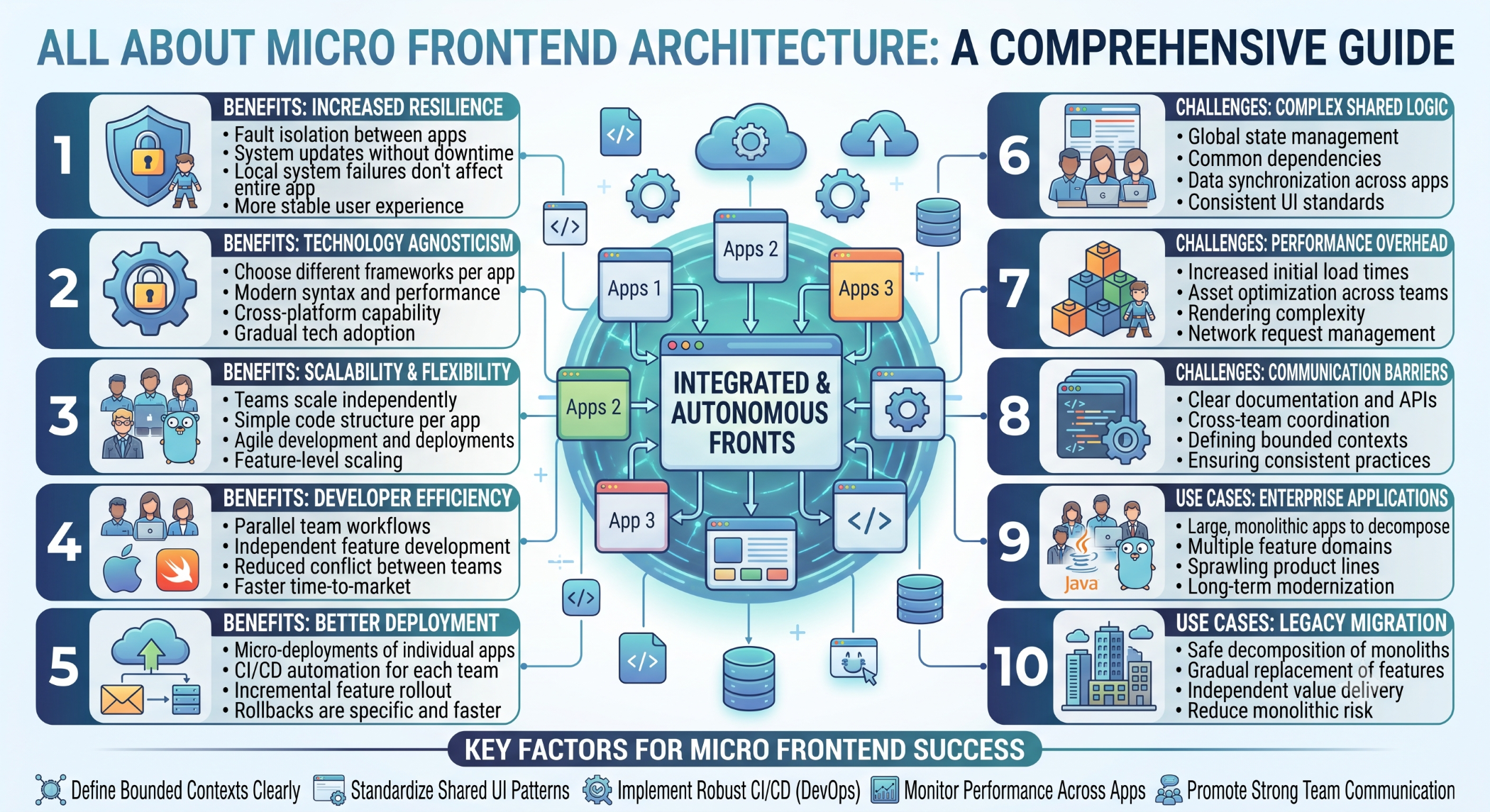
As web applications become larger and more complex, managing a single frontend codebase can become challenging. Multiple teams may need to work on different parts of the application, making development, testing, and deployment more difficult.
Micro frontend architecture addresses this challenge by dividing a large frontend application into smaller, independently managed modules. Each module can focus on a specific business function while working together as part of a single application.
What Is Micro Frontend Architecture?
Micro frontend architecture is an approach where a large frontend application is divided into smaller applications or modules based on business functionality.
For example, an e-commerce application can have separate frontend modules for product management, customer accounts, shopping cart, checkout, and order management.
Although these modules can be developed independently, users experience them as one complete application.
How Micro Frontends Work
A micro frontend application generally consists of multiple frontend modules that are combined to create the final user experience.
Different development teams can own different modules. They can develop, test, and deploy their modules independently while following common application standards.
This approach brings some of the concepts of microservices architecture to frontend development.
Benefits Of Micro Frontend Architecture
Independent Development: Teams can work on individual application modules without constantly modifying a large shared frontend codebase.
Independent Deployment: Individual modules can be released without requiring the entire application to be deployed at the same time.
Better Team Productivity: Large teams can be divided according to business domains, allowing developers to focus on specific areas of the application.
Incremental Modernization: Older frontend applications can be gradually modernized by replacing individual sections instead of rewriting the complete application.
Scalability: Large applications can be structured into smaller and more manageable frontend components.
Micro Frontend Vs Monolithic Frontend
In a traditional monolithic frontend, most application functionality is contained within a single frontend project.
This approach can work well for smaller applications and development teams. However, as an application grows, the shared codebase can become difficult to maintain.
Micro frontend architecture divides the application into smaller modules, allowing teams to manage and deploy different business areas independently.
Challenges Of Micro Frontend Architecture
Micro frontends can provide important benefits, but they also introduce additional complexity.
Applications need to manage communication between modules, shared dependencies, authentication, routing, testing, monitoring, and deployment.
Performance can also become a concern if multiple modules load duplicate libraries or unnecessary resources.
Maintaining a consistent user experience can be challenging when different teams work independently. A shared design system and development standards can help maintain consistency.
Popular Micro Frontend Approaches
Micro frontends can be implemented using different technologies and approaches.
Module Federation can allow separately developed frontend applications to share and load modules.
Web Components provide reusable components that can work across different frontend frameworks.
Single-SPA can be used to orchestrate multiple frontend applications within a single user experience.
The appropriate approach depends on the application's technology stack, team structure, deployment requirements, and business needs.
When Should You Use Micro Frontends?
Micro frontend architecture is generally more suitable for large and complex applications where multiple teams need to work independently.
It can be considered when:
The application contains multiple business domains.
Several development teams work on the same product.
Independent deployment is important.
The existing frontend has become difficult to maintain.
The business wants to gradually modernize a legacy application.
Different teams need ownership of specific application areas.
For a small application managed by one team, a well-structured traditional frontend may be simpler and more cost-effective.
Micro Frontend Architecture For Enterprise Applications
Enterprise applications often contain multiple business functions such as customer management, finance, reporting, inventory, sales, and administration.
Micro frontend architecture can allow these areas to be developed and maintained independently while still providing users with a unified application experience.
However, organizations should establish common standards for authentication, navigation, UI design, APIs, dependencies, monitoring, and deployment.
How Solace Infotech Can Help
Solace Infotech provides custom web application development services for businesses building scalable and maintainable digital solutions.
Our development teams can work with modern frontend technologies, backend APIs, cloud services, enterprise applications, e-commerce platforms, and customized business workflows.
Depending on the project requirements, a modular frontend architecture can be designed to support independent development, maintainability, scalability, and future modernization.
Conclusion
Micro frontend architecture provides a way to manage large frontend applications by dividing them into smaller, independently developed and deployed modules.
It can improve team autonomy, independent deployment, scalability, maintainability, and incremental modernization. However, it also introduces additional complexity around performance, testing, integration, governance, and monitoring.
Businesses should therefore evaluate their application size, team structure, technical requirements, and long-term goals before adopting micro frontend architecture.