Artificial Intelligence AI
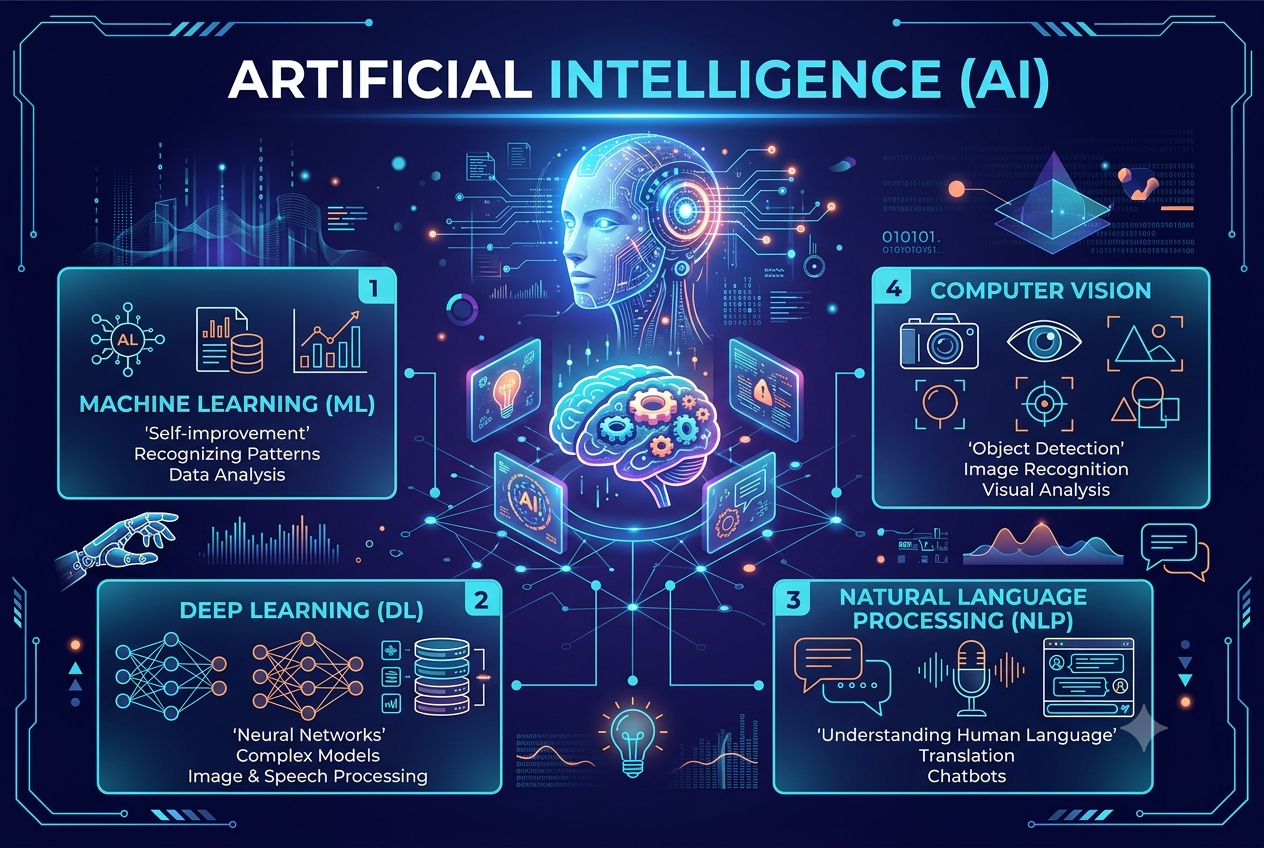
Artificial Intelligence (AI) enables software and machines to perform tasks that traditionally require human intelligence, including learning, reasoning, prediction, language understanding, and decision-making. In 2026, businesses are increasingly moving from basic AI experiments toward practical applications and AI-powered workflows.
1. Generative AI
Generative AI can create text, images, code, documents, and other content from natural-language instructions. Businesses are using it for content creation, software development, document analysis, customer support, and productivity.
2. AI Agents
AI agents are becoming an important part of modern business applications. Unlike basic chatbots, agents can reason through tasks, use tools, access information, and complete multi-step workflows with limited human intervention.
3. AI-Powered Automation
AI can automate repetitive activities such as document processing, data entry, customer queries, reporting, scheduling, and workflow management. This allows employees to focus more on complex and strategic tasks.
4. AI In Customer Experience
Businesses are using AI for personalized recommendations, intelligent search, chatbots, virtual assistants, sentiment analysis, and automated customer support. These applications can help businesses provide faster and more personalized customer interactions.
5. AI For Business Analytics
AI can analyze large volumes of structured and unstructured data to identify patterns, predict outcomes, detect anomalies, and support business decisions. Common applications include forecasting, fraud detection, customer analysis, and demand planning.
6. AI In Software Development
AI-powered development tools can assist developers with code generation, testing, documentation, code reviews, debugging, and application modernization. This is becoming an important part of modern software development workflows.
7. Responsible And Secure AI
As businesses adopt AI at scale, security, data privacy, governance, cost management, and responsible AI practices are becoming increasingly important. Organizations need appropriate controls around the data, models, applications, and workflows they use.
Conclusion
Artificial Intelligence is moving beyond simple automation and chatbots toward intelligent applications, AI agents, predictive analytics, and automated business workflows. For businesses, the focus should be on identifying practical problems where AI can deliver measurable value while maintaining security, privacy, and appropriate human oversight.