Automation Trends: How Technology Is Transforming Modern Businesses
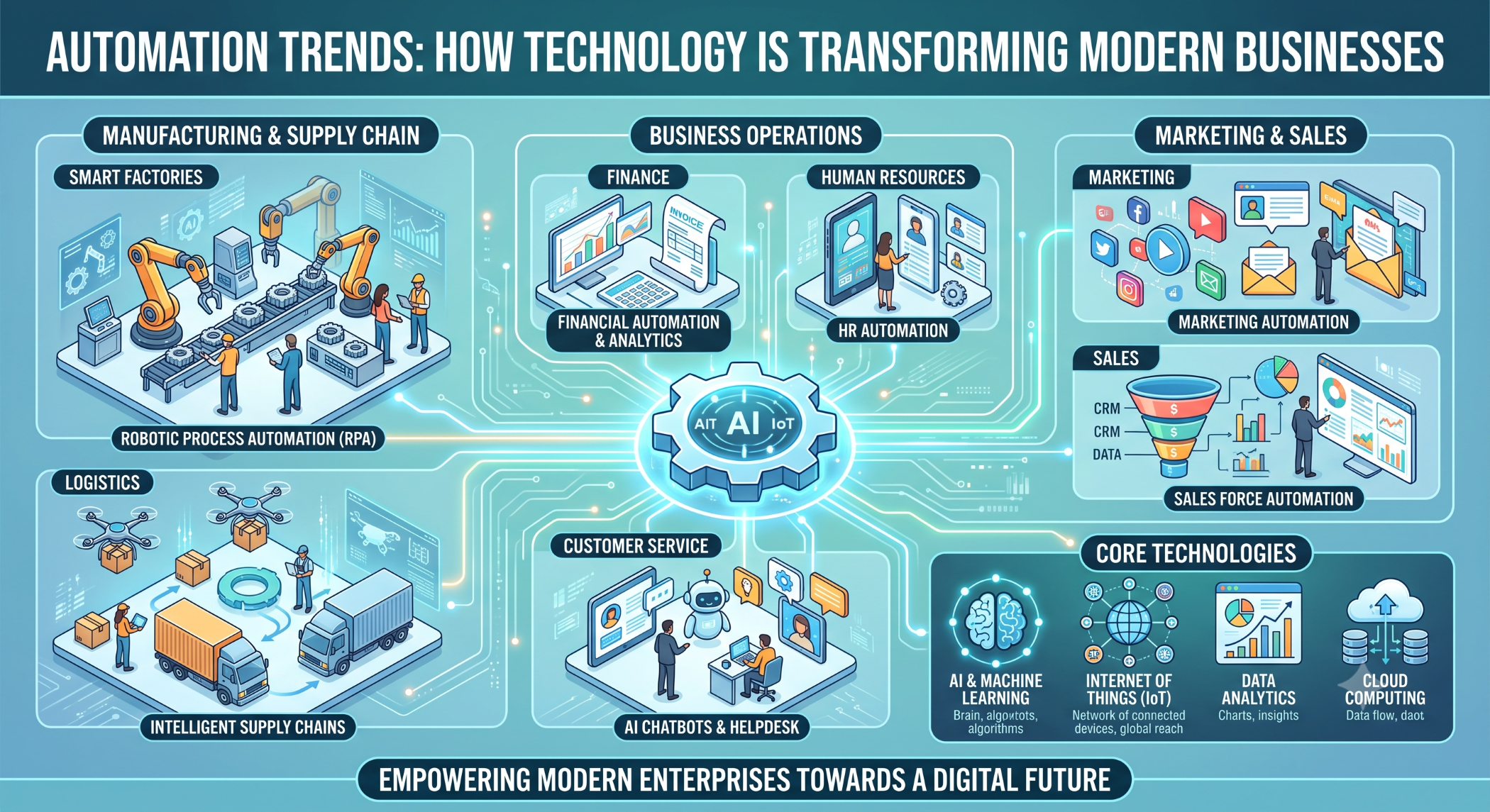
Businesses are increasingly using automation to reduce repetitive work, improve operational efficiency, and deliver faster customer experiences. What began with simple rule-based workflows is evolving into intelligent automation, where AI, cloud platforms, APIs, analytics, and business applications work together.
Understanding emerging automation trends can help businesses identify processes that can be streamlined and determine where technology can deliver measurable value.
Intelligent Automation
Traditional automation follows predefined rules. Intelligent automation combines automation with technologies such as Artificial Intelligence and Machine Learning.
For example, a system can receive a document, extract relevant information, classify it, and trigger the appropriate business workflow.
Document
↓
AI Processing
↓
Data Extraction
↓
Validation
↓
Automated Workflow
This can be useful for document processing, customer support, lead management, and other information-heavy processes.
AI-Powered Automation
Artificial Intelligence is becoming an important component of modern automation.
AI can help systems:
Classify incoming information.
Extract data from documents.
Generate responses.
Identify patterns.
Assist with decision-making.
Automate selected customer interactions.
The most valuable implementations focus on specific business problems rather than adding AI without a clear purpose.
API-Based Automation
Modern businesses often depend on multiple applications, such as CRM, ERP, payment, accounting, marketing, and customer-support systems.
APIs allow these systems to exchange data automatically.
For example:
Website
↓
API
↓
CRM
↓
Payment System
↓
Accounting Software
API-driven automation can reduce duplicate data entry and improve information flow between different business systems.
Cloud Automation
Cloud platforms make it easier to deploy and scale automated applications.
Businesses can use cloud-based infrastructure for scheduled jobs, data processing, application hosting, notifications, integrations, and background workflows.
Cloud automation can also support organizations that need flexible infrastructure as application usage changes.
Robotic Process Automation
Robotic Process Automation (RPA) uses software-based workers to automate repetitive, structured tasks.
Common examples include:
Data entry
Report generation
Data transfer between systems
Form processing
Repetitive administrative tasks
RPA can be useful when an existing legacy system does not provide modern APIs and repetitive interactions still need to be automated.
Workflow Automation
Businesses are increasingly automating complete workflows rather than individual tasks.
For example:
New Customer
↓
Registration
↓
Verification
↓
CRM Update
↓
Welcome Email
↓
Task Assignment
Connecting multiple steps can provide greater value than automating only one isolated activity.
Hyperautomation
Hyperautomation focuses on identifying and automating multiple processes across an organization using a combination of technologies.
It can involve:
Workflow automation + APIs + RPA + AI + Analytics
The objective is to automate processes end-to-end while improving visibility and reducing unnecessary manual intervention.
Data-Driven Automation
Automation systems increasingly use real-time data to trigger actions.
For example, an application could automatically:
Notify a sales team when a high-value lead is identified.
Trigger an alert when inventory reaches a defined threshold.
Create a task when a customer request requires follow-up.
Generate a report at a scheduled time.
Data-driven automation makes business processes more responsive.
Automation and Customer Experience
Automation is not limited to internal operations.
Businesses can automate customer-facing processes such as:
Booking confirmations
Order notifications
Support ticket routing
Account onboarding
Payment reminders
Personalized communications
The goal should be to make customer interactions faster and more convenient without removing human support where it is valuable.
Human + Automation
The future of automation is not necessarily about eliminating every manual activity.
Many processes benefit from a human-in-the-loop approach where automation handles repetitive work while people review exceptions, make important decisions, or manage complex cases.
This approach can improve efficiency while maintaining appropriate human oversight.
Automation Security
Automation creates connections between systems, which makes security especially important.
Businesses should implement appropriate authentication, authorization, input validation, access controls, monitoring, and audit trails.
Sensitive automated workflows should also include safeguards against incorrect data, unauthorized actions, and unexpected system behavior.
Automation at Solace Infotech
Solace Infotech works across AI, web and mobile applications, APIs, cloud technologies, product development, and enterprise software, providing the technical foundation required for customized automation solutions.
Automation can be implemented as a focused workflow improvement or as part of a larger digital transformation initiative, depending on business requirements.
Best Practices for Adopting Automation
Start with processes that are repetitive, measurable, and time-consuming. Define the expected business outcome before selecting a technology.
Automate the process in stages, monitor results, and maintain human oversight where decisions carry significant business impact.
The best automation strategy is not to automate everything. It is to automate the right processes in the right way.
Conclusion
Automation is moving toward more intelligent, connected, and adaptive business processes. AI, APIs, cloud platforms, RPA, analytics, and workflow automation are creating new opportunities for businesses to improve efficiency and customer experience.
Organizations that begin with clear business problems and measurable outcomes can use these technologies to reduce repetitive work, improve consistency, and build more scalable operations.