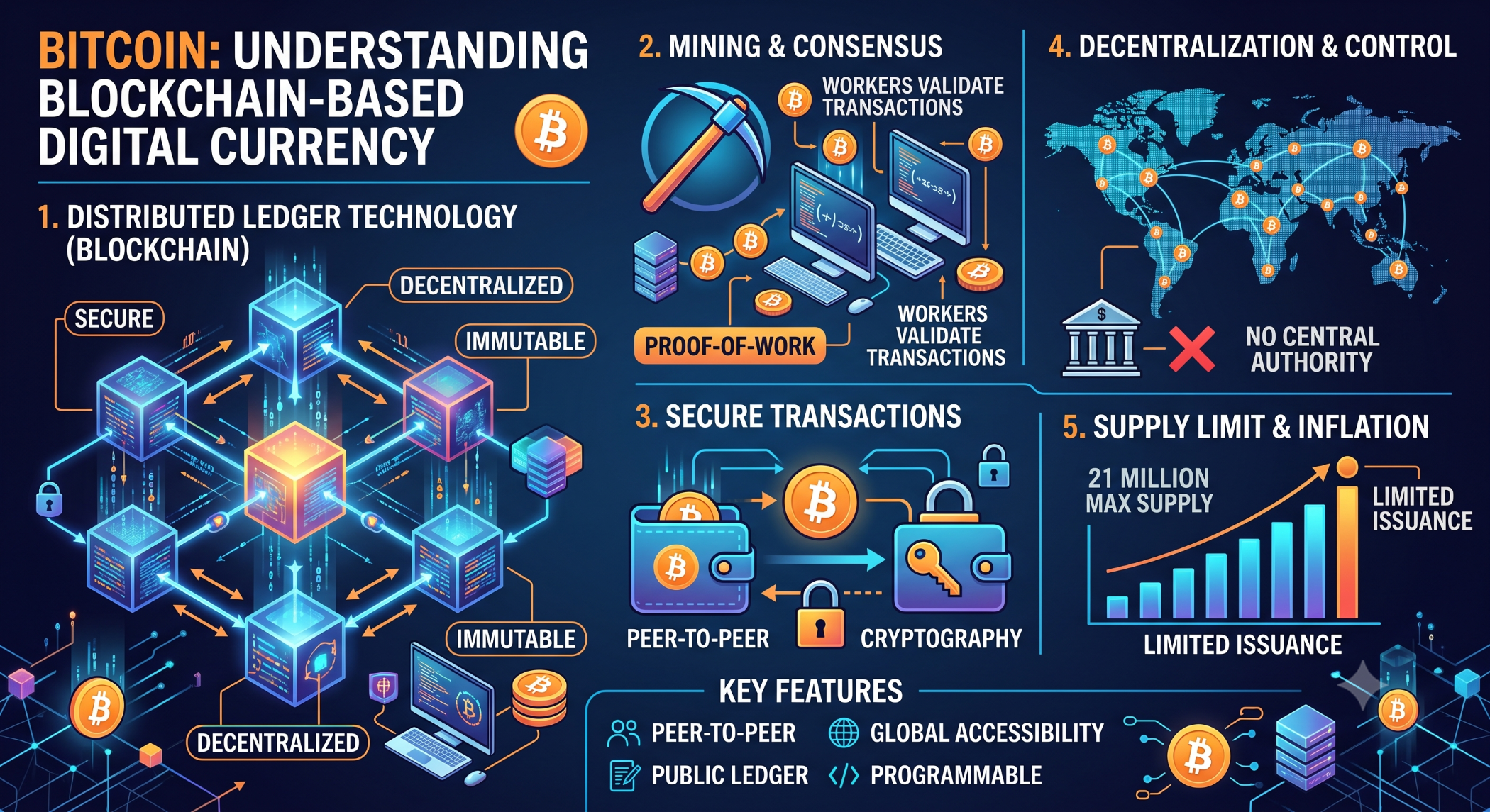
Bitcoin: Understanding Blockchain-Based Digital Currency
Bitcoin introduced a new approach to digital payments by allowing value to be transferred through a decentralized network without relying on a traditional central authority to maintain the transaction ledger.
Built on blockchain technology, Bitcoin records transactions on a distributed network of computers. Its design has also influenced the development of many other cryptocurrency and blockchain projects.
What Is Bitcoin?
Bitcoin is a decentralized digital asset and payment system. Transactions are recorded on a public blockchain maintained by a distributed network of participating computers.
Unlike traditional banking systems, Bitcoin does not depend on a single organization to maintain the complete transaction history.
A simplified transaction flow is:
User Creates Transaction
↓
Transaction Broadcast
↓
Network Validation
↓
Blockchain Confirmation
↓
Transaction Recorded
How Does Bitcoin Work?
Bitcoin uses cryptography and a distributed ledger to record and verify transactions.
When a transaction is created, it is broadcast to the Bitcoin network. Network participants validate the transaction according to Bitcoin's protocol rules. Valid transactions are included in blocks, which are added to the blockchain through the network's consensus process.
What Is Blockchain?
A blockchain is a continuously growing ledger of records organized into blocks.
Each block contains transaction information and a reference to the preceding block, creating a chronological chain.
Block 1 → Block 2 → Block 3 → Block 4
Copies of the ledger are maintained across participating nodes, making the system distributed rather than dependent on a single database server.
Bitcoin Mining
Bitcoin uses proof-of-work as its consensus mechanism.
Mining involves specialized computers competing to solve computationally difficult problems. Successful miners can add new blocks to the blockchain and receive protocol-defined rewards and transaction fees.
The mining process helps secure the network and make it computationally expensive to rewrite confirmed blockchain history.
Bitcoin Wallets
A Bitcoin wallet is used to manage the cryptographic information required to control Bitcoin.
Wallets can be implemented in different ways, including:
Hardware wallets
Software wallets
Mobile wallets
Custodial wallets
The most important security principle is protecting the credentials or private keys that control access to the assets.
Bitcoin Transactions
A Bitcoin transaction transfers control of bitcoin from one set of addresses to another.
Transactions are digitally signed using cryptographic keys. The network verifies that the transaction is authorized before it can be included in the blockchain.
Once included and sufficiently confirmed, the transaction becomes increasingly difficult to reverse.
Bitcoin Addresses and Private Keys
A Bitcoin address can be used to receive funds, while private keys provide control over the corresponding assets.
Private keys should never be shared publicly.
Losing the private key or recovery information can result in permanent loss of access to the associated funds.
Benefits of Bitcoin
Bitcoin's architecture provides several characteristics that distinguish it from traditional centralized payment systems.
Decentralization
The network is maintained by distributed participants rather than a single institution.
Transparency
The blockchain ledger is publicly observable, although Bitcoin addresses do not directly reveal a person's real-world identity.
Global Accessibility
Bitcoin transactions can be initiated from locations around the world where users can access the network.
Programmable Ecosystem
Bitcoin's broader ecosystem supports wallets, exchanges, payment services, custody solutions, and other applications built around the network.
Bitcoin vs Traditional Currency
Traditional currencies such as the US dollar or Indian rupee are issued and managed within centralized financial systems.
Bitcoin operates through a decentralized protocol and has a predetermined maximum supply of 21 million bitcoin.
The two systems therefore differ in issuance, governance, settlement mechanisms, and monetary policy.
Risks of Bitcoin
Bitcoin also introduces significant risks.
These include:
High price volatility
Private-key loss
Wallet and exchange security risks
Transaction irreversibility
Regulatory uncertainty
Fraud and scams
Businesses and individuals should understand these risks before using Bitcoin for payments, investment, or technology projects.
Bitcoin and Businesses
Businesses can potentially use Bitcoin-related technology for applications involving:
Digital payments
Cryptocurrency wallets
Blockchain-based platforms
Transaction monitoring
Digital asset management
A business considering cryptocurrency integration should evaluate transaction requirements, accounting, security, compliance, customer demand, and operational risks.
Bitcoin Security
Security is critical when working with Bitcoin.
Organizations should protect private keys, use appropriate wallet and custody mechanisms, restrict access to sensitive systems, and establish transaction approval procedures.
For higher-value operations, businesses may consider multi-signature controls or other security mechanisms appropriate to their risk model.
Bitcoin and Blockchain Development
Bitcoin is one application of blockchain technology. Businesses interested in blockchain development may also explore other networks depending on the required functionality.
A blockchain application can involve:
Blockchain Network
↓
Smart Contracts / Protocol
↓
Backend / APIs
↓
Web or Mobile Application
↓
Users
The appropriate architecture depends on the specific business requirements.
Blockchain Development at Solace Infotech
Solace Infotech works across blockchain, web applications, mobile development, APIs, and product engineering, providing capabilities that can support businesses exploring blockchain-based applications and digital solutions.
Technology selection should be based on the project's functionality, security requirements, scalability, regulatory environment, and long-term business objectives.
Best Practices
Businesses should clearly define the purpose of using Bitcoin or blockchain before selecting a technology.
Use secure wallet and key-management practices, protect sensitive credentials, evaluate regulatory requirements, and carefully assess third-party cryptocurrency services.
For production applications, security reviews and appropriate monitoring should be part of the implementation from the beginning.
Conclusion
Bitcoin introduced a decentralized approach to digital value transfer using cryptography, distributed networking, proof-of-work, and blockchain technology.
Its technology has influenced a broader ecosystem of cryptocurrencies and blockchain applications. However, Bitcoin also involves financial, operational, security, and regulatory risks.
For businesses, the right approach is to focus on the underlying business requirement and evaluate whether Bitcoin or blockchain technology provides a meaningful advantage before investing in an implementation.