Blockchain Technology: Understanding Decentralized Digital Systems
Businesses are exploring new technologies to improve transparency, security, automation, and digital transactions. Blockchain technology provides a distributed approach to recording and sharing information across a network of participants.
Although blockchain became widely known through Bitcoin and other cryptocurrencies, its applications extend to areas such as digital assets, supply-chain tracking, identity, financial services, and decentralized applications.
What Is Blockchain?
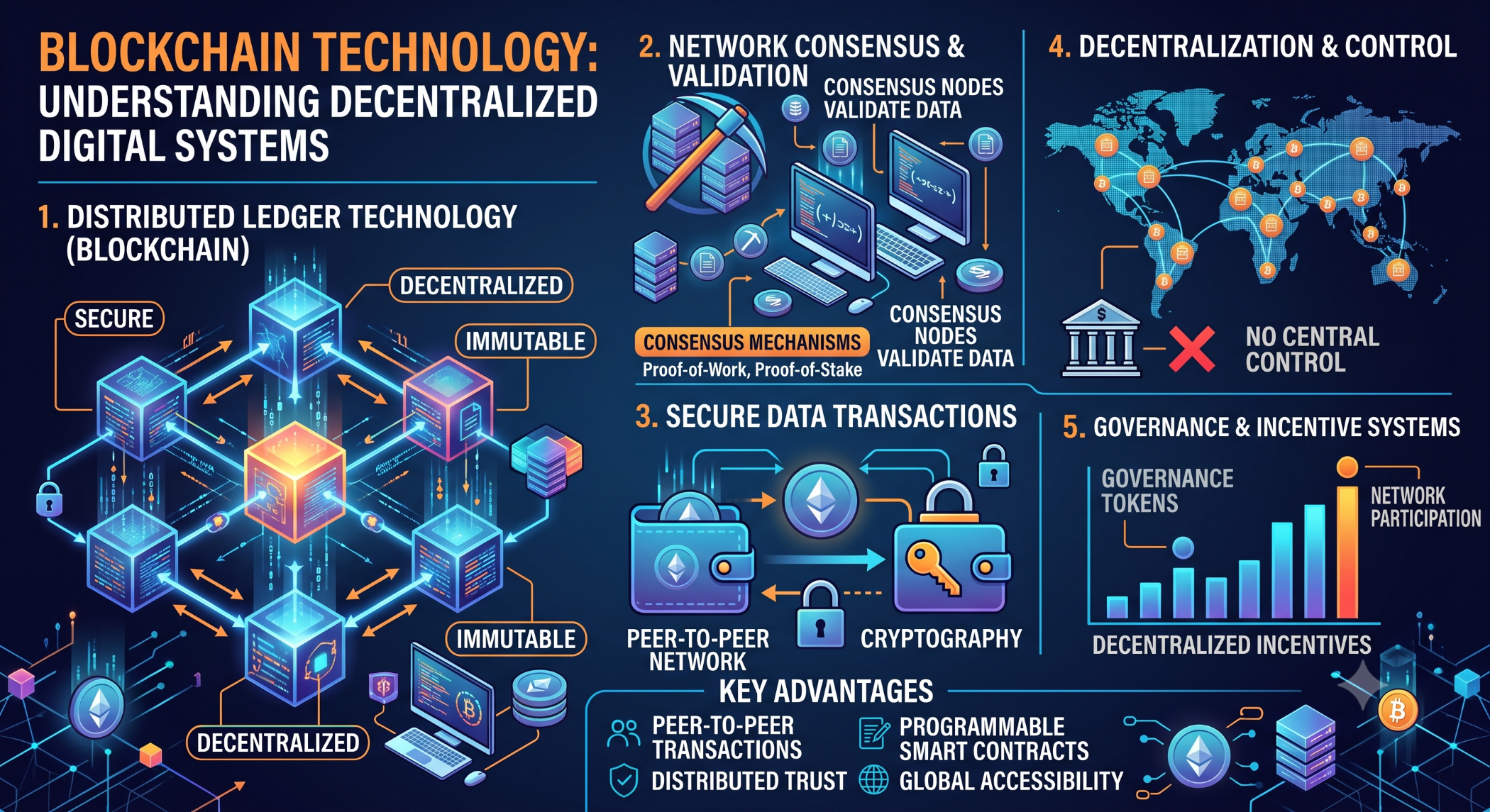
A blockchain is a distributed ledger in which records are grouped into blocks and linked together using cryptographic techniques.
A simplified structure looks like:
Block 1 → Block 2 → Block 3 → Block 4
Each block contains information about transactions or other records, along with information that connects it to the previous block.
How Does Blockchain Work?
A typical blockchain transaction can follow this process:
Transaction
↓
Network Broadcast
↓
Validation
↓
Block Creation
↓
Consensus
↓
Blockchain Update
The exact process depends on the blockchain network and its consensus mechanism.
Key Characteristics of Blockchain
Decentralization
Traditional databases are commonly controlled by a central organization or administrator. A blockchain can distribute the maintenance of its ledger across multiple participating nodes.
Transparency
Depending on the network, blockchain records can be publicly visible or accessible only to authorized participants.
Immutability
Once records are sufficiently confirmed and incorporated into the blockchain, changing historical information can be difficult and computationally expensive.
Cryptographic Security
Cryptographic techniques are used to protect transactions and connect blocks within the ledger.
Types of Blockchain
Public Blockchain
Public blockchains are generally open networks where participation and transaction visibility are governed by the protocol.
Bitcoin and Ethereum are examples of public blockchain networks.
Private Blockchain
A private blockchain restricts participation to authorized users or organizations.
This model can be considered for business environments where access needs to be controlled.
Consortium Blockchain
A consortium blockchain can be managed by multiple organizations rather than a single entity.
This approach may be suitable when several businesses need to share trusted records.
Blockchain and Smart Contracts
Some blockchain networks support smart contracts, which are programs deployed on a blockchain and executed according to predefined rules.
For example:
Condition Met
↓
Smart Contract Executes
↓
Blockchain State Updated
Smart contracts can support applications such as tokenization, decentralized finance, digital marketplaces, and automated business processes.
Blockchain Use Cases
Blockchain can be applied to several business and technology scenarios.
Digital Payments
Blockchain networks can support digital-asset transactions and payment-related applications.
Supply Chain
Organizations can use distributed records to track the movement or status of products across multiple participants.
Digital Assets
Blockchain can provide infrastructure for representing ownership or rights through digital tokens.
Identity
Blockchain-based identity solutions can explore decentralized approaches to managing credentials and verification.
Decentralized Applications
Blockchain networks can provide the backend infrastructure for applications that use smart contracts and decentralized data or assets.
Benefits of Blockchain
Blockchain can provide several potential advantages when its architecture fits the business problem.
Shared records: Multiple participants can work from a common ledger.
Transparency: Transaction history can be auditable according to the network's design.
Reduced dependence on intermediaries: Some workflows can be implemented directly through blockchain protocols and smart contracts.
Automation: Smart contracts can automate selected rule-based transactions.
Blockchain Limitations
Blockchain is not a replacement for every traditional database.
Potential challenges include:
Transaction throughput
Network latency
Transaction costs
Storage requirements
Smart-contract vulnerabilities
Regulatory considerations
Integration complexity
For many business applications, a traditional database may be more appropriate. Blockchain should be adopted where its specific characteristics provide meaningful value.
Blockchain Security
Blockchain systems still require careful security engineering.
Important areas include:
Private-key management
Wallet security
Smart-contract security
Access controls
Secure APIs
Infrastructure security
Smart contracts should be reviewed and tested carefully because vulnerabilities can result in significant financial or operational consequences.
Blockchain and Traditional Databases
A blockchain and a traditional relational database solve different problems.
A relational database is often preferred when an organization needs:
High-throughput transactional processing
Flexible querying
Centralized administration
Complex relational data
Blockchain can be valuable when multiple parties need a shared, tamper-resistant ledger and do not want to rely entirely on one organization's database.
Blockchain Application Architecture
A blockchain-based solution may combine decentralized and traditional technologies:
Web / Mobile Application
↓
Backend / API
↙ ↘
Database Blockchain
↓
Smart Contracts
This hybrid approach can keep conventional application data in databases while using blockchain only for the records or transactions that benefit from decentralization.
Blockchain Development at Solace Infotech
Solace Infotech works across blockchain, web applications, mobile development, APIs, cloud technologies, and product engineering.
These capabilities can be combined to build blockchain-enabled applications according to specific business requirements, including digital assets, integrations, decentralized workflows, and blockchain-based products.
Best Practices
Start with the business problem rather than the blockchain technology. Determine whether decentralization, shared records, auditability, or smart contracts provide a genuine advantage.
Select the blockchain network based on transaction requirements, costs, scalability, ecosystem maturity, security, and regulatory considerations.
Protect private keys and credentials, audit smart contracts where appropriate, and design the application architecture so that blockchain is used only where it provides clear value.
Conclusion
Blockchain technology provides a new approach to storing and sharing trusted digital records across distributed networks.
Its combination of cryptography, distributed consensus, and programmable smart contracts creates opportunities across payments, digital assets, supply chains, identity, and decentralized applications.
However, blockchain is not automatically the best solution for every project. Successful implementation requires a clear business case, appropriate architecture, strong security, and careful consideration of cost, scalability, and regulation.