BTC: Understanding Bitcoin and Its Role in Blockchain Technology
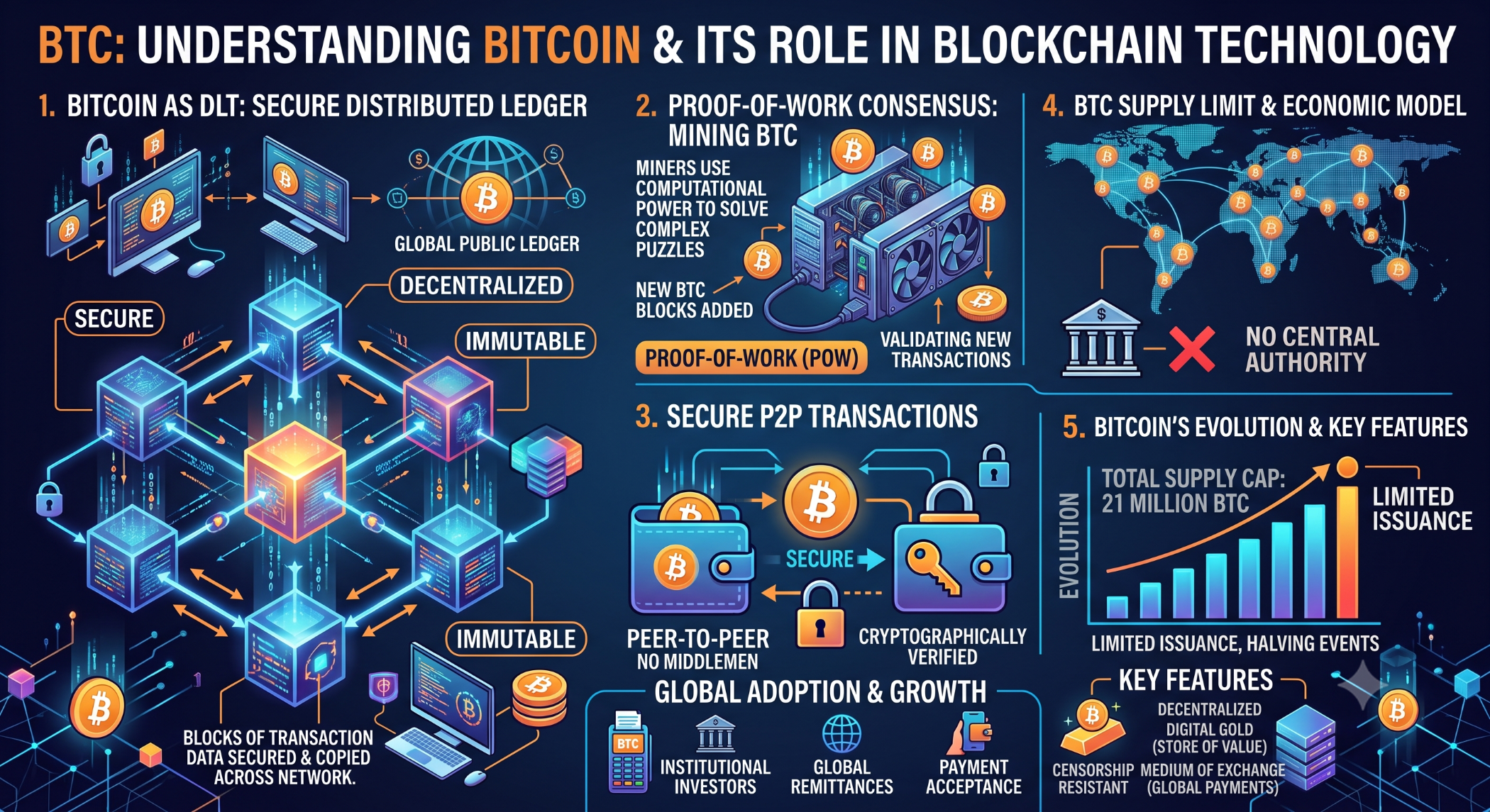
BTC is the commonly used ticker symbol for Bitcoin, one of the best-known digital assets built on blockchain technology. Bitcoin introduced a decentralized approach to transferring digital value without relying on a single organization to maintain the transaction ledger.
Understanding BTC also requires understanding the fundamentals of Bitcoin, blockchain, wallets, transactions, and network security.
What Does BTC Mean?
BTC is the abbreviation commonly used to represent Bitcoin.
Bitcoin operates on a decentralized blockchain network in which transactions are verified according to the network's protocol rather than by a single central authority.
A simplified transaction flow is:
Create Transaction
↓
Broadcast to Network
↓
Transaction Validation
↓
Block Confirmation
↓
Blockchain Ledger
How Does Bitcoin Work?
Bitcoin uses cryptography and a distributed ledger to record transactions.
When a user initiates a transaction, it is broadcast to participating nodes. Valid transactions are eventually included in blocks through Bitcoin's proof-of-work consensus process.
The blockchain provides a shared history of confirmed transactions.
What Is the Bitcoin Blockchain?
The Bitcoin blockchain is a distributed ledger containing the transaction history of the network.
Transactions are grouped into blocks, and blocks are linked chronologically:
Block 1 → Block 2 → Block 3 → Block 4
The distributed nature of the network means that no single database server controls the complete ledger.
BTC Transactions
A BTC transaction transfers control of bitcoin between Bitcoin addresses.
Transactions are authorized through cryptographic signatures. The network verifies whether the transaction follows the rules of the Bitcoin protocol before it can be confirmed.
Once a transaction is included in the blockchain, additional confirmations can make it increasingly difficult to alter the historical record.
Bitcoin Wallets
A Bitcoin wallet provides the tools and cryptographic information needed to manage BTC.
Common wallet categories include:
Hardware wallets
Mobile wallets
Desktop wallets
Custodial wallets
The security of a wallet depends heavily on protecting the private keys or recovery information controlling the associated assets.
BTC Mining
Bitcoin uses proof-of-work to reach consensus and add new blocks.
Miners use computing resources to compete for the opportunity to add blocks to the blockchain. Successful miners can receive protocol-defined block rewards and transaction fees.
Mining contributes to the security of the Bitcoin network by making attempts to rewrite confirmed history computationally expensive.
Bitcoin Supply
Bitcoin's protocol defines a maximum supply of 21 million BTC.
New bitcoin is introduced through the network's issuance mechanism, with the amount of new BTC created per block decreasing over time according to the protocol.
BTC vs Traditional Currency
Traditional currencies are issued and managed within centralized financial systems.
Bitcoin operates through a decentralized protocol.
The systems differ in areas such as:
Issuance
Governance
Transaction Processing
Settlement
Monetary Policy
These differences are central to understanding why Bitcoin is treated differently from conventional currencies.
Potential Uses of BTC
BTC can be used in various contexts, including:
Digital asset transfers
Cryptocurrency payments
Investment and treasury activities
Cross-border value transfer
Blockchain-related applications
The suitability of BTC for a particular business use case depends on factors such as cost, volatility, transaction requirements, regulations, and operational risk.
Risks of BTC
Bitcoin involves significant risks, including:
Price volatility
Private-key loss
Wallet security threats
Fraud and scams
Transaction irreversibility
Regulatory changes
Businesses should evaluate these risks carefully before incorporating BTC into their products or operations.
BTC Security
Security is especially important because control of bitcoin depends on cryptographic credentials.
Businesses should use secure wallet-management procedures, restrict access to private keys, use appropriate transaction controls, and protect systems that interact with cryptocurrency services.
For higher-value operations, additional controls such as multi-signature authorization may be appropriate.
BTC and Blockchain Development
Businesses interested in BTC-related applications may need technology beyond the blockchain itself.
A solution could combine:
Web / Mobile Application
↓
Backend / API
↓
Wallet / Blockchain Integration
↓
Bitcoin Network
Additional services may include transaction monitoring, reporting, authentication, and compliance-related workflows.
Bitcoin and Solace Infotech
Solace Infotech works across blockchain, web applications, mobile development, APIs, and product engineering, providing capabilities that can support businesses exploring blockchain-enabled applications and digital products.
BTC-related projects should be designed around the specific business objective, technical requirements, security model, and applicable regulatory obligations.
Best Practices
Define the business purpose before integrating BTC. Use secure wallet and key-management processes, protect sensitive credentials, monitor blockchain transactions, and evaluate third-party providers carefully.
For production systems, include appropriate security testing, monitoring, backup procedures, and operational controls.
Conclusion
BTC is the widely used symbol for Bitcoin, a decentralized digital asset based on cryptography, distributed networking, proof-of-work, and blockchain technology.
Bitcoin provides a distinct approach to digital value transfer, but using BTC also introduces financial, security, operational, and regulatory considerations.
For businesses, the best approach is to start with a clear use case and then evaluate whether Bitcoin and related blockchain technologies provide a meaningful advantage for the intended application.