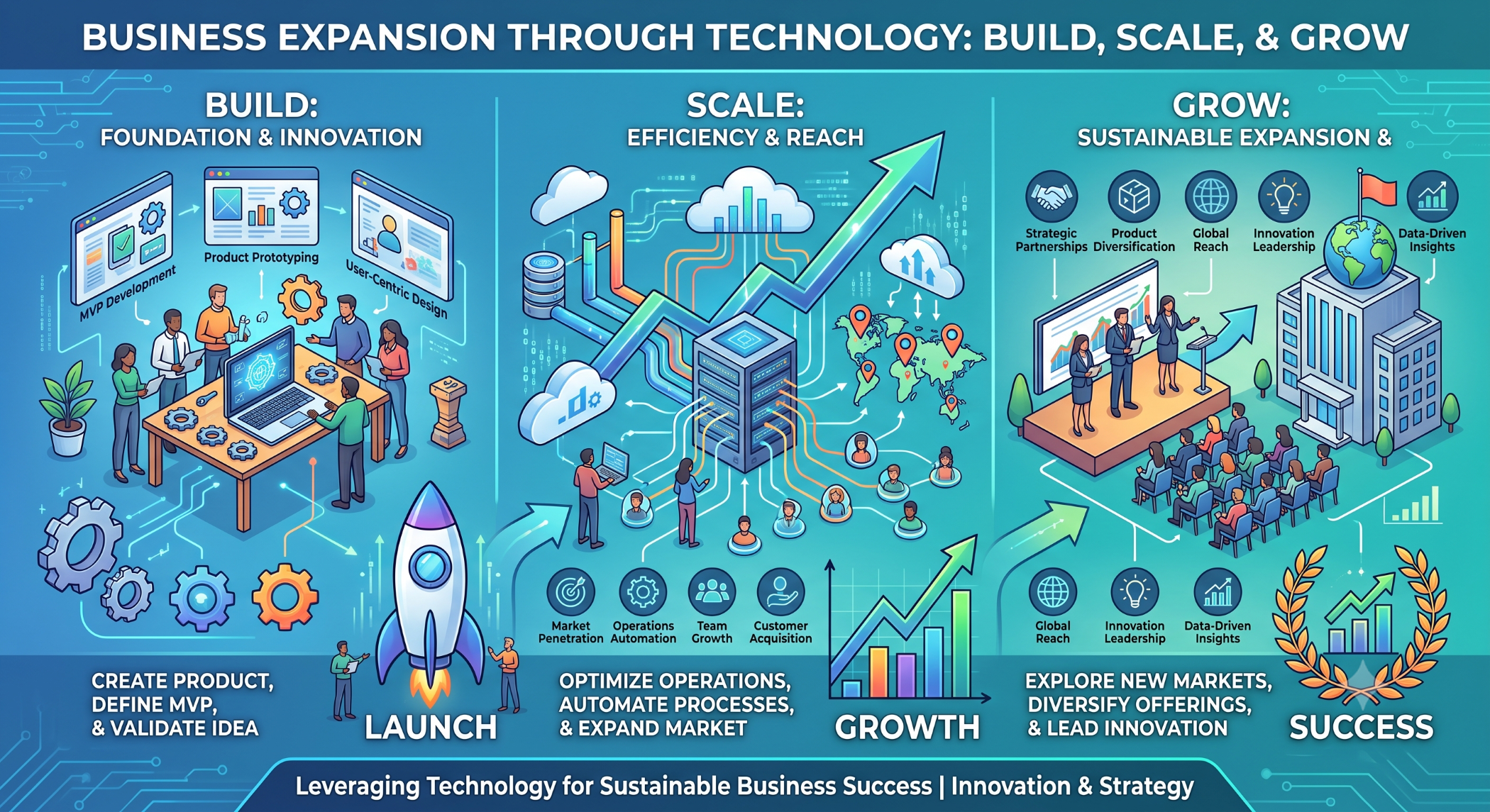
Business Expansion Through Technology: Build, Scale, and Grow
Business expansion brings new opportunities, but it also creates new operational and technical challenges. As a company grows, its systems need to support more customers, employees, transactions, data, and business processes.
Technology can play an important role in business expansion by improving efficiency, automating repetitive activities, connecting business systems, and creating digital channels for new markets.
How Technology Supports Business Expansion
A growing business may need to serve more customers without increasing operational complexity at the same rate.
Modern software can help organizations:
Automate repetitive processes.
Improve customer communication.
Manage larger volumes of data.
Connect different business systems.
Support remote and distributed teams.
Launch new digital products and services.
The right technology strategy should support business growth rather than become a limitation.
Build Scalable Applications
An application designed for a small user base may not perform well when usage increases.
Scalable architecture allows businesses to handle growth in:
Users
Transactions
Data
Integrations
Application features
For example:
Initial Application
↓
Performance Optimization
↓
Caching & Database Optimization
↓
Load Balancing
↓
Horizontal Scaling
The architecture should evolve according to actual business requirements and usage.
Expand Through Digital Channels
Businesses can reach new customers through websites, mobile applications, e-commerce platforms, portals, and SaaS products.
A well-designed digital platform can allow customers to access services without being limited by physical locations or traditional operating hours.
Mobile applications can also provide direct customer engagement through features such as notifications, self-service, and personalized experiences.
Automate Growing Operations
Manual processes often become difficult to manage as businesses expand.
For example, a process such as:
New Customer
↓
Verification
↓
CRM Entry
↓
Team Assignment
↓
Welcome Communication
can be automated to reduce repetitive work and improve consistency.
Automation allows employees to focus more on activities that require human judgment and customer interaction.
Connect Business Systems
Growing organizations often add new software systems for sales, finance, customer management, operations, and marketing.
APIs can connect these systems and allow information to move between them automatically.
For example:
Website
↓
API
↓
CRM
↓
ERP
↓
Accounting
Integration can reduce duplicate data entry and provide teams with more consistent information.
Cloud Technology and Expansion
Cloud infrastructure can provide businesses with flexible computing, storage, and application-hosting capabilities.
Depending on the architecture, businesses can scale resources as demand changes without having to design an entirely new infrastructure environment for every stage of growth.
Cloud strategies should still consider security, availability, cost, compliance, and performance.
Data for Better Expansion Decisions
As businesses grow, they generate more operational and customer data.
Analytics can help organizations understand:
Customer behavior
Sales trends
Product usage
Operational performance
Marketing effectiveness
Regional opportunities
Data-driven insights can help management identify where additional investment or process improvements may create the greatest value.
Technology Expansion Requires Planning
Adding technology without a clear business objective can increase costs and complexity.
Before implementing a new solution, businesses should understand:
Business objective: What problem will the technology solve?
Users: Who will use the system?
Scalability: How much growth should it support?
Integration: Which existing systems need to communicate with it?
Security: What data and access controls are required?
Maintenance: Who will manage and improve the system after launch?
Technology Solutions at Solace Infotech
Solace Infotech works across web and mobile development, e-commerce, AI, cloud, APIs, automation, product engineering, and business applications.
These capabilities can help businesses modernize existing platforms, create new digital products, automate operations, and build technology foundations that support expansion.
Best Practices for Technology-Led Expansion
Start with the business growth plan and then map technology requirements to it. Prioritize systems that remove current bottlenecks and create measurable business value.
Use modular architecture, integrate systems through well-designed APIs, protect business data, and monitor application performance as usage increases.
Expansion should be approached incrementally so that technology investment grows alongside actual business needs.
Conclusion
Business expansion is not only about acquiring more customers or entering new markets. It also requires the ability to scale operations, systems, teams, and customer experiences effectively.
Technology can provide the foundation for this growth through scalable applications, automation, cloud infrastructure, connected systems, mobile platforms, and data-driven decision-making.
The strongest expansion strategy combines a clear business vision with technology that can adapt, scale, and support the next stage of growth.