Introduction
Modern businesses rarely succeed through the efforts of one person. Complex projects require people with different skills to work together toward a common objective.
This is why collaboration is an essential part of successful organizations.
Collaboration means more than simply working alongside other people. It involves sharing knowledge, communicating openly, solving problems together, respecting different perspectives, and taking collective responsibility for outcomes.
At Solace Infotech, collaboration is explicitly part of the organization's stated core values, described as “Collaboration is our Framework.”
What Is Collaboration?
Collaboration is the process of working with one or more people to achieve a shared goal.
In a workplace, collaboration can happen between employees, departments, managers, customers, vendors, and technology partners.
For example, developing a software product may require collaboration between business analysts, UI/UX designers, developers, QA engineers, DevOps professionals, project managers, and clients.
Each participant brings different expertise. Collaboration connects those capabilities into one coordinated effort.
Why Collaboration Matters
Strong collaboration can improve how teams approach both everyday work and complex challenges.
When people share information and communicate effectively, they can identify problems earlier, develop better solutions, and avoid unnecessary duplication of work.
Collaboration also creates opportunities for people to learn from one another.
A developer may learn about business requirements from a product manager. A designer may gain insights from customer feedback. A project manager may better understand technical limitations through discussions with engineers.
The result is a more complete understanding of the problem and the solution.
Collaboration in Software Development
Software development is naturally collaborative.
A project rarely moves directly from an idea to finished software. Requirements need to be understood, designs need to be reviewed, code needs to be developed, functionality needs to be tested, and releases need to be deployed and monitored.
At every stage, communication between team members matters.
For example, if a developer misunderstands a requirement and does not clarify it with the business analyst or client, the team may spend significant time implementing the wrong behavior.
Collaboration helps surface such misunderstandings early.
Solace Infotech describes its development approach as involving dedicated development teams, project managers, milestone planning, communication, and sprint-based delivery.
Collaboration and Communication
Communication is one of the foundations of collaboration.
Team members need to share information clearly, listen actively, ask questions, and communicate problems before they become larger issues.
Good communication includes both speaking and listening.
A person who immediately rejects an idea without understanding it can discourage collaboration. Likewise, someone who never shares concerns can allow risks to remain hidden.
Effective collaboration creates space for people to express ideas, concerns, and alternative approaches professionally.
Sharing Knowledge
Every professional has unique knowledge and experience.
When that knowledge stays with one person, the team can become dependent on an individual. When knowledge is shared, the entire team becomes stronger.
Knowledge sharing can happen through documentation, code reviews, technical discussions, mentoring, demonstrations, project retrospectives, and informal conversations.
For example, a senior developer can explain an architectural decision to other team members so that they understand not only what was implemented but also why it was implemented that way.
Collaboration Encourages Innovation
Innovation often comes from combining different perspectives.
A developer may focus on technical feasibility. A designer may focus on usability. A business stakeholder may focus on commercial objectives. A customer may focus on practical experience.
When these perspectives are brought together, teams can identify opportunities that an individual may overlook.
Collaboration therefore creates an environment where ideas can be challenged, improved, and transformed into practical solutions.
Collaboration and Problem Solving
Complex problems often require more than one viewpoint.
Suppose an application is experiencing poor performance. A developer may investigate application logic, while a database specialist examines queries and indexes. A DevOps engineer may examine infrastructure and resource usage. A project manager may assess the business impact and priority.
By combining these perspectives, the team can reach a more complete solution.
Collaboration is particularly valuable when the root cause of a problem crosses technical and business boundaries.
Collaboration Builds Trust
Trust grows when people consistently communicate, support one another, and follow through on commitments.
Team members are more likely to share ideas when they believe their colleagues will listen respectfully.
They are also more likely to report problems early when they know that raising a concern will lead to constructive discussion rather than immediate blame.
This makes trust an important foundation for effective collaboration.
Respect Different Perspectives
Collaboration does not mean that everyone has to agree.
Healthy teams can have different opinions and still work effectively together.
A developer may recommend one technical approach while another engineer recommends a different one. A client may have a different interpretation of a feature than the development team.
The goal is not to eliminate disagreement. It is to discuss differences objectively and determine the best solution based on requirements, evidence, risks, cost, and business value.
Collaboration Across Departments
Collaboration should not stop within individual teams.
Sales teams need information from delivery teams. Marketing teams need input from technical experts. HR teams work with managers and employees. Operations teams coordinate with development and support teams.
Cross-functional collaboration helps ensure that different departments understand how their work affects the wider organization.
It can also reduce information silos.
Collaboration With Clients
In software development, clients are important members of the project ecosystem.
Successful delivery often requires clients to provide requirements, priorities, feedback, decisions, and clarification.
A collaborative client relationship encourages both sides to focus on the shared objective rather than treating the project as a simple handoff between customer and vendor.
Regular communication can help identify changes early and keep expectations aligned.
Collaboration and Remote Teams
Remote and distributed teams make collaboration even more important.
Team members may work from different locations, time zones, and working environments. Without deliberate communication practices, information can become fragmented.
Project-management systems, documentation, video meetings, chat platforms, shared repositories, and regular status updates can help maintain visibility.
However, tools alone do not create collaboration. Teams need clear responsibilities, communication norms, and a willingness to share information.
Collaboration and Agile Development
Agile development emphasizes communication, iterative delivery, feedback, and collaboration.
Teams typically work in smaller increments, review progress regularly, and adjust priorities based on feedback and new information.
This encourages collaboration throughout the development process instead of limiting stakeholder involvement to the beginning and end.
A collaborative Agile team can identify issues sooner and adjust the product more effectively.
Collaboration and Productivity
Collaboration should improve productivity rather than simply increase the number of meetings.
Poorly managed collaboration can create unnecessary discussions, delays, and interruptions.
Effective collaboration is purposeful.
People should know why they are collaborating, what decision or outcome is expected, who needs to participate, and what action follows.
Documentation and asynchronous communication can also reduce unnecessary meetings while keeping information accessible to the wider team.
Collaboration and Accountability
Collaboration works best when combined with accountability.
Working together does not mean that individual ownership disappears.
Each person should understand their responsibility while also recognizing how their work affects others.
For example, a developer may own a feature implementation, while QA owns validation. Both responsibilities are connected to the same project outcome.
Clear ownership combined with teamwork helps prevent tasks from falling between responsibilities.
Challenges to Effective Collaboration
Collaboration can fail when communication is poor, responsibilities are unclear, information is hidden, or people are unwilling to consider different viewpoints.
Another challenge is excessive dependency on meetings and real-time communication.
Organizations should therefore establish clear processes for decision-making, documentation, ownership, and escalation.
A strong collaborative culture does not mean communicating constantly. It means communicating effectively when communication is needed.
How to Improve Collaboration
Start with clear goals.
People collaborate more effectively when they understand the objective they are working toward.
Define responsibilities clearly so that everyone knows who owns each outcome.
Create open channels for communication and encourage people to raise risks early.
Share knowledge through documentation and mentoring.
Recognize contributions from different team members.
Most importantly, build a culture where people focus on the shared goal instead of protecting individual responsibilities or departments.
Collaboration at Solace Infotech
Collaboration is positioned as an important part of Solace Infotech's working culture. The company's stated values include collaboration, accountability, ethics, and nurturing people, while its development model emphasizes team-based delivery and direct communication through project managers.
Solace also describes its workplace as one where people work together as a team and value working in togetherness.
This reflects an important principle for technology organizations: combining individual expertise through effective teamwork can create stronger outcomes than isolated individual effort.
Collaboration and Continuous Improvement
Every project provides opportunities to improve the way a team works.
After completing a release or resolving a significant issue, teams can review what worked well and what could have been done differently.
These discussions can identify improvements in communication, planning, documentation, development practices, testing, and customer engagement.
Over time, such improvements create more mature and efficient teams.
Conclusion
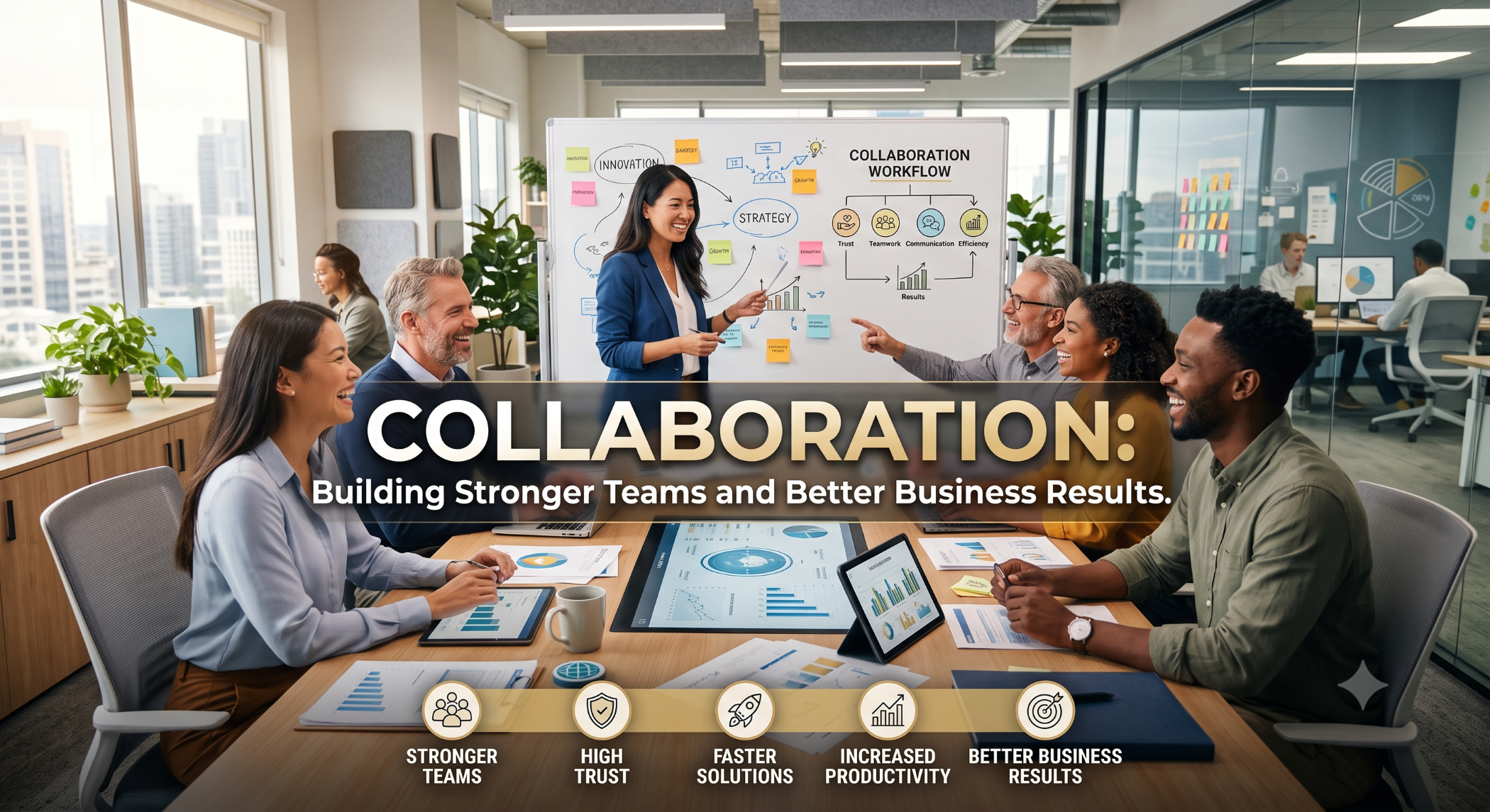
Collaboration is the framework that connects individual skills into collective success.
It helps teams share knowledge, solve difficult problems, develop better ideas, improve communication, and deliver stronger outcomes.
In software development, collaboration is particularly important because projects involve interconnected roles, technical dependencies, changing requirements, and customer expectations.
The strongest teams are not necessarily those with the most talented individuals. They are often the teams that know how to combine individual strengths, communicate openly, respect different perspectives, and work toward the same goal.
When collaboration becomes part of an organization's culture, people learn from each other, problems are addressed more effectively, and the entire business becomes stronger.