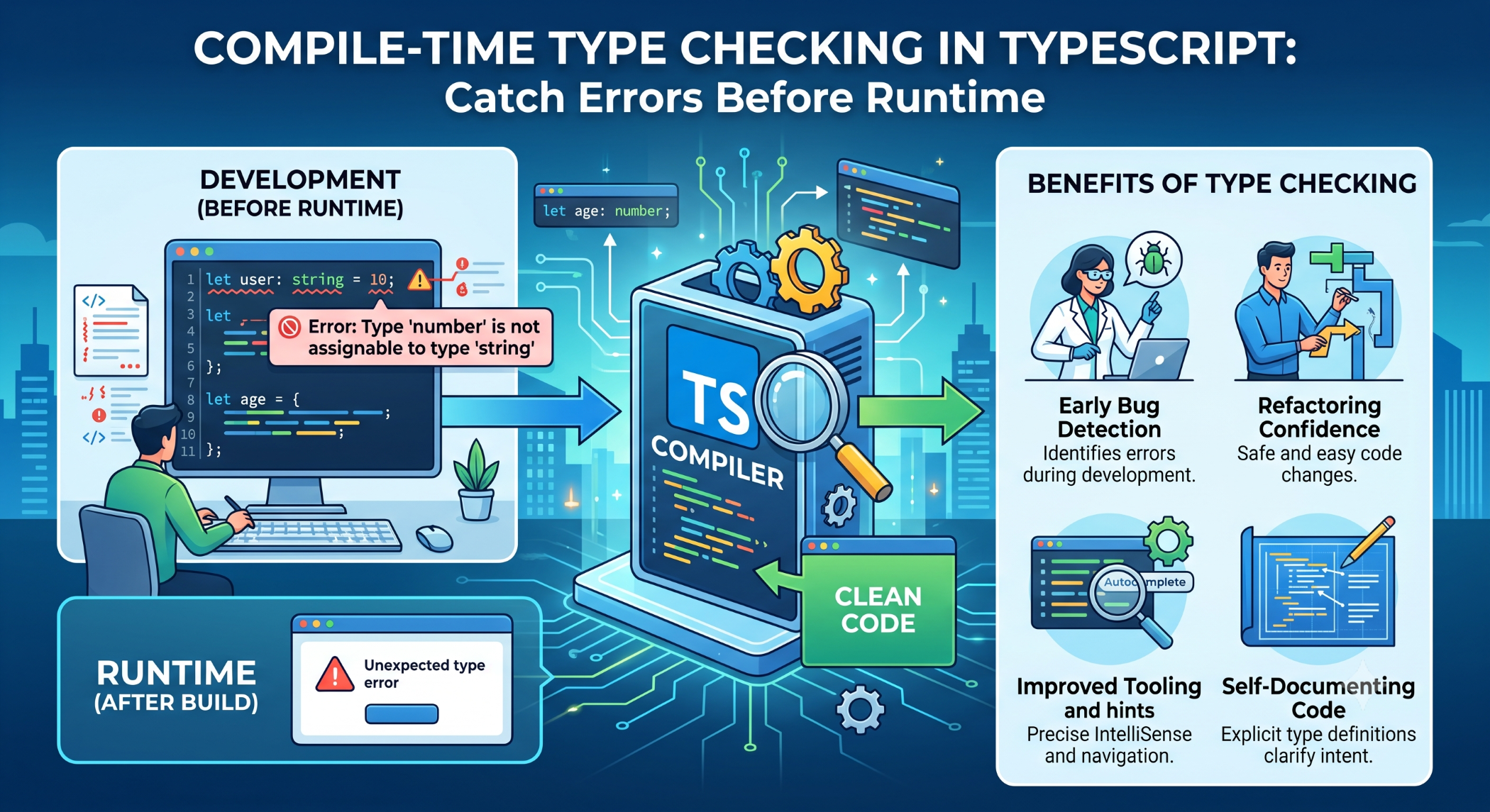
Compile-Time Type Checking in TypeScript: Catch Errors Before Runtime
As JavaScript applications become larger and more complex, identifying errors only after an application starts running can become expensive. Compile-time type checking provides developers with an opportunity to detect many type-related problems during development.
TypeScript uses static typing and a compiler to analyze source code before it is converted into JavaScript. This can help development teams identify certain errors earlier and build more maintainable applications.
What Is Compile-Time Type Checking?
Compile-time type checking means analyzing source code for type-related problems before the program is executed.
For example:
let age: number = 25;
age = "twenty-five";
TypeScript can identify that a string is being assigned to a variable declared as a number.
This allows developers to correct the problem before the application reaches the runtime environment.
Compile-Time vs Runtime Errors
The main difference is when the problem is detected.
A compile-time error can be identified during the development or build process.
A runtime error occurs while the application is executing.
For example:
function add(a: number, b: number): number {
return a + b;
}
add(10, "20");
TypeScript can report a type mismatch during development.
Without compile-time checking, some similar mistakes may only become apparent when the relevant code path executes.
Why Compile-Time Type Checking Is Useful
Early error detection can provide several benefits.
Catch Errors Earlier
Developers can identify many type-related mistakes before deploying the application.
Improve Code Quality
Explicit types make assumptions about data and function behavior clearer.
Reduce Debugging Time
Fixing an error during development is generally easier than discovering it after a feature has reached testing or production.
Improve Maintainability
Types provide additional information about how different parts of an application are expected to work.
Type Annotations
TypeScript allows developers to explicitly define types.
let username: string = "John";
let age: number = 30;
let isActive: boolean = true;
If an incompatible value is assigned, the TypeScript compiler can report an error.
Function Type Checking
Functions can also define parameter and return types:
function calculateTotal(
price: number,
quantity: number
): number {
return price * quantity;
}
This makes the expected inputs and output clear.
For example:
calculateTotal(100, 2);
is valid, while passing a string where a number is expected can be flagged by TypeScript.
Interfaces and Type Checking
Interfaces can define the expected structure of objects.
interface Customer {
id: number;
name: string;
email: string;
}
A function can then require that structure:
function displayCustomer(customer: Customer) {
console.log(customer.name);
}
This helps maintain consistency across larger applications.
Compile-Time Checking and APIs
TypeScript can describe the structure of data received from an API.
interface Product {
id: number;
name: string;
price: number;
}
This makes it easier for developers to work with expected data structures.
However, compile-time types do not verify the actual data received at runtime. External API responses can still contain unexpected values, so runtime validation may also be necessary.
Strict Type Checking
TypeScript provides compiler options that can make type checking more rigorous.
A project can enable strict checking in tsconfig.json:
{
"compilerOptions": {
"strict": true
}
}
Strict mode enables a broader set of type-checking rules and can help detect problems that might otherwise remain unnoticed.
Compile-Time Type Checking in Large Applications
Large applications often contain many modules, developers, APIs, and business rules. Without clear type definitions, changes in one part of the application can unintentionally affect another.
Compile-time checking provides an additional layer of confidence when refactoring and extending large codebases.
It can help developers identify:
Incorrect function arguments
Missing object properties
Invalid assignments
Incompatible return values
Incorrect method calls
Potential null or undefined issues
Type Checking Is Not Runtime Validation
An important distinction is that TypeScript's types are primarily a development and compilation feature.
After TypeScript is compiled to JavaScript, the type annotations are not present in the same form.
For example, external data should still be validated at runtime:
const response = await fetch("/api/customer");
const data = await response.json();
The application should not automatically assume that data matches a TypeScript interface simply because a type was declared.
Best Practices
Use meaningful types and interfaces, enable strict checking where practical, avoid unnecessary use of any, and keep type definitions aligned with real application behavior.
For external input, combine compile-time checking with runtime validation. This provides stronger protection because both development assumptions and actual incoming data are checked.
Compile-Time Type Checking at Solace Infotech
Compile-time type checking can be particularly valuable in Solace Infotech projects using TypeScript, Angular, React, Node.js, and other modern JavaScript-based technologies.
For larger applications, strong typing can support cleaner development practices, easier maintenance, safer refactoring, and better collaboration between development teams.
Conclusion
Compile-time type checking is one of the major advantages of TypeScript. By identifying many type-related problems before the application runs, it helps developers build software that is easier to understand, test, maintain, and extend.
It does not eliminate runtime errors or replace runtime validation, but when combined with good development practices, it provides an important additional layer of reliability.
For modern applications, catching problems during development is far better than discovering them after deployment, making compile-time type checking a valuable part of the software development process.