Introduction
Success is rarely the result of talent alone. It is built through continuous learning, focused effort, practical experience, and the ability to apply knowledge effectively.
Two qualities that play an important role in this journey are concentration and knowledge.
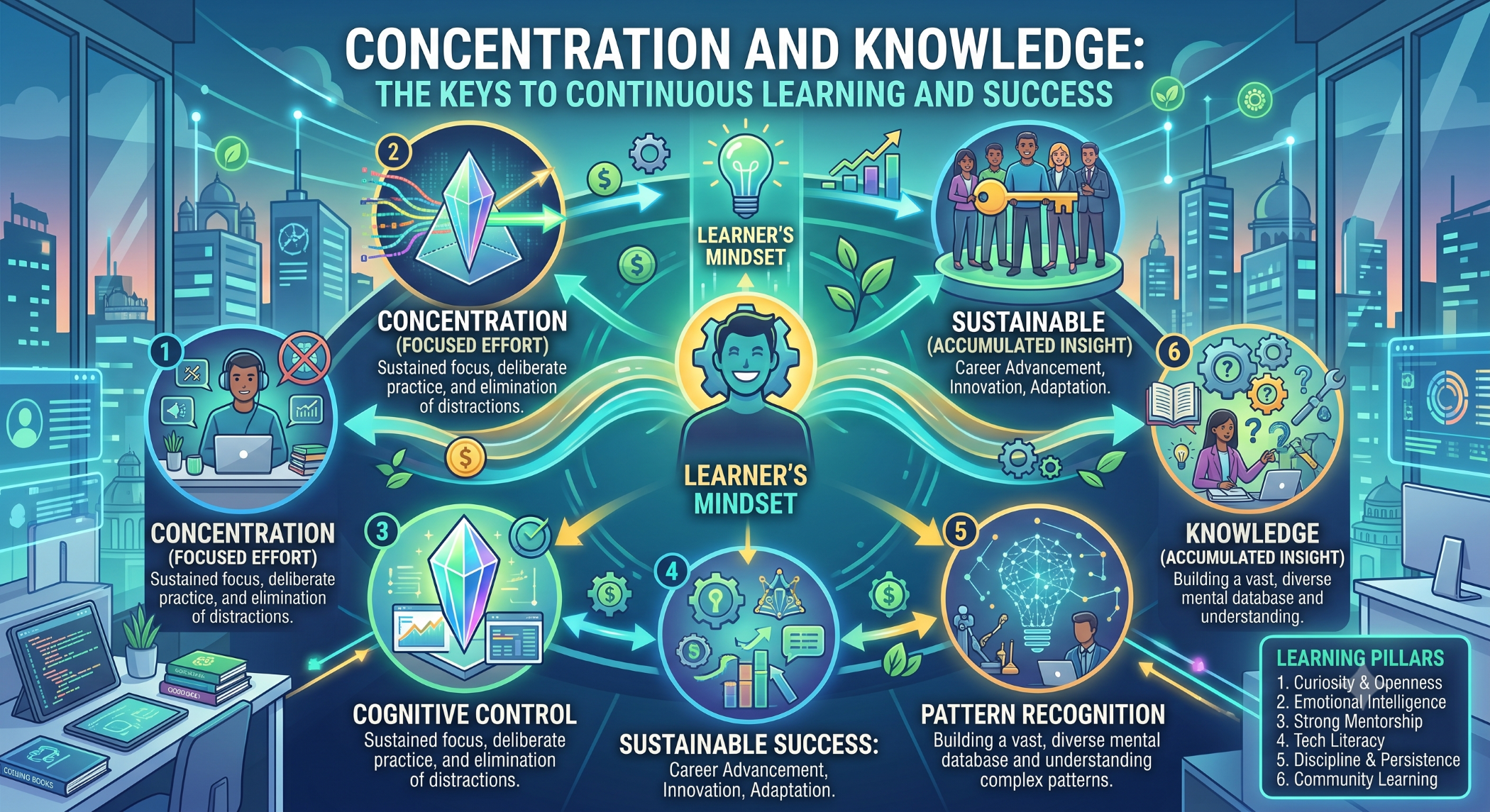
Knowledge gives us the information required to understand a subject, while concentration helps us absorb that information, apply it, and remain focused on achieving a goal. Together, they can improve productivity, problem-solving, decision-making, and professional growth.
What Is Concentration?
Concentration is the ability to focus attention on a specific task without being unnecessarily distracted.
In a professional environment, concentration helps employees complete tasks accurately, understand requirements, solve technical problems, and make thoughtful decisions.
For example, a software developer working on a complex application may need to analyze requirements, understand existing code, identify the root cause of a problem, and implement a solution. Constant interruptions can make this process more difficult.
Strong concentration allows professionals to give their full attention to the task and work more effectively.
Why Concentration Is Important
Modern workplaces provide many potential distractions. Emails, meetings, chat messages, notifications, social media, and constantly changing priorities can make it difficult to maintain deep focus.
Good concentration can help professionals:
Improve productivity: Focused work allows more attention to be given to important tasks.
Reduce mistakes: Concentrating on details can help identify errors before they become larger problems.
Improve learning: Focus makes it easier to understand and retain new information.
Solve problems effectively: Complex problems usually require uninterrupted thought and analysis.
Manage priorities: Concentration helps people remain focused on the most important objective rather than constantly switching between tasks.
What Is Knowledge?
Knowledge is the understanding gained through education, observation, experience, research, and continuous learning.
In the technology industry, knowledge is particularly important because tools, frameworks, programming languages, platforms, and development practices continue to evolve.
A professional cannot depend entirely on what they learned years ago. Continuous learning is necessary to remain effective in a changing environment.
Knowledge Comes From More Than Books
Formal education is only one source of knowledge.
Professionals can learn through:
Practical project experience
Mentoring
Technical documentation
Training programs
Collaboration with colleagues
Research
Experimentation
Learning from failures
Industry trends and developments
Practical experience is especially valuable because it helps transform theoretical concepts into usable skills.
For example, reading about cloud computing can provide foundational knowledge, but deploying and managing an actual cloud application develops a deeper understanding of infrastructure, performance, security, and operational challenges.
The Relationship Between Concentration and Knowledge
Concentration and knowledge complement each other.
Knowledge without concentration may not be applied effectively. A person may know what needs to be done but struggle to execute it because of distractions or lack of focus.
Concentration without knowledge also has limitations. A person can work with complete focus but still require the right information and skills to solve a problem.
The combination is powerful:
Knowledge provides the direction. Concentration provides the focus to use it.
This principle applies to students, developers, managers, entrepreneurs, and professionals in almost every industry.
Concentration Improves Learning
Learning a new subject requires attention.
When people constantly move between tasks, they may read or listen to information without fully understanding it. Concentrated learning creates an opportunity to analyze concepts, connect ideas, and remember important details.
For technology professionals, this is particularly relevant when learning a new framework or programming language.
Rather than trying to learn everything at once, a focused approach can begin with the fundamentals, followed by practical exercises and gradually more advanced concepts.
Knowledge Improves Problem-Solving
Problem-solving depends heavily on understanding.
Consider a software application experiencing slow performance. Solving the issue may require knowledge of databases, application architecture, server resources, caching, network behavior, and code optimization.
The more relevant knowledge a professional has, the more possibilities they can evaluate.
However, knowledge alone is not enough. Concentration is needed to analyze the evidence, isolate the actual cause, and select an appropriate solution.
How to Improve Concentration
Concentration can be strengthened through consistent habits.
Start by defining a clear objective before beginning a task. Knowing exactly what needs to be accomplished makes it easier to maintain focus.
Reduce unnecessary interruptions during important work. Notifications and unrelated messages can quickly break concentration.
Break large tasks into smaller objectives. Completing clearly defined steps makes complex work easier to manage.
Take appropriate breaks. Continuous work without rest can reduce attention and effectiveness.
Create a work environment that supports focused activity. Even small improvements to workspace organization and communication practices can make concentrated work easier.
How to Increase Knowledge
Knowledge grows through continuous learning.
Professionals should regularly explore subjects related to their field while also developing an understanding of broader business and industry trends.
For technology professionals, learning can include understanding new frameworks, APIs, cloud services, security practices, artificial intelligence, software architecture, and development methodologies.
However, learning should not be limited to collecting information. The most useful knowledge is knowledge that can be applied.
Learn, Practice, and Apply
One of the most effective ways to develop knowledge is to follow a simple cycle:
Learn → Practice → Apply → Review → Improve
A developer may learn a new framework, practice it through a small application, apply it to a real project, review the results, and then improve their implementation.
This process creates deeper knowledge than passive reading alone.
Experience also provides important lessons that formal education cannot always provide.
Concentration in the Workplace
Organizations can also help employees improve concentration.
Clear priorities, realistic workloads, effective project management, focused meetings, and well-defined responsibilities can reduce unnecessary distractions.
Teams should understand which tasks are urgent, which are important, and which can be handled later.
A workplace that encourages focused work can improve both employee productivity and the quality of deliverables.
Knowledge Sharing and Team Growth
Knowledge becomes even more valuable when it is shared.
Experienced team members can help others by documenting processes, conducting technical discussions, mentoring junior employees, and sharing lessons learned from previous projects.
Knowledge sharing reduces dependence on individual employees and helps organizations build stronger teams.
For example, when a developer documents an important implementation or troubleshooting process, other team members can use that information rather than repeatedly solving the same problem.
Concentration, Knowledge, and Career Growth
Career growth depends on more than technical ability.
Professionals who continuously expand their knowledge and remain focused on meaningful work can take on greater responsibilities over time.
A developer may grow into a technical lead. A project manager may move into delivery leadership. A business analyst may develop deeper expertise in product strategy.
In each case, continuous learning provides the knowledge required for the next level, while concentration helps professionals consistently apply that knowledge.
Conclusion
Concentration and knowledge are two important foundations of professional success.
Knowledge helps us understand problems, technologies, opportunities, and solutions. Concentration helps us use that knowledge effectively and remain focused despite distractions.
Neither quality develops overnight. Both require discipline, practice, curiosity, and continuous improvement.
In a rapidly changing technology environment, professionals who make learning a habit and protect their ability to focus are better prepared to adapt, solve difficult problems, and create lasting value for themselves and their organizations.
The more we learn and the better we concentrate, the more effectively we can turn knowledge into meaningful results.