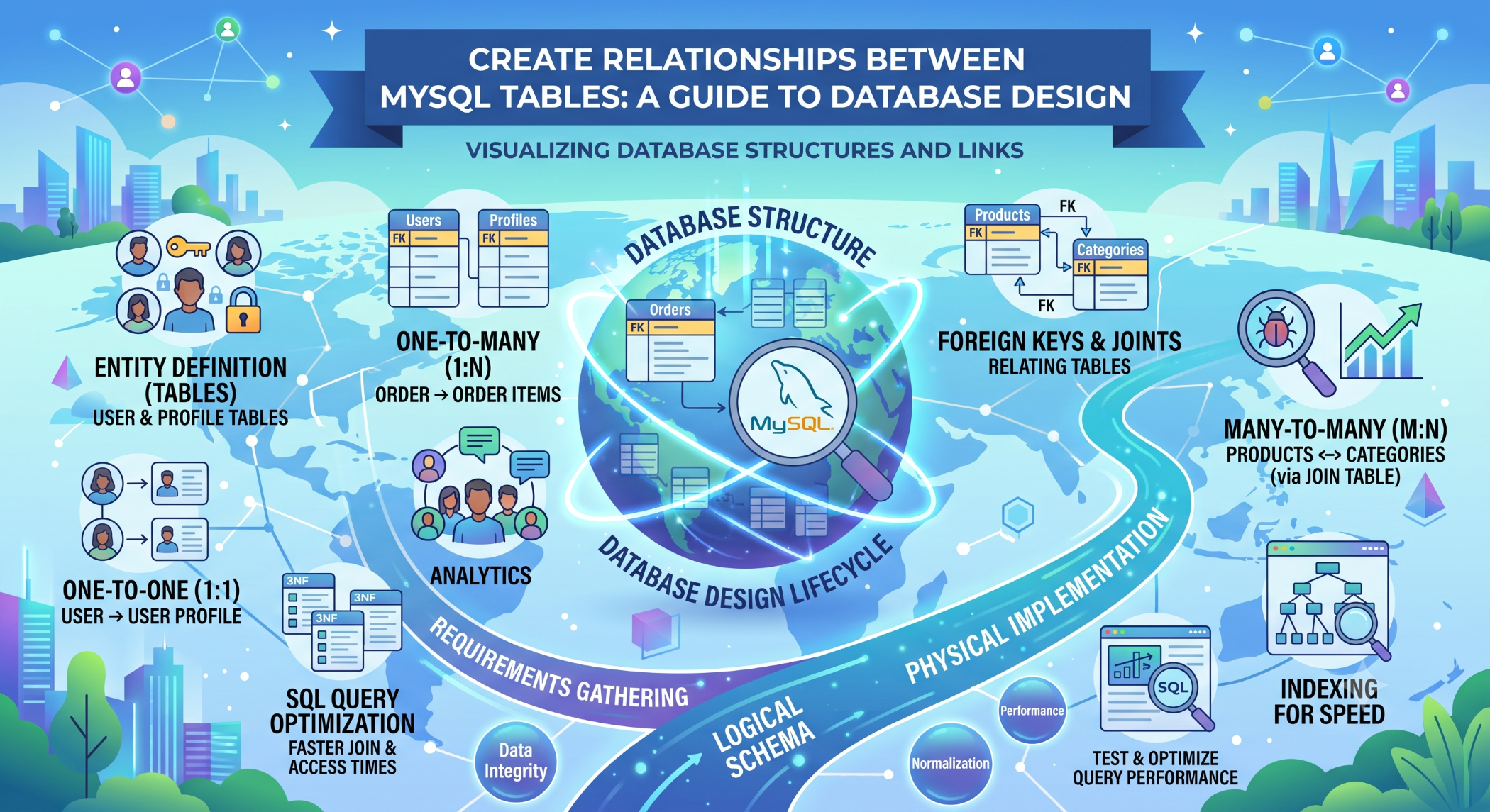
Create Relationships Between MySQL Tables: A Guide to Database Design
Relational databases organize information into multiple tables and connect related data through defined relationships. In MySQL, creating relationships between tables helps developers maintain data consistency, reduce duplication, and build structured database systems.
A well-designed relational database makes application development, querying, reporting, and long-term maintenance easier.
Why Create Relationships Between Tables?
Storing all application data in a single table can lead to duplicated information and difficult maintenance.
For example, an e-commerce application may have separate tables for:
Customers
Products
Orders
Order Items
Payments
Relationships allow these tables to work together without repeatedly storing the same information.
Primary Keys
A primary key uniquely identifies each record in a table.
For example:
CREATE TABLE customers (
id INT PRIMARY KEY AUTO_INCREMENT,
name VARCHAR(100),
email VARCHAR(150)
);
Here, id uniquely identifies each customer.
Primary keys are commonly used as references when creating relationships with other tables.
Foreign Keys
A foreign key connects a column in one table to a primary key in another table.
For example:
CREATE TABLE orders (
id INT PRIMARY KEY AUTO_INCREMENT,
customer_id INT,
order_date DATETIME,
FOREIGN KEY (customer_id)
REFERENCES customers(id)
);
Here, customer_id establishes a relationship between the orders and customers tables.
One-to-One Relationship
In a one-to-one relationship, one record in one table is associated with one record in another table.
For example:
User → User Profile
A user may have one profile, and each profile belongs to one user.
This type of relationship is useful when related information needs to be separated into different tables for organizational, security, or architectural reasons.
One-to-Many Relationship
One-to-many is one of the most common relationships.
For example:
Customer
↓
Multiple Orders
One customer can place multiple orders, while each order belongs to one customer.
The foreign key is stored in the orders table:
customer_id INT
This references:
customers(id)
Many-to-Many Relationship
A many-to-many relationship occurs when multiple records in one table can be associated with multiple records in another.
For example:
Students ↔ Courses
A student can enroll in multiple courses, and a course can have multiple students.
This is normally implemented using a junction table:
CREATE TABLE student_courses (
student_id INT,
course_id INT,
PRIMARY KEY (student_id, course_id),
FOREIGN KEY (student_id)
REFERENCES students(id),
FOREIGN KEY (course_id)
REFERENCES courses(id)
);
The junction table stores the relationships between the two entities.
Using JOIN Queries
Once tables are related, SQL JOIN operations can retrieve connected information.
For example:
SELECT
customers.name,
orders.id,
orders.order_date
FROM customers
JOIN orders
ON orders.customer_id = customers.id;
This query retrieves customer and order information from related tables.
Referential Integrity
Foreign keys can help maintain referential integrity.
For example, a database can prevent an order from referencing a customer that does not exist.
Relationship constraints can also define what should happen when related records are updated or deleted.
For example:
FOREIGN KEY (customer_id)
REFERENCES customers(id)
ON DELETE CASCADE
Cascade behavior should be chosen carefully because deleting one record can affect many related records.
Indexes and Relationships
Indexes are important when working with related tables, particularly for frequently executed joins and filtering operations.
For example:
CREATE INDEX idx_orders_customer_id
ON orders(customer_id);
Well-designed indexes can improve query performance as the amount of data increases.
Relationship Design Best Practices
Define clear entities before creating tables and use appropriate primary and foreign keys.
Avoid storing the same information repeatedly across multiple tables. Use normalized structures where practical, but also consider application query requirements when designing the schema.
Choose foreign-key constraints and delete/update behavior carefully, and test important queries with realistic data volumes.
Relationships in MySQL Applications
Relationships are particularly important for applications such as:
E-commerce platforms
CRM systems
ERP applications
Banking systems
Booking platforms
Customer portals
Content management systems
For example, an e-commerce application can connect customers to orders, orders to products through order items, and products to categories.
MySQL Database Development at Solace Infotech
Solace Infotech works with MySQL and database-driven web applications, developing solutions where structured database design, relationships, indexing, query optimization, and application integration are important components.
The database architecture should be designed around the application's business rules, expected data volume, query patterns, and scalability requirements.
Conclusion
Creating relationships between MySQL tables is a fundamental part of relational database design. Primary keys, foreign keys, one-to-one relationships, one-to-many relationships, and many-to-many relationships help developers organize data efficiently and maintain consistency.
A well-designed relational database reduces unnecessary duplication and provides a strong foundation for scalable applications.
Before creating relationships, understand the business entities and how they interact. Then design the tables, constraints, and indexes around those relationships to create a database that is both reliable and efficient.