What Is a Crypto Wallet?
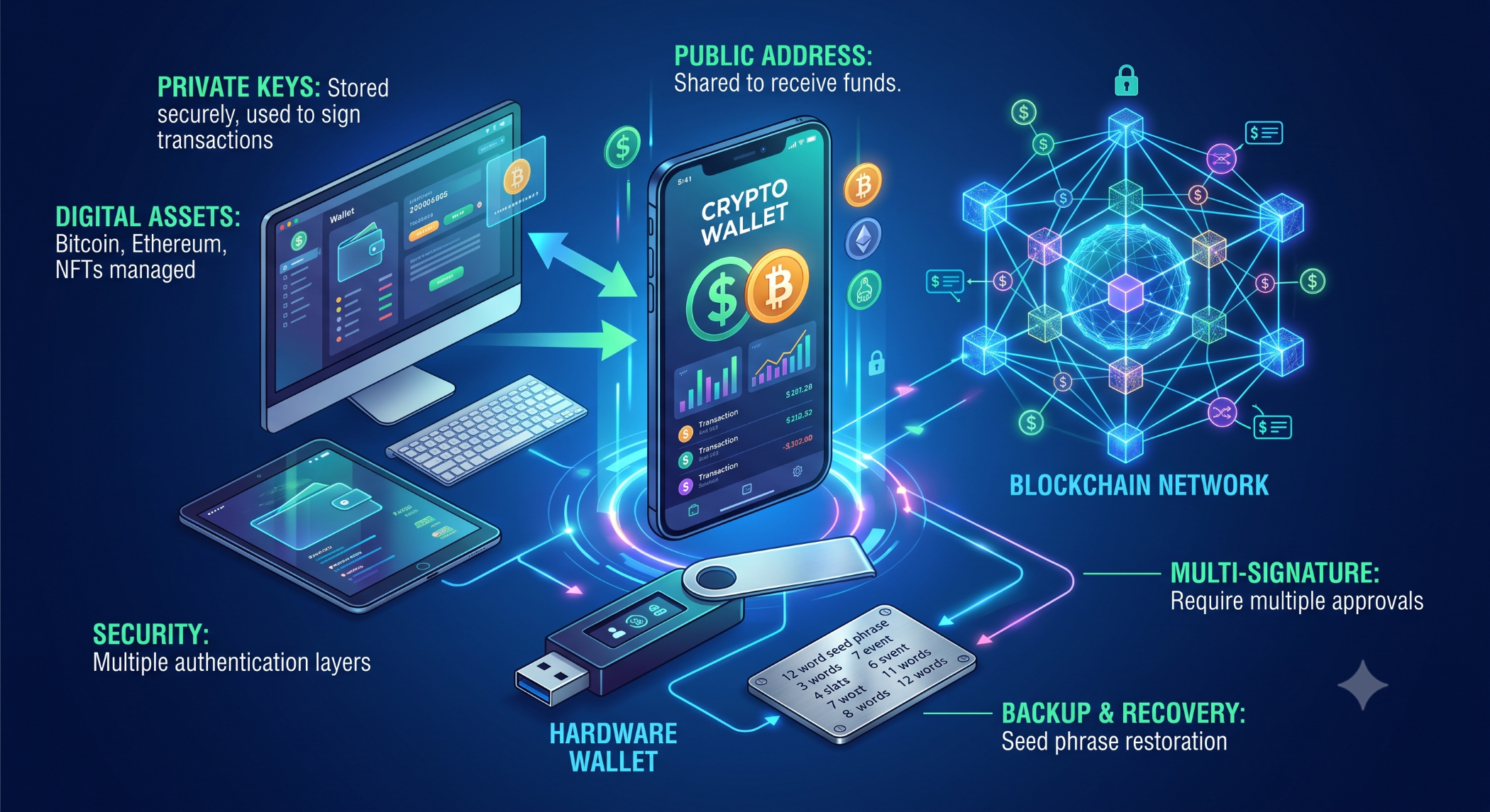
A crypto wallet is a digital tool that allows users to manage cryptocurrency and other blockchain-based assets. Despite the name, a crypto wallet does not typically store coins in the way a physical wallet stores cash. Instead, it manages the cryptographic keys that allow users to access and control assets recorded on a blockchain.
A wallet can generate and manage public addresses for receiving assets and private keys or other credentials used to authorize transactions. Because control of the relevant private key is generally essential for accessing blockchain assets, protecting wallet credentials is one of the most important aspects of cryptocurrency management.
Crypto wallets are now an important component of blockchain applications, cryptocurrency exchanges, decentralized applications, digital marketplaces, and fintech platforms. Solace Infotech also identifies crypto wallet applications as one of the use cases within its banking and finance technology work.
How Does a Crypto Wallet Work?
A crypto wallet generally works with two important concepts: a public address and a private key.
The public address can be shared with other users so they can send cryptocurrency to the wallet. The private key is used to authorize transactions and should remain confidential.
When a user sends cryptocurrency, the wallet uses the appropriate cryptographic credentials to create and authorize a blockchain transaction. The transaction is then submitted to the relevant network, where it is validated according to the blockchain's rules.
The cryptocurrency itself remains recorded on the blockchain. The wallet provides the tools and credentials needed to interact with those blockchain records.
Types of Crypto Wallets
Crypto wallets can be divided into several categories based on how they store and protect private keys.
Hot Wallets
Hot wallets are connected to the internet and are generally designed for convenient, frequent transactions.
Mobile wallets, desktop wallets, and many browser-based wallets fall into this category. They are convenient for everyday cryptocurrency use, but their internet connectivity can increase exposure to phishing, malware, compromised devices, and other security threats.
Hot wallets are particularly useful when users need quick access to their digital assets.
Cold Wallets
Cold wallets keep private keys offline when they are not being used for transactions.
Hardware wallets are a common example. Because the private keys can remain isolated from an internet-connected environment, cold wallets are often considered suitable for users who prioritize long-term asset security.
However, offline storage does not eliminate risk. Users still need to protect recovery phrases, verify transaction details, and purchase hardware from trustworthy sources.
Hardware Wallets
Hardware wallets are dedicated physical devices designed to protect cryptographic keys.
A hardware wallet can keep sensitive key material isolated from a general-purpose computer or smartphone. Transactions can still be initiated through compatible software, while the signing operation takes place within the hardware device.
This approach can provide an additional security layer for users managing significant digital assets.
Software Wallets
Software wallets are applications installed on computers or mobile devices.
They can provide features such as:
Sending and receiving cryptocurrency
Transaction history
Address management
Asset tracking
Network selection
Backup and recovery
The security of a software wallet depends heavily on the security of the device, application, credentials, and surrounding infrastructure.
Custodial and Non-Custodial Wallets
Another important distinction is between custodial and non-custodial wallets.
With a custodial wallet, a third-party service manages the user's private keys or controls access to the underlying assets. Cryptocurrency exchanges commonly use custodial infrastructure.
With a non-custodial wallet, the user is responsible for controlling the private keys or recovery credentials.
Non-custodial wallets provide greater direct control but also place more responsibility on the user. Losing a recovery phrase or compromising private keys can result in permanent loss of access.
Important Features of a Crypto Wallet
A modern crypto wallet can provide much more than basic send-and-receive functionality.
Multi-asset support allows users to manage multiple cryptocurrencies and blockchain networks within one application.
Transaction management helps users review transaction details, network fees, confirmation status, and transaction history.
Address management allows users to generate and organize blockchain addresses.
Security controls can include PINs, passwords, biometric authentication, device verification, transaction confirmation, and additional authorization mechanisms.
Backup and recovery features help users restore wallet access when supported by the wallet's design.
Portfolio tracking can provide users with an overview of their digital assets and their current values.
Businesses building advanced wallet platforms can also integrate exchange services, payment gateways, blockchain APIs, compliance systems, analytics, notifications, and other financial services.
Crypto Wallet Security
Security is the most important consideration when developing or using a crypto wallet.
Private keys should never be unnecessarily exposed to application code, external services, logs, or unauthorized users. Sensitive credentials should be protected through appropriate cryptographic and secure-storage mechanisms.
Additional security measures can include strong authentication, encrypted storage, secure key management, transaction validation, device security checks, rate limiting, monitoring, and fraud detection.
Developers should also protect the wallet application against common web and mobile security vulnerabilities. A wallet holding or controlling digital assets should receive significantly more security attention than a conventional application because a successful attack can result in direct financial loss.
Wallet Backup and Recovery
A wallet's recovery mechanism is extremely important.
Many non-custodial wallets use a recovery phrase or another mechanism that allows users to restore access to their assets. Users must understand that the recovery credential can be highly sensitive. Anyone who obtains the necessary recovery information may be able to gain control of the associated assets.
Wallet applications should therefore provide clear backup instructions and warnings against sharing recovery information.
From a software-development perspective, recovery functionality should be designed carefully so that security is not weakened simply to make account recovery more convenient.
Crypto Wallets for Businesses
Crypto wallets can form part of several different business models.
Fintech companies can build wallets for digital payments and asset management. Cryptocurrency exchanges can integrate wallet infrastructure for deposits and withdrawals. E-commerce platforms can explore cryptocurrency payment capabilities. Blockchain startups can create specialized wallets for their own applications or ecosystems.
Gaming and Web3 applications can also use wallets to interact with blockchain-based assets and decentralized applications.
The right wallet architecture depends on the business model. A consumer mobile wallet, exchange wallet, enterprise treasury wallet, and embedded wallet can have very different requirements for security, custody, scalability, compliance, and user experience.
Challenges in Crypto Wallet Development
Developing a crypto wallet requires careful consideration of both technical and business risks.
Security: Private-key protection and transaction authorization are fundamental requirements.
Blockchain integration: Different networks can have different transaction models, APIs, confirmation processes, and fee mechanisms.
User experience: Blockchain concepts can be complicated for non-technical users, so wallet applications should provide clear and understandable interfaces.
Scalability: A wallet serving a large number of users may require robust infrastructure, caching, monitoring, and reliable blockchain communication.
Compliance: Businesses operating cryptocurrency services may need to consider applicable financial, identity-verification, transaction-monitoring, and regulatory requirements in their target markets.
Recovery: Account and wallet recovery must balance usability with strong security.
Mobile Crypto Wallet Development
Mobile wallets can make cryptocurrency accessible through smartphones and tablets.
A mobile wallet can include biometric authentication, QR-code scanning, push notifications, transaction monitoring, address management, and portfolio tracking.
Developers must pay particular attention to mobile security, secure credential storage, application permissions, device compromise, and protection against phishing attacks.
The choice between native and cross-platform development should be based on the application's performance, security, integration, maintenance, and business requirements.
Solace Infotech provides native mobile development services and also works with hybrid application technologies, making mobile development a practical foundation for financial applications such as crypto wallets.
The Future of Crypto Wallets
Crypto wallets are evolving from simple cryptocurrency storage interfaces into broader digital-asset platforms.
Future wallet applications can combine payments, decentralized applications, asset management, identity, tokenized assets, analytics, and other blockchain services in a single experience.
For businesses, the opportunity is not limited to creating another cryptocurrency wallet. More specialized solutions can be designed around specific industries, customer groups, payment workflows, or blockchain ecosystems.
A successful wallet product should therefore focus on a combination of security, usability, reliable blockchain integration, scalability, and business purpose.
How Solace Infotech Can Help
Building a crypto wallet requires expertise in mobile or web development, backend architecture, API integration, security, and blockchain technology.
Solace Infotech has experience delivering enterprise applications for banking and finance use cases, including crypto wallet applications, across multiple technology ecosystems.
A properly designed wallet application can provide users with a secure and convenient way to manage digital assets while giving businesses a foundation for broader blockchain and fintech services.