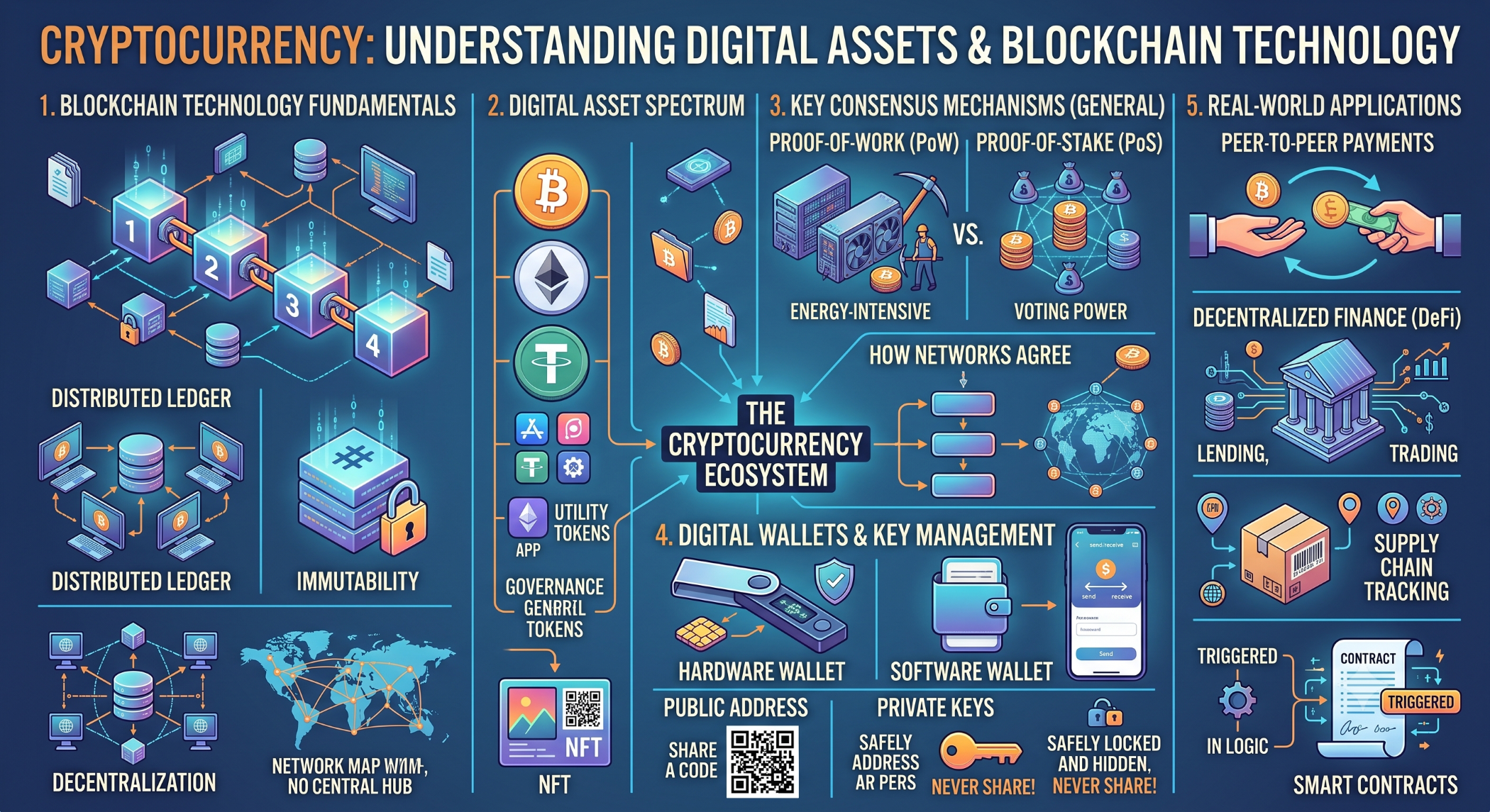
Cryptocurrency: Understanding Digital Assets and Blockchain Technology
Digital technology has changed how people transfer, store, and exchange value. Cryptocurrency is a category of digital assets that uses cryptography and distributed ledger technology to support transactions and ownership records.
Bitcoin introduced the first widely adopted decentralized cryptocurrency, followed by thousands of other digital assets with different technologies, purposes, and economic models.
What Is Cryptocurrency?
Cryptocurrency is a digital asset that typically uses cryptographic techniques to secure transactions and a distributed ledger to record ownership and activity.
Unlike traditional currencies issued by central banks, many cryptocurrencies operate through decentralized networks. However, the level of decentralization varies between projects.
A simplified transaction flow is:
User Creates Transaction
↓
Blockchain Network
↓
Transaction Validation
↓
Consensus Mechanism
↓
Ledger Updated
How Does Cryptocurrency Work?
A cryptocurrency network generally relies on several components working together.
Blockchain: Records transactions or other state changes.
Cryptography: Helps secure transactions and control ownership.
Wallets: Provide users with the tools and keys needed to manage digital assets.
Consensus: Allows network participants to agree on valid transactions and the state of the ledger.
Different cryptocurrencies implement these components in different ways.
Types of Cryptocurrency
Bitcoin
Bitcoin is the best-known cryptocurrency and operates on its own decentralized blockchain network.
It is commonly associated with digital payments, ownership of a scarce digital asset, and decentralized value transfer.
Altcoins
Altcoins generally refers to cryptocurrencies other than Bitcoin.
They can support very different use cases, including payments, smart contracts, digital applications, governance, and tokenized assets.
Stablecoins
Stablecoins are digital assets designed to maintain a relatively stable value relative to an external reference, often a fiat currency.
Their mechanisms and reserve models vary significantly between projects.
Utility and Governance Tokens
Some blockchain projects use tokens to provide access to application functionality or allow holders to participate in governance according to the project's rules.
Cryptocurrency Wallets
A cryptocurrency wallet helps users manage the cryptographic credentials associated with their digital assets.
Common categories include:
Hardware wallets
Software wallets
Mobile wallets
Custodial wallets
The exact security model depends on the wallet design.
Private keys or recovery credentials should be protected carefully because losing or exposing them can result in loss of control over assets.
Cryptocurrency Transactions
A cryptocurrency transaction generally involves transferring digital assets from one address or account to another.
The transaction is signed using cryptographic credentials and submitted to the relevant network.
Once validated and confirmed according to the network's rules, the transaction is recorded on the distributed ledger.
Blockchain and Cryptocurrency
Cryptocurrency and blockchain are closely related but are not the same thing.
Cryptocurrency is a digital asset or economic system.
Blockchain is a technology that can provide a distributed ledger for recording transactions and other state changes.
Blockchain technology can also be used for applications that do not involve cryptocurrency.
Benefits of Cryptocurrency
Cryptocurrency can provide several potential advantages depending on the network and use case.
Digital Ownership
Cryptographic keys can provide users with direct control over digital assets without requiring a traditional centralized account structure.
Global Accessibility
Blockchain networks can allow transactions to be initiated across geographic boundaries where users have access to the network.
Programmability
Some blockchain networks support smart contracts, allowing software-defined rules and applications to operate on the network.
Transparent Transaction Records
Public blockchain networks can provide publicly verifiable transaction histories, although addresses do not necessarily reveal a user's real-world identity.
Cryptocurrency Risks
Cryptocurrency also involves substantial risks.
These include:
Price volatility
Private-key loss
Wallet security threats
Fraud and scams
Smart-contract vulnerabilities
Network risks
Regulatory uncertainty
The risks vary significantly between individual cryptocurrencies and blockchain projects.
Cryptocurrency and Businesses
Businesses may explore cryptocurrency technology for:
Digital payments
Wallet applications
Blockchain-based marketplaces
Tokenized assets
Digital-asset platforms
Blockchain integrations
Before adopting cryptocurrency, businesses should evaluate customer demand, transaction requirements, accounting implications, security, operational processes, and applicable regulations.
Cryptocurrency Security
Security is one of the most important aspects of cryptocurrency applications.
Businesses should protect private keys, use appropriate access controls, secure APIs, monitor transactions, and carefully evaluate third-party wallet, exchange, and custody services.
For higher-value operations, organizations may use additional controls such as multi-signature authorization and transaction approval workflows.
Smart Contracts and Cryptocurrency
Some cryptocurrency ecosystems support smart contracts that can execute predefined program logic.
A simplified architecture can look like:
User
↓
Web / Mobile Application
↓
Blockchain / Smart Contract
↓
Digital Asset Transaction
Smart contracts can enable applications such as decentralized exchanges, digital marketplaces, token systems, and other blockchain-based products.
Cryptocurrency Regulations
Cryptocurrency regulations differ by country and can change over time.
Businesses involved in cryptocurrency may need to consider requirements related to taxation, licensing, anti-money-laundering controls, consumer protection, securities regulations, reporting, and digital-asset custody.
Regulatory requirements should be reviewed before launching a cryptocurrency-related product.
Cryptocurrency Development at Solace Infotech
Solace Infotech works across blockchain, web applications, mobile development, APIs, and product engineering, providing capabilities that can support businesses exploring cryptocurrency and blockchain-based applications.
The technology architecture should be selected according to the project's use case, blockchain network, security requirements, scalability, integrations, and applicable regulations.
Best Practices
Start with a clear business use case rather than selecting a cryptocurrency based only on popularity or market value.
Evaluate the underlying blockchain, transaction model, security architecture, ecosystem maturity, costs, scalability, and regulatory environment.
For production applications, protect keys and credentials carefully, audit smart contracts where applicable, and implement appropriate monitoring and operational controls.
Conclusion
Cryptocurrency represents a broad category of digital assets built using cryptography, blockchain technology, distributed networks, and consensus mechanisms.
From Bitcoin and altcoins to stablecoins and token-based applications, different cryptocurrencies serve different technical and economic purposes.
For businesses, cryptocurrency should be evaluated as a technology and business decision rather than simply as a financial asset. A successful implementation requires careful consideration of security, architecture, scalability, regulations, and the specific problem the technology is intended to solve.