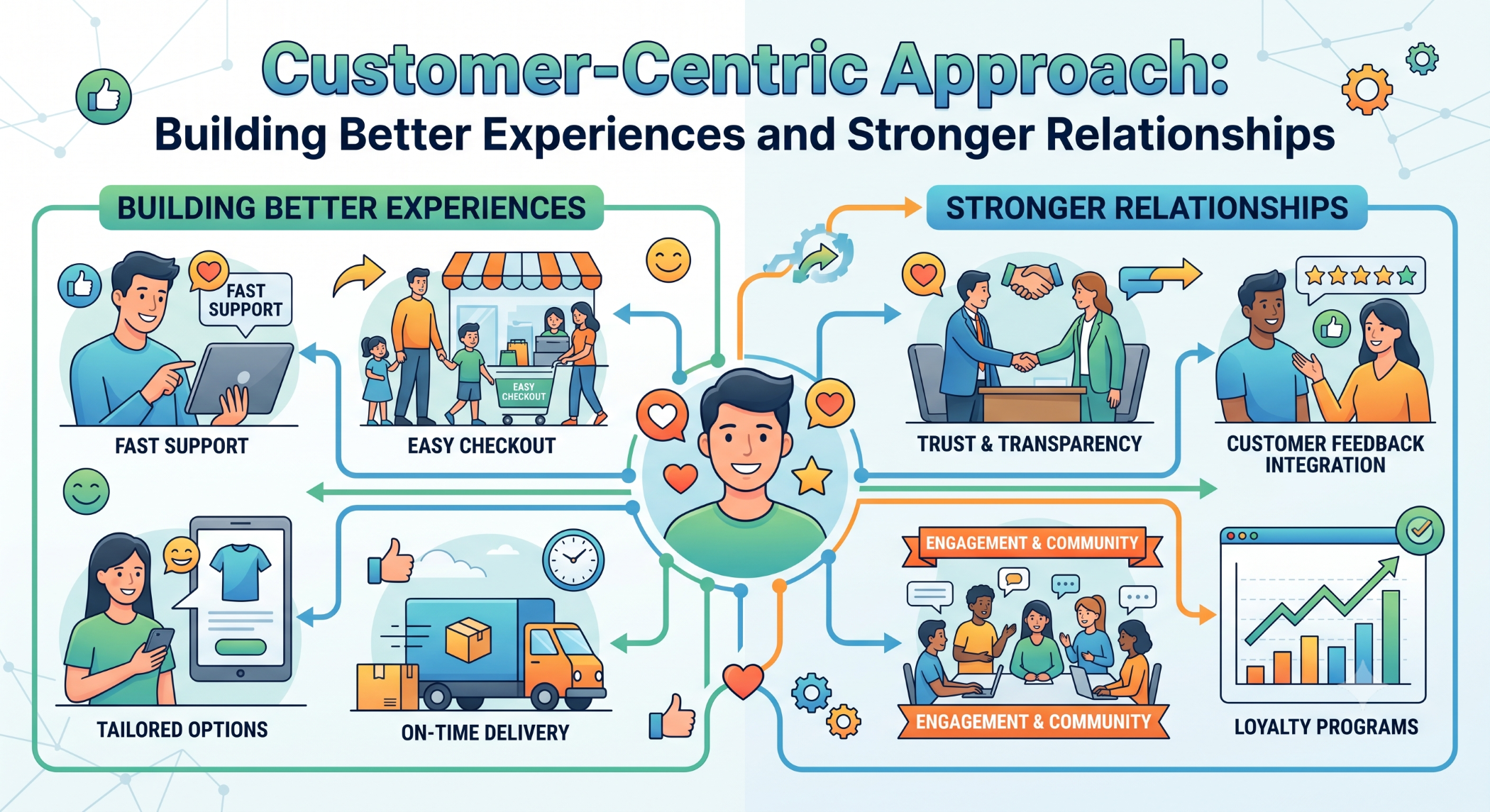
Customer-Centric Approach: Building Better Experiences and Stronger Relationships
Customers today expect more than a good product or service. They expect businesses to understand their needs, communicate effectively, provide convenient experiences, and respond to changing expectations.
A customer-centric approach places the customer at the center of business decisions and encourages organizations to improve every interaction across the customer journey.
What Is a Customer-Centric Approach?
A customer-centric business focuses its products, services, processes, and experiences around customer needs.
Instead of asking only what the business wants to sell, the organization also considers:
What problems customers need to solve.
How customers prefer to interact.
Where customers experience difficulties.
How the overall experience can be improved.
This approach applies across sales, marketing, customer support, product development, and operations.
Why Customer-Centricity Matters
A strong customer experience can help businesses build trust and improve long-term relationships.
A customer-centric strategy can help organizations:
Understand customer expectations.
Improve customer satisfaction.
Increase retention.
Provide more personalized experiences.
Identify product and service improvements.
Build stronger brand relationships.
Understand the Customer Journey
Customer-centric businesses look at the complete customer journey rather than individual interactions.
A simplified journey may look like:
Discovery
↓
Inquiry
↓
Purchase
↓
Onboarding
↓
Support
↓
Retention
Understanding where customers encounter delays, confusion, or unnecessary effort can reveal opportunities for improvement.
Use Customer Feedback
Customer feedback provides valuable information about what is working and what is not.
Businesses can collect feedback through:
Surveys
Support conversations
Product reviews
Interviews
Website analytics
App feedback
Feedback should not simply be collected. Teams should analyze it, identify common patterns, and use the findings to improve products and processes.
Personalization
Customers increasingly expect relevant interactions.
Businesses can use customer data to personalize experiences such as:
Product recommendations
Communication
Offers
Content
Service interactions
Personalization should be based on appropriate data practices and clear customer expectations.
Technology Enables Customer-Centricity
Technology can help businesses understand and serve customers more effectively.
For example:
Customer Interaction
↓
Digital Platform
↓
Customer Data
↓
Analytics / CRM
↓
Personalized Action
↓
Improved Experience
CRM systems, mobile applications, customer portals, analytics, automation, and AI can all support a customer-centric strategy.
Customer-Centric Applications
Businesses can use technology to create convenient customer experiences through:
Self-service portals: Customers can manage accounts, submit requests, access documents, or track services without depending on support teams for every task.
Mobile applications: Apps can provide direct access to services, notifications, transactions, and personalized features.
Customer support systems: Integrated support platforms can help teams track requests and respond more consistently.
Automation and Customer Experience
Automation can make customer interactions faster and more consistent.
For example:
Customer Request
↓
Automatic Classification
↓
Correct Team / Workflow
↓
Notification
↓
Resolution
Automation should improve convenience without creating unnecessary barriers or removing human interaction where customers need it.
AI and Customer-Centric Experiences
Artificial Intelligence can support customer-centric applications by helping businesses process large volumes of information and respond more efficiently.
Potential applications include:
AI-powered customer support
Recommendation systems
Document processing
Sentiment analysis
Intelligent search
Personalized experiences
AI should complement customer service rather than replace human judgment in situations requiring empathy, complex reasoning, or escalation.
Customer-Centric Product Development
Customer-centricity should also influence product development.
Instead of building features solely because they are technically possible, teams should prioritize functionality based on customer problems, business value, and usage data.
A practical process is:
Customer Need
↓
Research
↓
Feature Definition
↓
Development
↓
Customer Feedback
↓
Continuous Improvement
Measure Customer Experience
Customer-centric strategies should be supported by measurable outcomes.
Businesses may monitor:
Customer satisfaction
Retention
Support response time
Resolution time
Product usage
Conversion rates
Customer feedback
The most useful metrics depend on the business model and customer journey.
Data Privacy and Trust
Customer-centricity requires responsible handling of customer information.
Businesses should collect only appropriate information, protect customer data, control access, and provide transparency about how information is used.
Trust is an essential part of a long-term customer relationship.
Customer-Centric Technology at Solace Infotech
Solace Infotech works across web applications, mobile apps, CRM integrations, AI, automation, APIs, analytics, and custom software development.
These technologies can help businesses create customer portals, mobile experiences, automated workflows, support systems, and integrated digital platforms designed around customer needs.
Best Practices
Start by understanding customer problems rather than selecting technology first. Map the customer journey, identify areas of friction, and prioritize improvements that create measurable value.
Use customer feedback and analytics to guide decisions, personalize experiences responsibly, and continuously improve products and services.
Conclusion
A customer-centric approach is about more than providing good customer service. It means designing products, processes, technology, and communication around the needs of the customer.
By combining customer insights with technology such as CRM, automation, AI, mobile applications, analytics, and self-service platforms, businesses can create more convenient and personalized experiences.
The strongest customer-centric organizations continuously listen, measure, improve, and adapt to changing customer expectations.