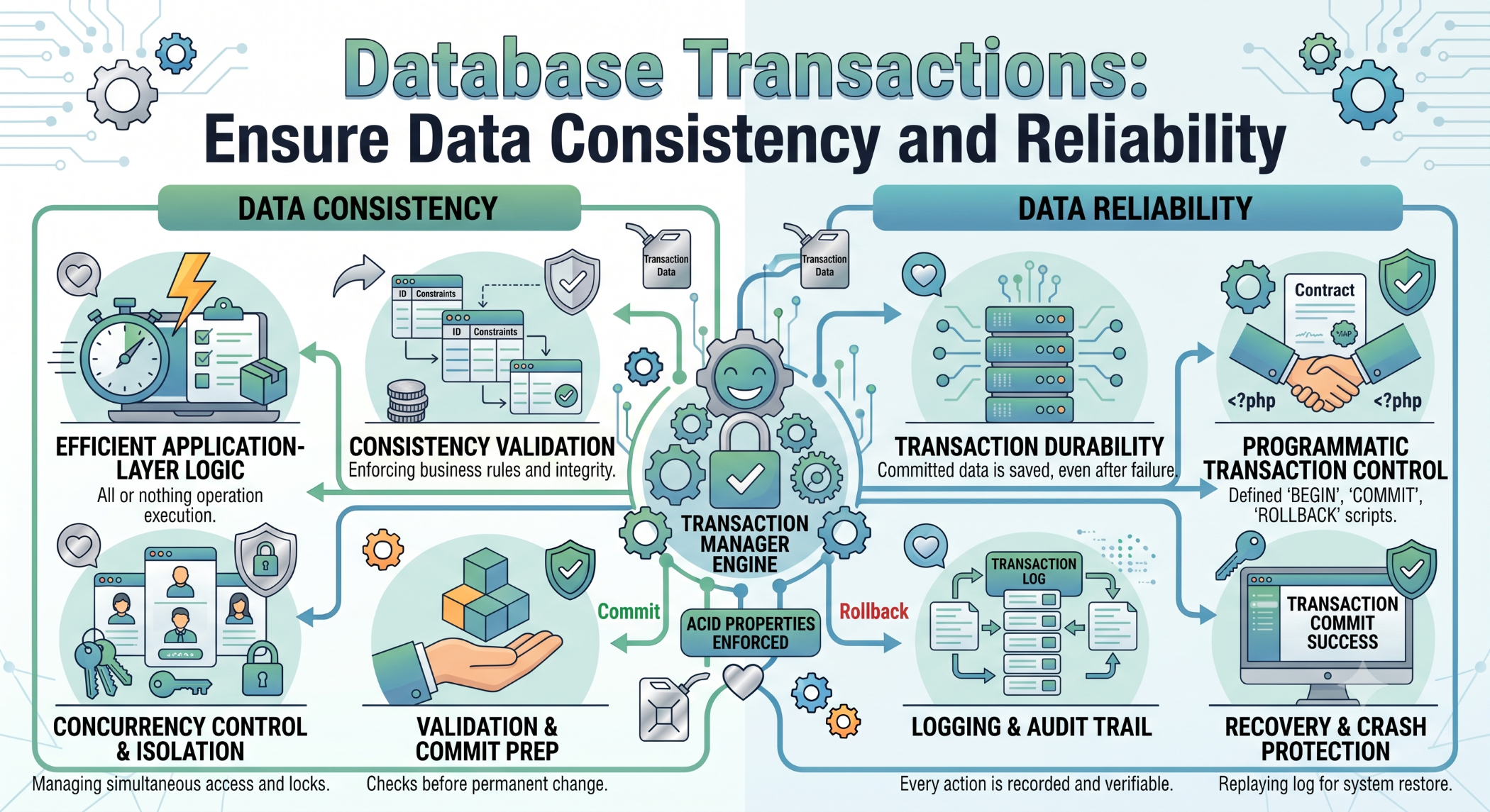
Database Transactions: Ensure Data Consistency and Reliability
Modern applications often perform multiple database operations as part of a single business process. For example, transferring money between accounts may require updating one account, updating another account, and recording the transaction.
If one operation succeeds while another fails, the application can end up with inconsistent data. Database transactions help prevent this by allowing related operations to be treated as a single unit of work.
What Is a Database Transaction?
A database transaction is a sequence of one or more operations that are treated as a logical unit.
The transaction should either complete successfully or be undone when an error prevents completion.
A simplified workflow is:
Start Transaction
↓
Operation 1
↓
Operation 2
↓
Operation 3
↓
Commit
If an operation fails, the application can roll back the transaction.
Start Transaction
↓
Operation 1
↓
Operation 2
↓
Error
↓
Rollback
COMMIT and ROLLBACK
Two of the most important transaction operations are COMMIT and ROLLBACK.
COMMIT
COMMIT permanently applies the changes made during the transaction.
START TRANSACTION;
UPDATE accounts
SET balance = balance - 100
WHERE id = 1;
UPDATE accounts
SET balance = balance + 100
WHERE id = 2;
COMMIT;
If all required operations succeed, the transaction can be committed.
ROLLBACK
ROLLBACK reverses changes made during the current transaction.
START TRANSACTION;
UPDATE accounts
SET balance = balance - 100
WHERE id = 1;
-- Error occurs
ROLLBACK;
This helps prevent partial updates from leaving the database in an incorrect state.
ACID Properties
Reliable database transactions are commonly described using the ACID properties.
Atomicity
A transaction is treated as a single unit. Its changes are either applied together or rolled back.
Consistency
A successful transaction should leave the database in a state that satisfies its defined constraints and rules.
Isolation
Concurrent transactions should be handled according to the database's isolation rules so that intermediate states are controlled appropriately.
Durability
Once a transaction is committed, the database should persist the changes according to its durability guarantees.
Together, these properties provide a foundation for reliable transactional processing.
Transactions in MySQL
MySQL supports transactions with transactional storage engines such as InnoDB.
A basic example is:
START TRANSACTION;
INSERT INTO orders (
customer_id,
total_amount
)
VALUES (101, 500);
UPDATE inventory
SET quantity = quantity - 1
WHERE product_id = 20
AND quantity > 0;
COMMIT;
If the application detects that the inventory update did not succeed, it can roll back the transaction instead of leaving an incomplete order workflow.
Transactions in PHP
PHP applications can manage database transactions through libraries such as PDO.
For example:
try {
$pdo->beginTransaction();
$stmt = $pdo->prepare(
"INSERT INTO orders (customer_id, total_amount)
VALUES (:customer_id, :total_amount)"
);
$stmt->execute([
'customer_id' => 101,
'total_amount' => 500
]);
$pdo->commit();
} catch (Throwable $e) {
if ($pdo->inTransaction()) {
$pdo->rollBack();
}
throw $e;
}
This allows the application to commit successful work or roll back when an exception occurs.
Common Transaction Use Cases
Transactions are useful whenever multiple operations need to remain consistent.
Examples include:
Bank transfers
E-commerce orders
Inventory updates
Payment processing
Booking systems
Account management
Financial records
For example, an e-commerce order may require an order record, payment record, and inventory update.
Transactions and Data Consistency
Consider an order process:
Create Order
↓
Reserve Inventory
↓
Record Payment
↓
Update Order Status
If the payment record is created but inventory is not updated, the application may contain inconsistent information.
A transaction can help when all operations occur within the same transactional boundary.
However, when the workflow spans external services, a single database transaction cannot automatically roll back an already-completed external operation. Such workflows often require additional patterns for handling failures and compensation.
Transaction Isolation
Databases support different isolation levels that control how concurrent transactions interact.
Common isolation levels include:
Read Uncommitted
Read Committed
Repeatable Read
Serializable
Higher isolation can provide stronger consistency guarantees but may increase locking or reduce concurrency depending on the workload.
The appropriate isolation level should be selected according to the application's consistency and performance requirements.
Transactions and Concurrency
Multiple users may attempt to modify the same data at the same time.
For example, two customers could attempt to purchase the final available unit of a product simultaneously.
Transactions, locking, and appropriate database constraints can help prevent invalid states.
Application developers should understand how the selected database engine handles concurrent operations.
Keep Transactions Short
Long-running transactions can hold locks for longer periods and increase contention.
Keep transactions focused on the operations that genuinely need atomicity.
Avoid performing slow external API calls or unnecessary processing while a database transaction is open unless the architecture specifically requires it.
Transactions and External APIs
A database transaction cannot automatically undo an action already completed by an external service.
For example:
Database Transaction
↓
Payment API
↓
External System
If the payment succeeds and the database transaction later fails, the payment provider may not automatically reverse the payment.
Such workflows may require idempotency, retries, compensation actions, event-driven processing, or other distributed transaction patterns.
Transactions and Constraints
Transactions work well alongside database constraints.
Constraints such as:
Primary keys
Foreign keys
UNIQUE
NOT NULL
help enforce data integrity while transactions control groups of related changes.
Combining these mechanisms provides stronger protection than relying on application code alone.
Error Handling
Always handle transaction failures carefully.
A robust transaction workflow should:
Start the transaction.
Perform the required operations.
Validate important results.
Commit on success.
Roll back when the workflow fails.
Log and monitor failures appropriately.
The exact implementation depends on the programming language and database library.
Best Practices
Use transactions when multiple database operations must succeed or fail together. Keep transactions as short as practical, choose an appropriate isolation level, and handle errors explicitly.
Do not assume that a transaction can undo external API calls. For distributed workflows, design explicit failure and recovery mechanisms.
Transactions at Solace Infotech
Transactions are important in Solace Infotech projects involving e-commerce, payment workflows, booking systems, business applications, APIs, and database-driven software.
Database transactions can help keep related operations consistent while application-level mechanisms can handle workflows that extend beyond a single database.
Conclusion
Database transactions provide a reliable way to group related operations into a single unit of work. With mechanisms such as START TRANSACTION, COMMIT, and ROLLBACK, applications can reduce the risk of partial updates and inconsistent data.
Transactions are particularly important for operations involving payments, inventory, orders, bookings, and other business-critical information.
The strongest approach combines transactions, database constraints, appropriate isolation, careful error handling, and application-level recovery strategies to create reliable and maintainable systems.