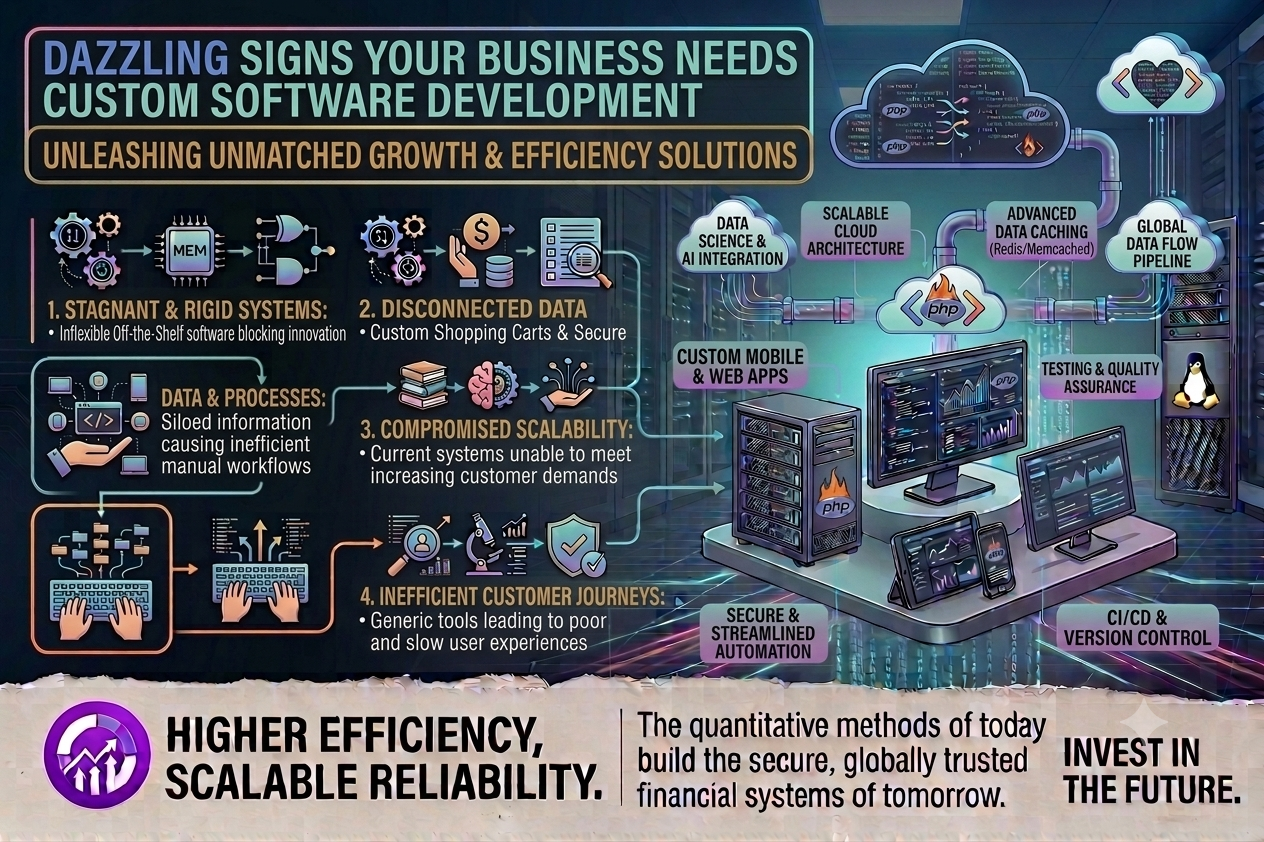
Dazzling Signs That Show Your Business Needs Custom Software Development
As businesses grow, their operational requirements become increasingly complex. While off-the-shelf software can be effective during the early stages of growth, many organizations eventually encounter limitations that hinder productivity, scalability, and innovation.
Custom software development provides businesses with solutions specifically designed around their workflows, processes, and goals. Recognizing the signs that your business needs custom software can help prevent operational bottlenecks and support long-term growth.
1. Your Team Relies on Multiple Disconnected Systems
Many businesses use separate applications for customer management, accounting, project management, inventory, communication, and reporting.
When employees spend significant time switching between systems, manually transferring data, or maintaining duplicate records, productivity can suffer.
Custom software can integrate multiple business functions into a centralized platform, improving efficiency and reducing data inconsistencies.
2. Manual Processes Consume Too Much Time
If employees repeatedly perform tasks such as:
Data entry
Report generation
Spreadsheet updates
Status tracking
Invoice creation
Customer follow-ups
then automation opportunities may exist.
Custom software can automate repetitive processes and allow employees to focus on higher-value activities.
3. Existing Software Cannot Support Your Business Processes
Every business has unique workflows. Generic software often forces organizations to adapt their operations to fit predefined functionality.
Signs of this problem include:
Frequent workarounds
Heavy dependence on spreadsheets
Manual approvals
Duplicate data entry
Complex operational procedures
Custom development allows software to support the business rather than forcing the business to adapt to software limitations.
4. Reporting and Analytics Are Inadequate
Business decisions depend on accurate and timely information.
If management teams struggle to generate meaningful reports or combine information from multiple systems, decision-making can become slower and less reliable.
Custom software can provide dashboards, analytics, and reporting capabilities aligned with specific business objectives and performance indicators.
5. Customer Experience Is Being Affected
Customers increasingly expect fast, personalized, and seamless experiences.
Warning signs include:
Slow response times
Delayed order processing
Poor customer visibility
Inconsistent communication
Difficulty accessing information
Custom software can improve customer interactions through automation, self-service portals, workflow optimization, and system integration.
6. Business Growth Is Creating Operational Bottlenecks
Growth often introduces new challenges:
Increased transactions
More customers
Larger teams
Additional products
Expanded services
Software that worked for a small organization may struggle to support growing operational demands.
Custom solutions can be designed with scalability in mind, allowing businesses to expand without constantly replacing systems.
7. Integration Requirements Are Increasing
Modern businesses commonly use multiple digital platforms, including:
CRM systems
ERP platforms
Payment gateways
Marketing tools
Inventory systems
Customer support platforms
If your software cannot communicate effectively with other business systems, operational inefficiencies can increase.
Custom development can create seamless integrations that improve data flow and business visibility.
8. Security and Compliance Requirements Have Increased
As businesses grow, data security becomes increasingly important.
Organizations handling customer data, financial information, healthcare records, or sensitive business information may require security controls beyond what standard software provides.
Custom software can be developed with:
Role-based access control
Data encryption
Audit trails
Secure authentication
Compliance-specific requirements
9. Your Competitors Are Moving Faster
Technology can become a competitive advantage.
Businesses that automate operations, improve customer experiences, and leverage data effectively are often better positioned to respond to market changes.
Custom software enables organizations to implement features, workflows, and capabilities that support their specific competitive strategy.
10. You Want to Create a Unique Digital Product
Sometimes businesses need software that simply does not exist in the market.
Examples include:
Industry-specific platforms
SaaS applications
Customer portals
Marketplaces
Mobile applications
Internal business systems
Custom development makes it possible to create technology solutions tailored to a unique business model or opportunity.
Benefits of Custom Software Development
When implemented correctly, custom software can provide:
Improved efficiency
Better automation
Centralized business operations
Enhanced customer experience
Increased scalability
Stronger security
Better reporting and analytics
Greater flexibility
Competitive differentiation
Organizations can align technology investments more closely with business goals and long-term growth strategies.
Questions to Ask Before Investing in Custom Software
Before starting a custom software project, consider:
What business problem are we solving?
Which processes need improvement?
What integrations are required?
How many users will use the system?
What security requirements apply?
What growth is expected over the next few years?
What return on investment is expected?
Which business metrics should improve?
Clear requirements help ensure successful software development outcomes.
Conclusion
If your business relies heavily on manual processes, disconnected systems, operational workarounds, or software limitations, it may be time to consider a custom solution.
Recognizing these dazzling signs that your business needs custom software development can help organizations improve efficiency, support growth, enhance customer experiences, and create a stronger foundation for future success. Custom software is not simply a technology investment—it is often a strategic investment in long-term business performance.