Digital Transformation: A Technology-Driven Approach to Business Growth
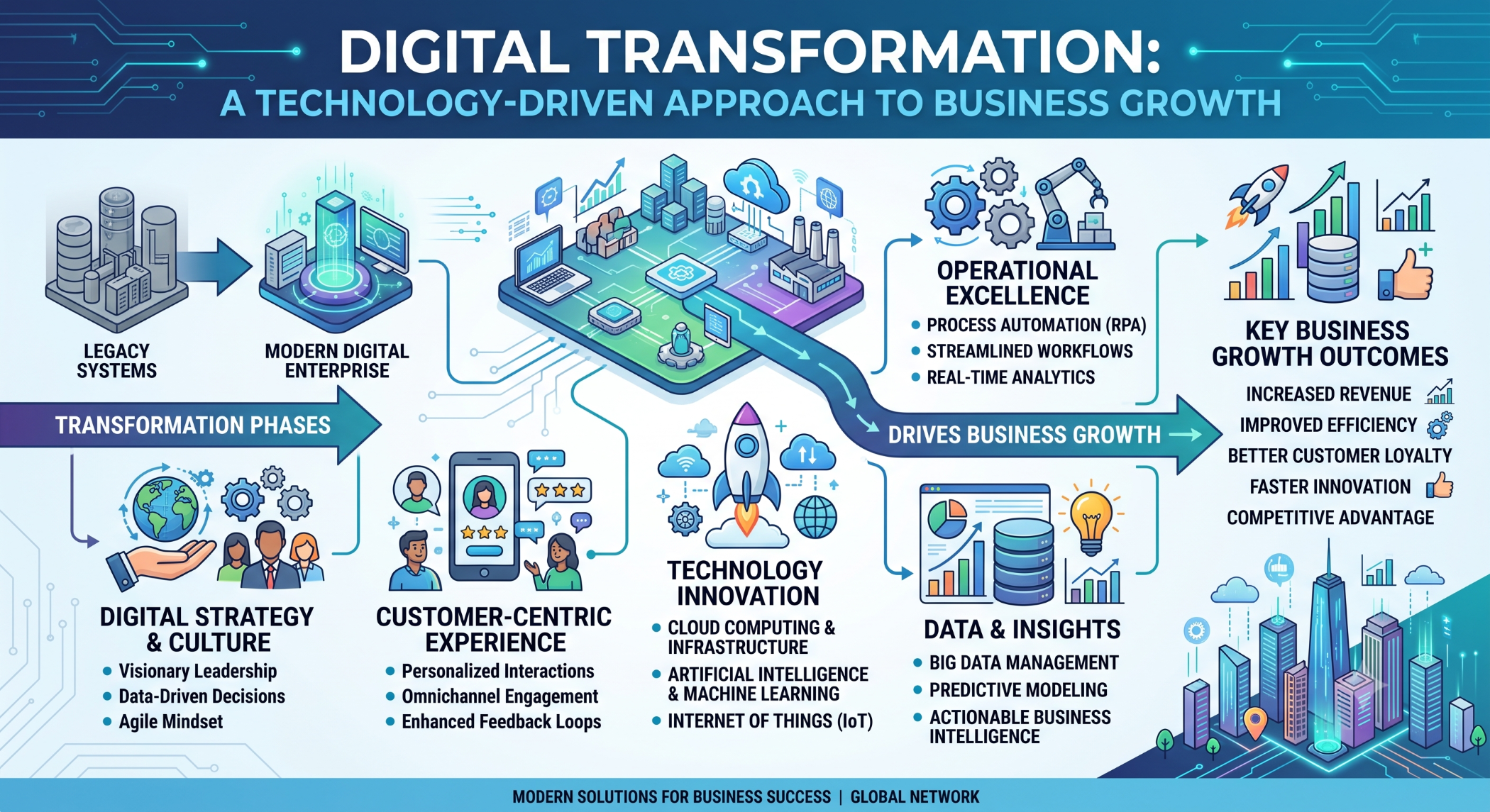
Businesses today operate in an environment where technology, customer expectations, and market conditions are constantly changing. Digital transformation helps organizations respond to these changes by using modern technology to improve business processes, customer experiences, and decision-making.
Digital transformation is not simply about replacing manual work with software. It involves rethinking how a business operates and using technology to create measurable improvements.
What Is Digital Transformation?
Digital transformation is the process of using digital technologies to improve business operations, customer experiences, and organizational capabilities.
It can involve technologies such as:
Cloud computing
Artificial Intelligence
Mobile applications
Web applications
Data analytics
APIs and integrations
Automation
Customer relationship management systems
The exact technology mix depends on the organization's goals and existing infrastructure.
Why Digital Transformation Matters
Businesses that continue relying on disconnected systems and manual processes may face unnecessary delays, duplicated work, and limited visibility.
Digital transformation can help organizations:
Improve operational efficiency.
Reduce repetitive manual work.
Connect business systems.
Improve customer experiences.
Access information faster.
Support data-driven decisions.
Scale business processes more effectively.
Automation as Part of Digital Transformation
Automation is one of the most common components of digital transformation.
For example, a business can automate a workflow such as:
Customer Request
↓
Data Validation
↓
CRM Update
↓
Task Assignment
↓
Notification
↓
Reporting
Automating connected processes can reduce manual effort while making business operations more consistent.
Cloud Technology
Cloud computing provides businesses with flexible infrastructure for hosting applications, databases, storage, and services.
Cloud adoption can support:
Flexible infrastructure
Remote access
Application scalability
Centralized services
Disaster recovery
Faster deployment
Cloud migration should be planned carefully based on security, compliance, performance, and business requirements.
Artificial Intelligence
AI is increasingly being incorporated into digital transformation strategies.
Businesses can use AI for tasks such as:
Document processing
Customer support
Data analysis
Content processing
Forecasting
Workflow assistance
AI should be introduced where it solves a meaningful business problem rather than simply because the technology is available.
Connecting Business Systems
Many organizations use multiple applications across departments.
APIs can connect these systems so information can move automatically between them.
For example:
Website
↓
API
↓
CRM
↓
ERP
↓
Accounting
Connected systems can reduce duplicate data entry and give teams a more consistent view of business information.
Improving Customer Experience
Digital transformation should ultimately create value for customers.
Businesses can improve customer experiences through:
Self-service portals
Mobile applications
Faster communication
Personalized experiences
Online booking and payments
Automated notifications
Digital support channels
The technology should make customer interactions simpler rather than introducing additional complexity.
Data-Driven Decision Making
Digital systems generate valuable operational and customer data.
Analytics can help businesses understand:
Customer behavior
Sales performance
Operational efficiency
Product usage
Marketing results
Business trends
When data from different systems is connected and presented effectively, decision-makers can make more informed choices.
Digital Transformation Challenges
Digital transformation can involve significant organizational and technical challenges.
Common challenges include:
Legacy systems: Older applications may be difficult to integrate or modernize.
Data migration: Moving information between systems requires careful planning and validation.
Security: Connecting systems and moving data creates additional security considerations.
Employee adoption: Teams need training and support when processes change.
Cost: Large transformation projects require investment in technology, development, infrastructure, and change management.
A Practical Digital Transformation Approach
A successful transformation does not require changing everything at once.
A practical approach is:
Identify Business Problem
↓
Assess Existing Process
↓
Define Digital Solution
↓
Implement in Phases
↓
Measure Results
↓
Improve and Scale
Starting with high-impact processes can help businesses demonstrate value before expanding transformation initiatives.
Digital Transformation at Solace Infotech
Solace Infotech works across web and mobile application development, AI, cloud technologies, APIs, automation, e-commerce, product development, and enterprise software.
These capabilities can support businesses at different stages of digital transformation, from modernizing an existing application to developing new digital products and integrated business workflows.
Best Practices
Start with business objectives rather than technology. Identify the processes that create the most friction, define measurable outcomes, and choose technologies that support those goals.
Modernize incrementally where practical, protect business data, train employees, and continuously measure whether the transformation is delivering the expected results.
Conclusion
Digital transformation is a long-term process of improving how businesses operate and serve their customers through technology.
By combining cloud computing, automation, AI, connected systems, mobile applications, data analytics, and modern software, organizations can become more efficient, responsive, and scalable.
The most successful transformation initiatives begin with a clear business problem and use technology as an enabler for measurable improvement.