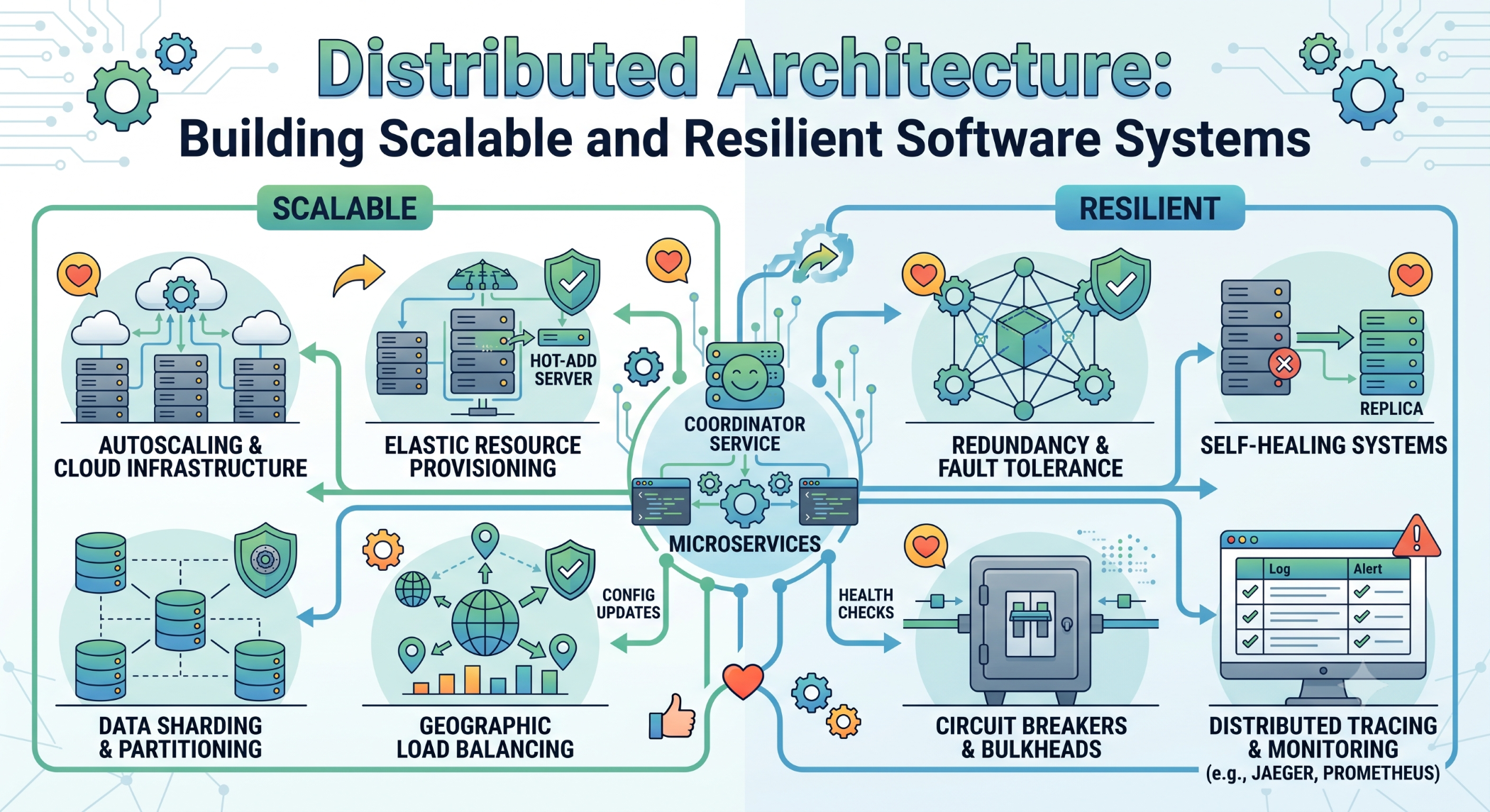
Distributed Architecture: Building Scalable and Resilient Software Systems
As applications grow, a single server or tightly coupled application architecture may become difficult to scale and maintain. Distributed architecture provides an approach where application components are spread across multiple services, servers, or computing resources that communicate over a network.
This approach can help businesses build systems that handle larger workloads while improving flexibility and resilience.
What Is Distributed Architecture?
Distributed architecture is a software design approach in which application components operate across multiple machines or services and communicate over a network.
A simplified architecture looks like:
Users
↓
Load Balancer
↓
Application Services
↙ ↓ ↘
API Database Cache
↓
Background Jobs
Each component can perform a specific responsibility while working together as part of the overall application.
Why Use Distributed Architecture?
A distributed system can provide several advantages for growing applications.
Businesses may use it to:
Scale individual application components.
Improve availability.
Handle large workloads.
Separate business responsibilities.
Support independent deployments.
Integrate multiple technologies and services.
However, distributed architecture also introduces additional complexity, so it should be adopted when the requirements justify it.
Components of a Distributed System
A distributed application may contain several components.
Application Services
Different services can handle specific business functionality.
For example:
User Service
Order Service
Payment Service
Notification Service
Separating responsibilities can make large applications easier to scale and maintain.
Databases
Distributed applications may use one or more databases depending on their architecture and data requirements.
Database design should consider consistency, availability, performance, and how information is shared between services.
Message Queues
Message queues can allow services to communicate asynchronously.
For example:
Order Created
↓
Message Queue
↙ ↘
Inventory Notification
This can prevent one service from needing to wait for every downstream operation to complete.
Distributed Architecture and Scalability
One of the main benefits of distributed architecture is the ability to scale individual components.
For example, if an application receives many more API requests than background jobs, additional API instances can be deployed without proportionally increasing every other component.
Load Balancer
↙ ↓ ↘
API 1 API 2 API 3
This is commonly known as horizontal scaling.
Fault Tolerance and Availability
A distributed architecture can reduce dependence on a single application instance.
If one service instance fails, traffic can potentially be routed to another healthy instance.
However, distribution does not automatically guarantee reliability. The system must be designed to handle service failures, network interruptions, unavailable databases, and other partial failures.
Service-to-Service Communication
Services in a distributed architecture need reliable ways to communicate.
Common approaches include:
REST APIs
gRPC
Message queues
Event-driven communication
WebSockets for selected realtime use cases
The communication model should match the requirements of the application.
Synchronous vs Asynchronous Communication
Synchronous Communication
One service directly requests information from another service and waits for a response.
Service A → Service B → Response
This can be appropriate when an immediate response is required.
Asynchronous Communication
A service publishes an event or message without waiting for the receiving service to complete its work.
Service A
↓
Message Queue
↓
Service B
This can improve decoupling and allow background processing.
Distributed Architecture and Microservices
Microservices are one approach to distributed architecture.
In a microservices architecture, an application is divided into relatively independent services, each focused on a specific business capability.
For example:
E-Commerce Platform
|
┌────────┬───────┼────────┐
↓ ↓ ↓ ↓
Users Orders Payments Notifications
Microservices can provide flexibility but also introduce operational complexity, monitoring requirements, network dependencies, and distributed-data challenges.
Distributed Systems and Data Consistency
Data consistency can become more complicated when multiple services manage related information.
For example, an order system may need to coordinate:
Order
↓
Payment
↓
Inventory
↓
Shipping
Instead of assuming every operation succeeds immediately, the application may need transactions within individual services, event-driven workflows, retries, and compensation mechanisms.
The correct approach depends on the business requirements.
Caching in Distributed Architecture
Caching can reduce database load and improve response time.
Distributed applications may use shared caching systems so multiple application instances can access commonly used information.
However, cache invalidation and consistency become important considerations when data changes frequently.
Distributed Architecture and Security
Security must be applied across every component.
Important areas include:
Authentication
Authorization
API security
Service-to-service authentication
Encryption
Secrets management
Network controls
Audit logging
A user's authorization should be checked at the appropriate service boundary rather than assuming that an internal service is automatically trusted.
Monitoring Distributed Systems
Monitoring becomes especially important because failures can occur across multiple components.
Teams should monitor:
Service health
API latency
Error rates
Database performance
Queue activity
CPU and memory usage
Network failures
Centralized logging and distributed tracing can also help developers identify where a request failed or became slow.
Challenges of Distributed Architecture
Distributed systems introduce challenges that do not exist in the same way in simpler architectures.
These may include:
Network failures: Services depend on communication over networks that can fail or become slow.
Operational complexity: More services mean more deployments, logs, configurations, and monitoring requirements.
Data consistency: Keeping related data synchronized across services can be difficult.
Debugging: A single user request may pass through many services, making failures harder to trace.
Because of these challenges, distributed architecture should not be introduced merely because it is popular.
When Should You Use Distributed Architecture?
Distributed architecture can be useful when an application requires significant scalability, independent service deployment, high availability, or integration across multiple systems.
For a small application, a well-designed modular monolith may be simpler and more cost-effective.
The architecture should evolve according to actual business and technical requirements.
Distributed Architecture at Solace Infotech
Solace Infotech works across web applications, mobile applications, APIs, cloud technologies, databases, automation, and enterprise software, where distributed architectures can be applied when scalability and system integration requirements justify them.
Architecture decisions should be based on factors such as expected traffic, service boundaries, data requirements, availability, team structure, and long-term maintenance.
Best Practices
Start with clear business and technical requirements before distributing application components. Keep service responsibilities well defined, use reliable communication patterns, design for partial failures, and implement monitoring from the beginning.
Avoid unnecessary microservices and excessive infrastructure complexity. A distributed system should solve a real scalability, availability, or organizational problem.
Conclusion
Distributed architecture allows applications to operate across multiple services or computing resources, providing opportunities for scalability, flexibility, resilience, and independent development.
At the same time, distributed systems introduce additional challenges involving communication, data consistency, monitoring, security, and failure handling.
The best architecture is not necessarily the most distributed one. Businesses should choose an approach that provides the required scalability and reliability while keeping the system practical to build, operate, and maintain.