Ethereum: Understanding the Blockchain Platform for Smart Contracts and DApps
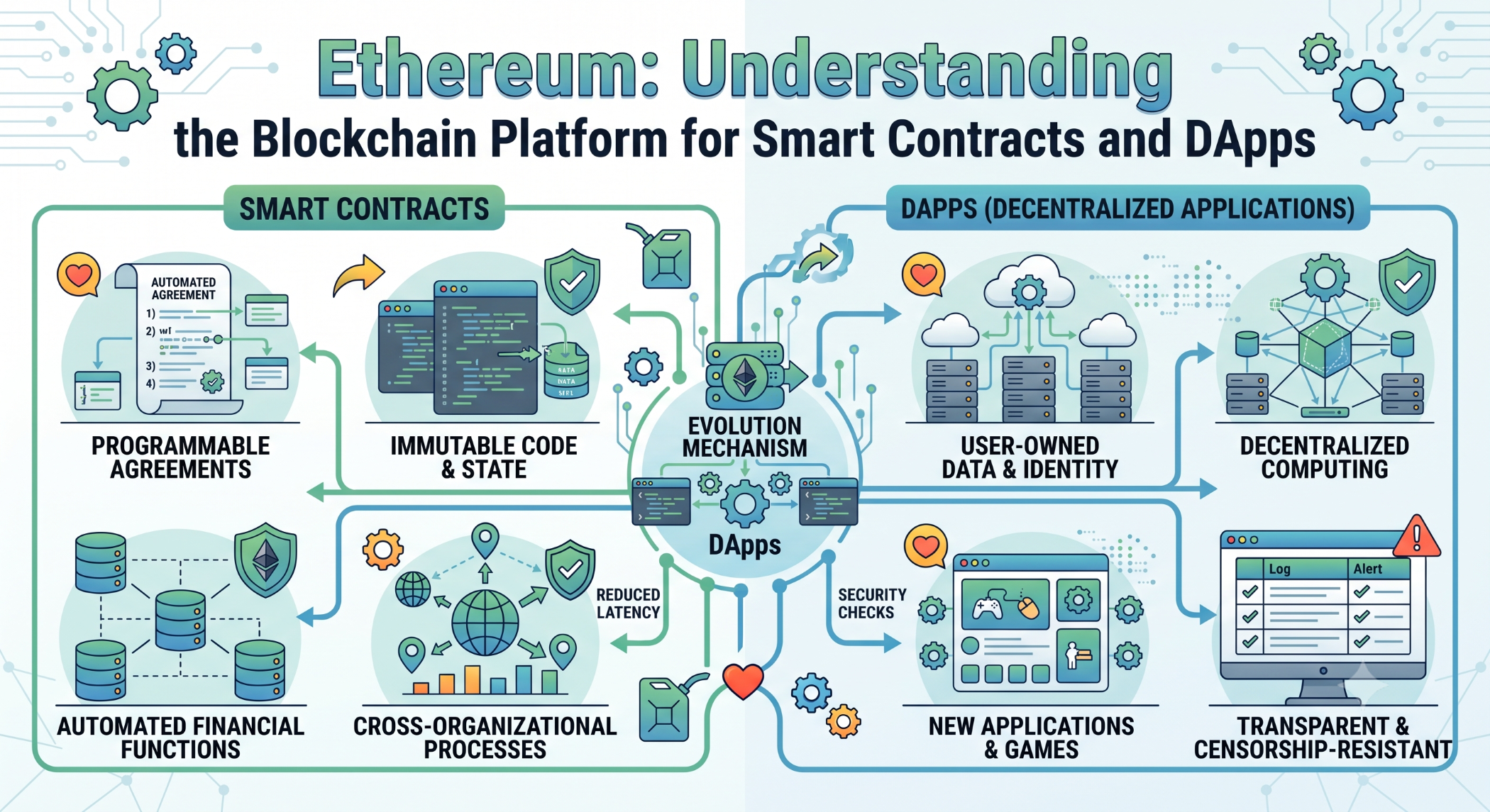
Ethereum expanded the concept of blockchain beyond digital currency by providing a platform where developers can deploy smart contracts and decentralized applications (DApps). Its programmable blockchain has become an important part of the broader Web3 and blockchain ecosystem.
Unlike a blockchain designed primarily for transferring a digital currency, Ethereum is designed as a general-purpose platform for executing programmable transactions and maintaining application state.
What Is Ethereum?
Ethereum is a decentralized blockchain platform that allows users and applications to interact through transactions and smart contracts.
Its native digital asset is Ether (ETH), which is used for activities such as paying transaction fees and participating in the network's proof-of-stake consensus mechanism.
A simplified Ethereum workflow is:
User
↓
Wallet / Application
↓
Ethereum Transaction
↓
Network Validation
↓
Smart Contract / Blockchain State
↓
Confirmed Result
How Does Ethereum Work?
Ethereum processes transactions through a distributed network of nodes. Transactions may transfer ETH or interact with deployed smart contracts.
When a smart contract function is called, the network processes the transaction according to the contract's code and Ethereum's protocol rules.
The resulting state changes are recorded on the blockchain.
Ethereum and Smart Contracts
A smart contract is a program deployed on a blockchain that executes according to predefined rules.
For example, a simple business rule could be represented as:
Condition Met
↓
Smart Contract Executes
↓
Blockchain State Updated
Smart contracts can be used to manage tokens, digital assets, marketplaces, financial applications, and other programmable workflows.
Ethereum Virtual Machine
The Ethereum Virtual Machine (EVM) is the execution environment used by Ethereum to process smart-contract code.
Developers commonly write Ethereum smart contracts using Solidity, which is designed for EVM-compatible smart-contract development.
For example:
pragma solidity ^0.8.0;
contract SimpleStorage {
uint256 public value;
function setValue(uint256 newValue) public {
value = newValue;
}
}
The contract can be deployed to an Ethereum-compatible network and interacted with through transactions.
Ethereum and Gas Fees
Ethereum transactions require computational resources. These resources are measured using gas.
Users pay transaction fees based on the amount of computational work required and the network's fee conditions.
For businesses developing on Ethereum, transaction fees should be considered when designing application workflows.
Ethereum Proof of Stake
Ethereum uses Proof of Stake (PoS) as its consensus mechanism.
Validators participate in maintaining network security by staking ETH and following the protocol's validation rules.
This differs from Bitcoin's Proof-of-Work approach, which relies on computational mining.
Ethereum and Digital Assets
Ethereum supports programmable token standards that allow developers to create digital assets and applications.
Examples include:
Fungible Tokens
Non-Fungible Tokens
Stablecoins
Governance Tokens
Utility Tokens
The specific behavior and economics of a token depend on its smart contracts and surrounding application.
Ethereum and Decentralized Applications
Decentralized applications use blockchain infrastructure for some or all of their application logic and data.
A simplified DApp architecture can look like:
Web / Mobile Interface
↓
Wallet
↓
Smart Contract
↓
Ethereum
The frontend can interact with blockchain contracts through a wallet and compatible blockchain libraries.
Common Ethereum Use Cases
Ethereum can support a broad range of applications.
Decentralized Finance
Smart contracts can be used to create applications for activities such as decentralized trading, lending, and other financial workflows.
NFT Platforms
Ethereum has been widely used for applications involving non-fungible tokens and digital ownership.
Digital Marketplaces
Smart contracts can support blockchain-based marketplaces where transactions are recorded on-chain.
Tokenization
Businesses can explore representing certain digital or real-world rights through blockchain-based tokens, subject to legal and regulatory requirements.
Ethereum vs Bitcoin
Bitcoin primarily focuses on decentralized digital money and a secure transaction ledger.
Ethereum provides a programmable blockchain designed to support smart contracts and decentralized applications.
A simplified comparison is:
Bitcoin → Digital currency / payment-focused blockchain
Ethereum → Programmable blockchain / smart contracts / DApps
The networks use different architectures, consensus mechanisms, and development models.
Ethereum Security
Smart-contract security is a critical consideration.
A coding mistake in a deployed smart contract can have significant consequences because blockchain transactions may be difficult or impossible to reverse.
Security practices should include:
Code review
Smart-contract testing
Security audits where appropriate
Access controls
Safe key management
Monitoring
Developers should also carefully evaluate third-party contracts and libraries used by an application.
Ethereum and Scalability
Ethereum's base layer has finite throughput, and applications must consider transaction costs and network activity.
Scaling approaches can include Layer 2 networks and other ecosystem technologies designed to process transactions more efficiently while interacting with Ethereum.
Businesses should evaluate the required transaction volume, fees, latency, security model, and ecosystem compatibility before choosing where to deploy an application.
Ethereum Development
A typical Ethereum development stack may include:
Frontend
↓
Web3 Library
↓
Wallet
↓
Smart Contract
↓
Ethereum / Compatible Network
Developers may use tools and libraries such as Solidity, EVM-compatible development frameworks, and blockchain interaction libraries.
Ethereum and Business Applications
Businesses can explore Ethereum for applications involving:
Digital assets
Tokenization
Smart contracts
Decentralized marketplaces
Automated transactions
Blockchain-based records
Blockchain should be used where its decentralization, transparency, programmability, or asset-ownership properties provide a meaningful advantage over conventional technologies.
Ethereum Development at Solace Infotech
Solace Infotech works across blockchain, web applications, mobile development, APIs, and product engineering, capabilities that can support Ethereum-based applications and blockchain integrations.
The appropriate architecture should be selected according to the project's business purpose, smart-contract requirements, security, scalability, transaction costs, and regulatory environment.
Best Practices
Start with a clear business use case before selecting Ethereum. Determine which data and logic actually need to be on-chain and keep conventional application data off-chain where appropriate.
Use secure key-management practices, test and audit smart contracts when necessary, monitor transaction behavior, and evaluate Layer 2 or other scaling options when transaction costs or throughput become important.
Conclusion
Ethereum provides a programmable blockchain platform that supports smart contracts, decentralized applications, digital assets, and blockchain-based business solutions.
Its combination of the EVM, smart contracts, Proof of Stake, and a broad developer ecosystem has made it an important platform for blockchain development.
For businesses, Ethereum should be evaluated based on the specific problem being solved. A successful implementation requires careful consideration of smart-contract security, transaction costs, scalability, application architecture, and regulatory requirements.