Introduction
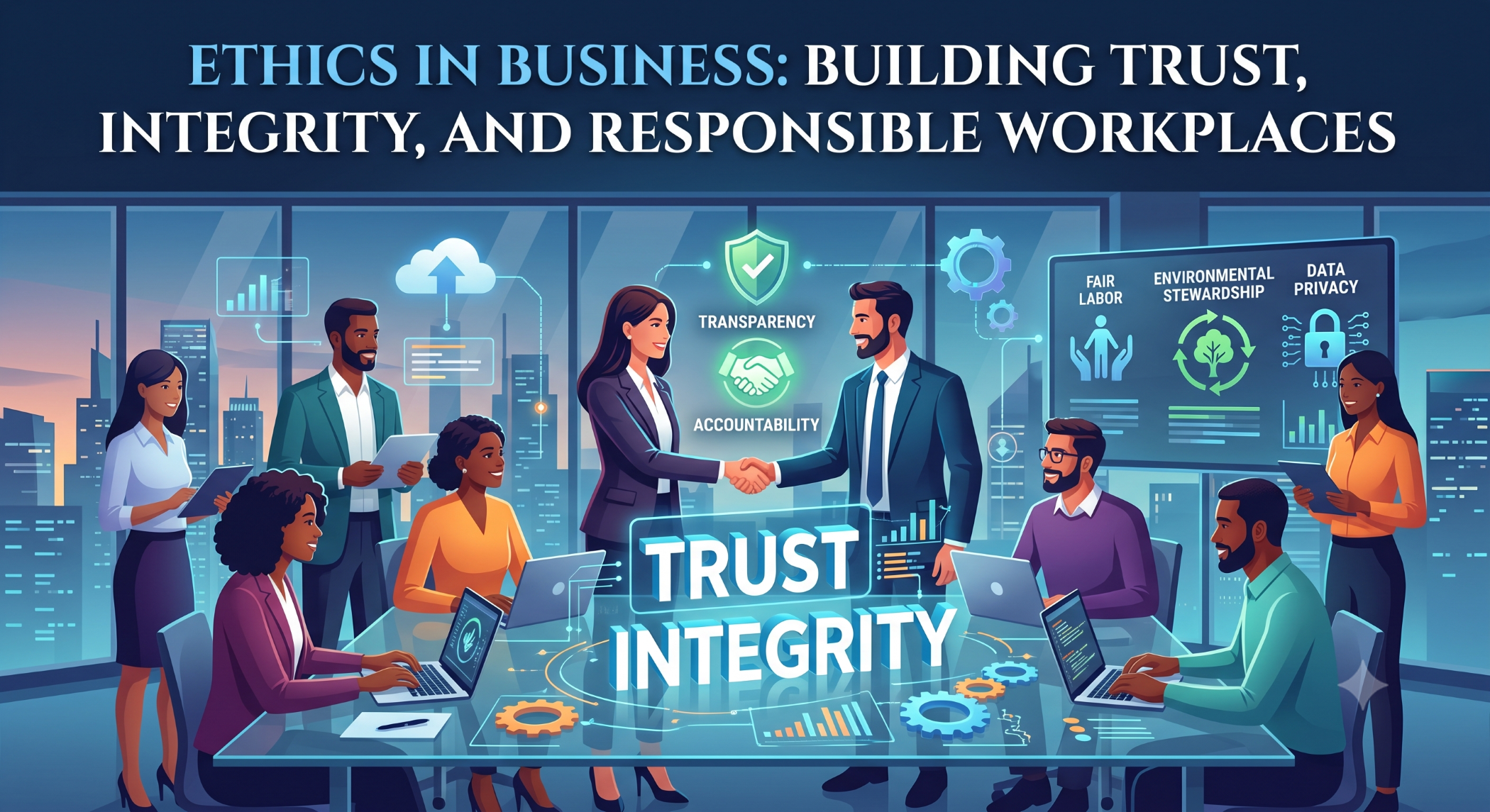
Every successful organization needs more than technology, products, and financial performance. It also needs principles that guide how people behave and make decisions.
This is where ethics becomes important.
Business ethics refers to the principles and standards that influence how a company and its employees conduct themselves. Ethical behavior helps organizations make responsible decisions, build trust, protect relationships, and maintain their reputation.
In technology organizations, ethics can influence everything from customer communication and software development to data protection, employee relationships, and business decisions.
What Is Ethics?
Ethics refers to principles that help people determine what is right, fair, honest, and responsible.
In a workplace, ethics influence how employees interact with colleagues, clients, vendors, and other stakeholders.
Ethical behavior may include being honest about project status, protecting confidential information, respecting others, avoiding conflicts of interest, and taking responsibility for mistakes.
Ethics provide guidance particularly when there is no specific rule covering a situation.
Why Ethics Matter in Business
Businesses depend on trust.
Customers trust companies with their money, information, requirements, and sometimes critical business operations. Employees trust organizations to treat them fairly. Business partners trust companies to honor agreements.
Unethical behavior can damage these relationships quickly.
A company may gain a short-term advantage through misleading communication or questionable practices, but the long-term consequences can include lost customers, damaged reputation, employee dissatisfaction, and financial or legal problems.
Ethical business practices help create a foundation for sustainable growth.
Ethics and Integrity
Ethics and integrity are closely connected.
Integrity means acting consistently with your principles, including when doing the right thing is inconvenient.
For example, if a development team discovers that a delivery will be delayed, integrity means communicating the situation honestly rather than reporting the work as complete.
Similarly, if a software defect is discovered after release, an ethical approach is to assess the impact, communicate appropriately, and work toward a solution.
Ethics in the Workplace
Workplace ethics influence everyday interactions.
Employees should communicate respectfully, treat colleagues fairly, avoid discrimination and harassment, protect confidential information, and follow company policies and applicable laws.
Managers also have an important responsibility. Their behavior can influence the culture of the entire organization.
When leaders demonstrate fairness, transparency, and accountability, employees are more likely to adopt similar standards.
Ethics and Customer Relationships
Customer relationships are built on trust.
Ethical customer communication means providing accurate information about services, pricing, capabilities, timelines, limitations, and risks.
Businesses should avoid making unrealistic promises simply to win a customer.
For technology companies, this is particularly important during project estimation and delivery. A realistic commitment that is successfully delivered is generally more valuable than an unrealistic promise that creates disappointment later.
Ethics in Software Development
Ethics has a significant role in software engineering.
Developers and technology teams may work with sensitive customer information, financial data, authentication credentials, business processes, and critical infrastructure.
They therefore have a responsibility to consider the possible consequences of technical decisions.
For example, an application should not intentionally expose sensitive information simply because fixing the security issue would require additional effort.
Ethical software development considers security, privacy, accessibility, reliability, and user impact alongside functionality.
Data Privacy and Ethics
Data has become one of the most valuable resources for modern businesses.
Organizations may collect information about customers, employees, transactions, usage patterns, and business activity.
Ethical data practices require organizations to understand what data they collect, why they collect it, how it is used, who can access it, and how it is protected.
Privacy should not be treated simply as a compliance requirement. It is also a matter of customer trust.
Ethics and Artificial Intelligence
Artificial intelligence creates new ethical questions for organizations.
AI systems can influence decisions, generate content, process personal information, and automate activities that previously required human judgment.
Organizations should therefore consider issues such as data privacy, transparency, security, bias, accuracy, human oversight, and appropriate use.
AI-generated output should also be reviewed rather than automatically trusted, especially when the output can affect customers, employees, finances, or critical business processes.
Responsible AI requires organizations to balance innovation with accountability.
Ethics and Confidential Information
Technology professionals often have access to sensitive information.
This can include source code, customer data, business strategies, credentials, financial information, and internal documents.
Employees should protect this information and access it only when necessary for legitimate business purposes.
Confidential information should never be used for personal gain or shared without authorization.
Strong access controls and security policies can support ethical behavior, but employees must also exercise professional judgment.
Ethics and Accountability
Accountability is an important part of ethical behavior.
When someone makes a mistake, an ethical response is to acknowledge it, understand its impact, and work toward a resolution.
Avoiding responsibility or deliberately hiding a problem can make the situation worse.
Organizations should create an environment where people can raise concerns and discuss mistakes constructively while maintaining appropriate accountability.
Ethics and Fair Decision-Making
Business decisions often involve competing priorities.
A company may have to choose between speed and quality, cost and security, or short-term revenue and long-term customer value.
Ethical decision-making considers the wider consequences rather than focusing only on immediate gains.
Leaders should ask whether a decision is fair, transparent, responsible, and aligned with the organization's principles.
Ethical Leadership
Leadership has a particularly strong influence on company ethics.
Employees observe how leaders behave when problems occur, when profits are under pressure, and when difficult decisions must be made.
If leaders consistently demonstrate honesty, fairness, accountability, and respect, those behaviors can become part of the organizational culture.
Ethical leadership also requires leaders to acknowledge mistakes and avoid creating an environment where employees feel pressured to hide problems.
Ethics and Company Culture
Company culture is shaped by everyday behavior.
A company may publish a list of values, but employees learn the real culture from what is rewarded, tolerated, and demonstrated by leadership.
For example, a company that claims to value transparency should encourage honest reporting of risks and challenges.
A company that values collaboration should create an environment where people can share ideas and disagree professionally.
Ethics become meaningful when they are reflected in daily actions.
Ethics in Technology Partnerships
Technology companies often work with external clients, vendors, contractors, and partners.
Ethical relationships require clear expectations, honest communication, respect for agreements, appropriate handling of confidential information, and transparency about responsibilities.
When problems arise, both parties should focus on facts and solutions rather than using blame or misleading communication.
Strong ethical relationships can support long-term partnerships.
Ethics and Employee Development
Ethical organizations also invest in their people.
Employees should have fair opportunities to learn, grow, and take on responsibilities.
Performance evaluations should focus on meaningful contributions and professional behavior rather than favoritism.
Managers should provide constructive feedback and communicate expectations clearly.
A culture of fairness can increase trust and create stronger employee relationships.
Ethical Use of Technology
Not every technically possible solution is automatically a good solution.
Organizations should consider the potential impact of technology on users, employees, customers, and society.
For example, collecting excessive personal information simply because it is technically possible may create unnecessary privacy risk.
Likewise, automating a decision without considering its consequences can introduce operational or ethical problems.
Technology should be used responsibly and with a clear understanding of its potential impact.
Common Ethical Challenges
Organizations can encounter ethical challenges in many areas.
These may include conflicts of interest, misuse of confidential information, misleading communication, inappropriate access to data, unfair treatment, intellectual-property concerns, security compromises, and unrealistic commitments.
The best way to handle such issues is to establish clear policies, encourage open communication, provide appropriate training, and ensure that leadership consistently supports ethical behavior.
How to Build an Ethical Workplace
Building an ethical culture requires more than writing a code of conduct.
Organizations should clearly communicate expectations and ensure employees understand them.
Leaders should demonstrate ethical behavior in everyday decisions.
Employees should have appropriate channels for reporting concerns.
Managers should respond consistently to ethical issues.
Training can help employees understand how ethical principles apply to real situations.
Most importantly, organizational incentives should not encourage employees to achieve results through unethical behavior.
Ethics and Long-Term Success
Ethics may not always produce the fastest short-term result, but it can support long-term stability.
Customers are more likely to trust organizations that communicate honestly. Employees are more likely to remain engaged in environments where they are treated fairly. Business partners are more likely to build lasting relationships when expectations are clear and commitments are respected.
A strong ethical reputation can therefore become an important business asset.
Ethics at Solace Infotech
Ethics is one of the core values publicly identified by Solace Infotech. The company presents ethics alongside collaboration, accountability, and nurturing people as principles that guide its organizational culture. (solaceinfotech.com)
For a technology organization, emphasizing ethics is particularly relevant because software teams often work with customer data, business-critical systems, intellectual property, and sensitive information.
Conclusion
Ethics is the foundation of trust and responsible business behavior.
It influences how organizations treat their employees, communicate with customers, protect information, develop technology, and make difficult decisions.
Ethical behavior is not limited to following laws or company policies. It also means choosing honesty, fairness, responsibility, and transparency when facing difficult situations.
In the technology industry, where software and data can have significant real-world consequences, ethical decision-making is increasingly important.
When ethics becomes part of everyday behavior rather than simply a statement on a website, organizations can build stronger teams, deeper customer relationships, and a more sustainable foundation for long-term success.