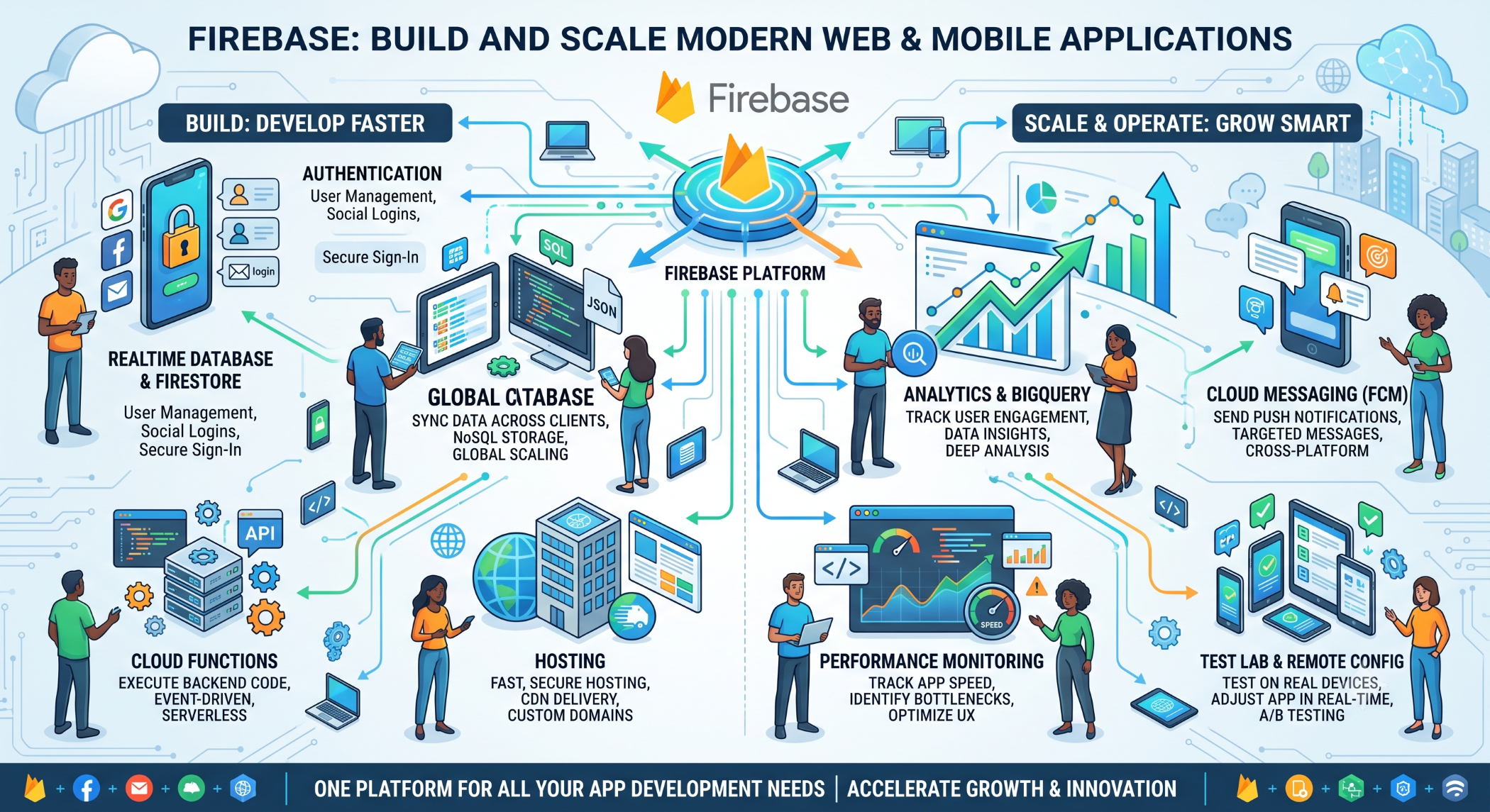
Firebase: Build and Scale Modern Web and Mobile Applications
Modern applications often require authentication, databases, file storage, notifications, analytics, and reliable backend services. Building every one of these capabilities from scratch can increase development time and maintenance effort.
Firebase provides a collection of cloud services that can help developers build and manage web and mobile applications more efficiently.
What Is Firebase?
Firebase is Google's application development platform that provides services for building, running, and growing applications.
Developers can use Firebase for capabilities such as:
User authentication
Databases
Cloud storage
Push notifications
Analytics
Application hosting
Crash monitoring
Serverless backend functionality
The exact services required depend on the application's architecture and business requirements.
Firebase Authentication
Authentication allows applications to securely identify users.
Firebase Authentication supports multiple sign-in methods, including email and password and various supported identity providers.
A typical application flow is:
User
↓
Login / Sign Up
↓
Firebase Authentication
↓
Authenticated Application
This can reduce the amount of authentication infrastructure developers need to build themselves.
Firebase Database
Firebase provides database options for applications that need cloud-hosted data.
Cloud Firestore is a NoSQL document database designed for application development, while the Realtime Database provides real-time data synchronization capabilities.
Developers can select the appropriate option based on data structure, querying requirements, synchronization needs, and application architecture.
Firebase Cloud Storage
Applications frequently need to store images, videos, documents, and other files.
Firebase Cloud Storage provides cloud-based file storage that can be integrated with Firebase Authentication and application security rules.
For example, a mobile application could allow authenticated users to upload profile images or documents to protected storage.
Firebase Cloud Messaging
Mobile applications often need to send notifications to users.
Firebase Cloud Messaging (FCM) provides cross-platform messaging capabilities for Android, iOS, and web applications.
Businesses can use notifications for use cases such as:
Order updates
Appointment reminders
New messages
Promotional communication
Application alerts
Notification strategies should respect user preferences and avoid unnecessary messaging.
Firebase Hosting
Firebase Hosting provides hosting for web applications and static content.
It supports HTTPS and can be integrated with other Firebase services, making it useful for deploying web experiences and frontend applications.
Firebase Analytics
Understanding how users interact with an application is important for improving products.
Firebase provides analytics capabilities that can help teams understand areas such as user engagement, events, and application usage.
Analytics should be used alongside clearly defined business metrics so teams can focus on information that supports product decisions.
Firebase Crashlytics
Application crashes can significantly affect the user experience.
Firebase Crashlytics helps developers identify and investigate application crashes and related issues. This can make it easier to prioritize bugs affecting real users.
Firebase Cloud Functions
Firebase supports serverless backend execution through Cloud Functions for Firebase.
Developers can use backend functions to respond to events such as database changes, HTTP requests, authentication events, and other supported triggers.
For example:
User Action
↓
Firebase Event
↓
Cloud Function
↓
Business Logic
↓
Database / Notification / API
This can be useful when an application needs backend processing without maintaining a traditional server for every function.
Benefits of Firebase
Firebase can help development teams accelerate application development by providing managed services for common application requirements.
Key advantages include:
Faster development: Developers can use ready-made services instead of building every backend component from scratch.
Integrated ecosystem: Authentication, databases, storage, messaging, analytics, and other services can work together.
Scalability: Cloud infrastructure can support applications as usage grows, subject to service limits and architecture.
Cross-platform support: Firebase services can be used with web and mobile applications.
When Should You Use Firebase?
Firebase can be a good option for:
Mobile applications
Real-time applications
MVPs and prototypes
Consumer applications
Applications requiring integrated authentication and cloud services
Web applications with managed backend requirements
However, businesses should consider data complexity, vendor dependence, pricing, compliance, and long-term architecture before selecting Firebase.
Firebase Security
Security should be designed from the beginning.
Firebase services use mechanisms such as authentication and security rules to control access to application resources. Developers should ensure that database and storage rules follow the application's actual authorization requirements.
Never rely only on frontend checks to protect sensitive data.
Firebase at Solace Infotech
Firebase can complement mobile and web application development by providing managed services for authentication, databases, notifications, cloud storage, analytics, and backend functionality.
At Solace Infotech, technology selection should be based on project requirements, including application type, scalability, integrations, security, performance, and long-term maintenance.
Conclusion
Firebase provides a broad set of services that can simplify the development of modern web and mobile applications. From authentication and databases to notifications, storage, analytics, and serverless backend functionality, it can reduce the amount of infrastructure developers need to build and maintain.
Firebase is not automatically the right choice for every application. The best approach is to evaluate the product's architecture, data requirements, security needs, expected scale, and long-term business goals before adopting the platform.