Firebase Free: Explore Firebase Features at No Cost
Developing a web or mobile application often requires services for authentication, databases, hosting, storage, notifications, and analytics. Firebase provides many of these capabilities through a managed cloud platform, making it easier for developers to build applications without managing all backend infrastructure themselves.
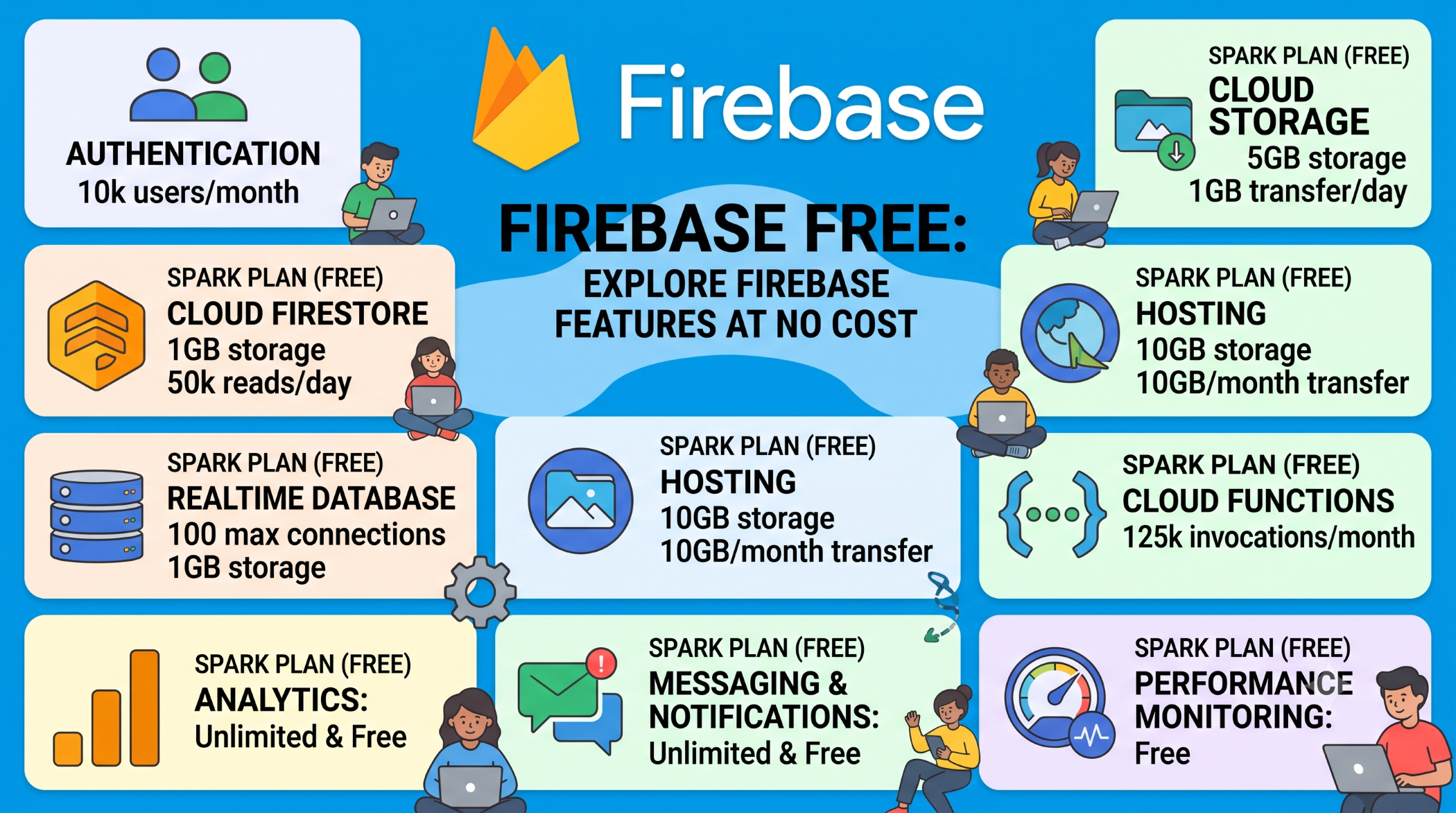
For developers starting a new project, prototype, or proof of concept, the Firebase Spark plan can provide access to selected Firebase services without requiring a billing account. The exact quotas and available features depend on the individual Firebase product and current plan.
What Is Firebase Free?
Firebase Free generally refers to the Spark plan, Firebase's no-cost plan.
It is useful for developers who want to experiment with Firebase services, build prototypes, or run applications within the plan's included quotas.
The free plan is not unlimited. Each service has its own usage limits and restrictions.
Firebase Services Available on the Free Plan
Depending on the service, the Spark plan can provide limited usage for capabilities such as:
Authentication
Cloud Firestore
Realtime Database
Firebase Hosting
Cloud Storage
Cloud Functions in supported configurations
Analytics
Cloud Messaging
Developers should always verify the current quota for the specific service because Firebase pricing and product availability can change over time.
Firebase Authentication
Firebase Authentication helps applications manage user sign-in and identity.
A development team can use supported authentication providers to build login and registration functionality without implementing the entire authentication infrastructure from scratch.
For a small prototype, the included free usage may be sufficient.
Firebase Database
Firebase provides both Cloud Firestore and Realtime Database.
Firestore uses a document-based model and is designed for flexible application data and querying. Realtime Database focuses on synchronizing data in real time.
The free quotas can make either service useful for experimentation and smaller workloads, but growing applications should monitor reads, writes, storage, and network usage carefully.
Firebase Hosting
Firebase Hosting can be used to deploy websites and frontend applications.
A developer can use it to host a project without setting up a traditional web server.
For example:
Web Application
↓
Firebase Hosting
↓
Users
The included free quota is useful for small websites, prototypes, and development environments.
Firebase Cloud Messaging
Firebase Cloud Messaging (FCM) supports notifications for Android, iOS, and web applications.
It can be used for use cases such as:
Order updates
New messages
Reminders
Application alerts
Customer notifications
Messaging requirements should be designed carefully to provide useful communication rather than unnecessary notifications.
Benefits of Firebase Free
The free plan provides a practical way to explore Firebase before committing to paid usage.
Useful for Prototypes
Developers can validate an application idea and test Firebase integrations with limited initial infrastructure costs.
Faster Development
Ready-made services can reduce the amount of backend functionality developers need to build themselves.
Easy Experimentation
Teams can test authentication, databases, hosting, messaging, and other services before deciding whether Firebase is the right long-term platform.
Limitations of Firebase Free
The free plan has usage quotas, so it may not be suitable for every production workload.
A growing application can eventually exceed free limits because of:
Increased database operations
Higher storage requirements
Larger network traffic
Increased authentication activity
Greater application usage
When usage exceeds the included quotas, the project may need to move to a paid Firebase plan where supported.
Firebase Free vs Paid
The main difference is the amount of usage and the billing model.
The Spark plan provides included no-cost quotas.
The Blaze plan uses a pay-as-you-go model, allowing applications to consume additional resources beyond the free allowances according to the applicable service pricing.
Businesses should estimate expected usage before moving a production application to a paid plan.
Is Firebase Free Good for Production?
Firebase Free can be suitable for smaller applications or projects that remain comfortably within the included quotas.
For a business expecting significant traffic, storage, database activity, or backend processing, the free plan should not be treated as a guaranteed permanent production solution.
Monitor actual usage and understand the cost implications before launching a high-traffic application.
Best Practices
Start with the free plan for development or proof-of-concept work, but design the application with future usage in mind.
Monitor database reads and writes, storage, network usage, and other consumption metrics. Set appropriate budgets and alerts when using a billing-enabled project.
Also evaluate security rules, authentication, data architecture, and vendor dependency before moving a Firebase application into production.
Firebase at Solace Infotech
Firebase can be useful for mobile and web application development, particularly when a project needs integrated authentication, cloud databases, hosting, notifications, analytics, or other managed backend services.
At Solace Infotech, technology selection should be based on the application's requirements, expected scale, integrations, security needs, performance expectations, and long-term maintenance strategy.
Conclusion
Firebase Free provides a convenient way to explore Firebase services and build prototypes or smaller applications with limited initial infrastructure costs.
Its value is particularly strong during the early stages of development, but businesses should understand the service-specific quotas and plan for potential growth.
The right approach is to start within the free tier, monitor usage closely, and evaluate the paid model before application demand begins to exceed the included limits.