Introduction
The modern workplace is changing rapidly. Businesses increasingly work across locations, time zones, technologies, and diverse teams. Employees also have different working styles, responsibilities, and professional needs.
This makes flexibility an important part of modern work culture.
Being flexible does not mean having no structure. It means being able to adapt processes, schedules, responsibilities, and approaches when circumstances require change while keeping business objectives and accountability clear.
What Is Flexible Work?
Flexible work refers to working arrangements that provide some adaptability in where, when, or how employees perform their responsibilities.
Depending on the organization, flexibility can include remote work, hybrid work, flexible schedules, adjusted working hours, flexible project responsibilities, or other arrangements that support business and employee needs.
The exact model depends on the nature of the work. Some roles require employees to be available at specific times or locations, while other roles can be performed more flexibly.
Why Flexibility Matters
Businesses rarely operate exactly according to plan.
Customer requirements can change, project priorities can shift, technical issues can arise, and teams may need to respond to unexpected situations.
Flexible organizations can adapt more quickly.
At the employee level, flexibility can make it easier to manage changing circumstances while maintaining professional responsibilities.
The key is to combine flexibility with clear expectations and measurable outcomes.
Flexibility and Productivity
Flexibility can support productivity when employees have an appropriate working environment and clear priorities.
For example, some professionals may perform complex tasks more effectively during periods when they can work without interruptions. Others may benefit from adjusting their schedule to accommodate collaboration with colleagues in different time zones.
However, flexibility does not automatically create productivity.
Without clear objectives, communication, and accountability, flexible arrangements can create confusion.
The goal should be flexibility with responsibility.
Flexible Working in the Technology Industry
Technology companies are particularly suited to flexible working because many software-development activities can be performed digitally.
Developers, designers, QA professionals, project managers, and other technology specialists can often collaborate using cloud-based tools, source-control platforms, project-management systems, communication tools, and online meeting platforms.
This allows teams to work across different locations while remaining connected.
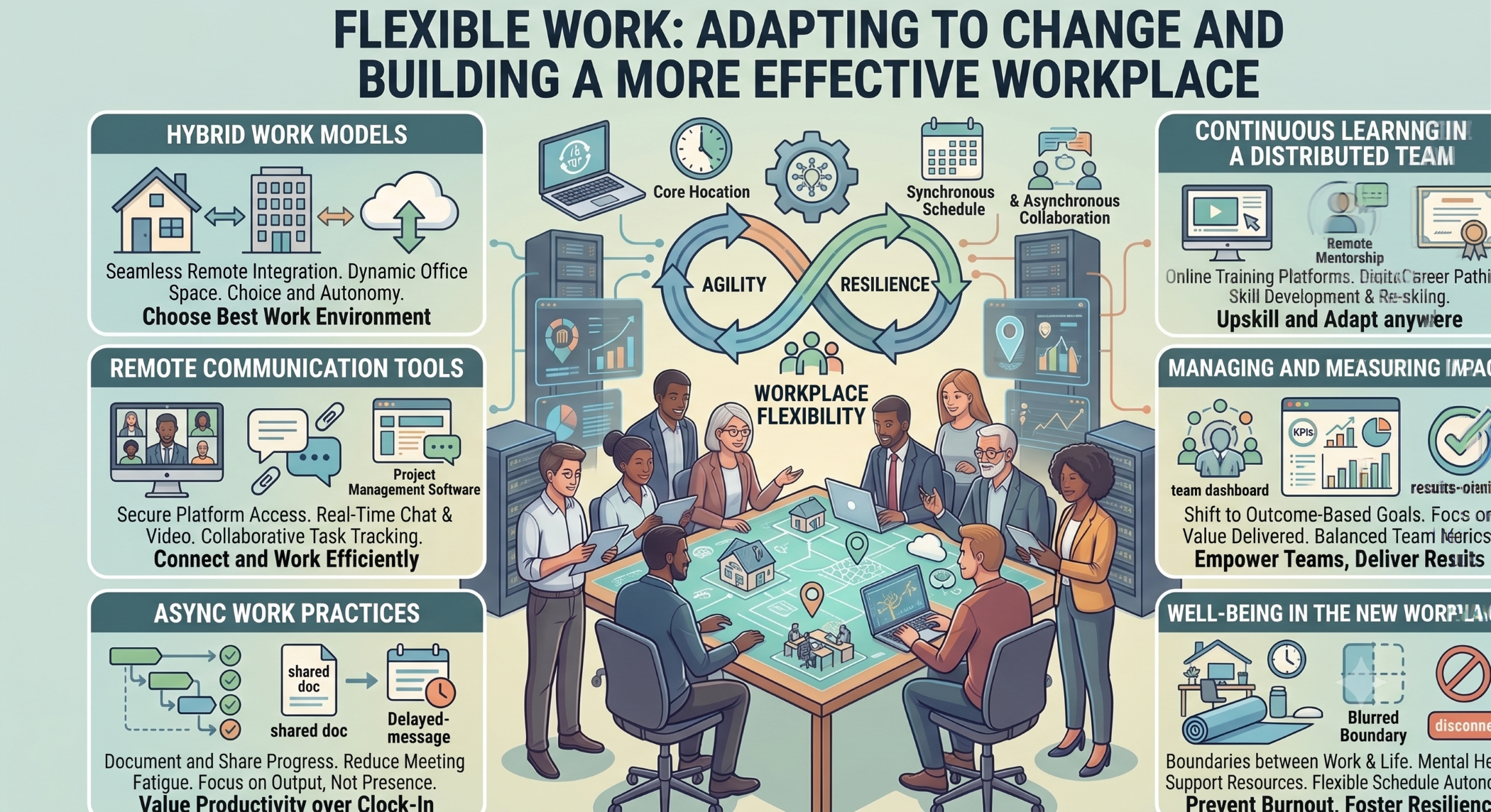
Remote and Hybrid Work
Remote work allows employees to perform their responsibilities from outside the traditional office.
Hybrid work combines office-based and remote working.
Both approaches require clear communication and well-defined processes.
Teams need to understand when they should be available, how decisions are documented, where project information is stored, and how urgent issues are communicated.
A flexible workplace should not mean that information becomes harder to access.
Flexibility and Employee Trust
Flexibility works best when organizations trust employees to manage their responsibilities.
Trust does not mean removing accountability.
Employees should still be expected to meet commitments, communicate progress, and deliver work at the required standard.
When expectations are clear, managers can focus more on outcomes rather than continuously monitoring how employees spend every minute of their day.
Flexibility and Accountability
Flexibility and accountability should operate together.
For example, an employee may have flexibility in when they complete a task, but the expected result and deadline remain clear.
This approach shifts attention from physical presence to meaningful outcomes.
A strong flexible-work culture therefore defines:
What needs to be delivered
Who owns it
When it is expected
How progress will be communicated
What quality standard is required
These elements provide structure while still allowing reasonable flexibility.
Flexibility and Collaboration
Collaboration can become more challenging when teams work across locations.
Organizations need deliberate communication practices to compensate.
Shared documentation, project-management tools, regular team meetings, clear status updates, and well-defined workflows can help teams remain aligned.
Not every discussion needs a meeting. Important decisions should also be documented so that people working at different times or locations can access the relevant information.
Flexibility Across Time Zones
Technology companies often work with international clients and distributed teams.
Different time zones can create challenges, but flexibility can also make global collaboration easier.
Teams can establish overlapping working hours for important discussions while allowing individuals to complete focused work outside those periods.
Clear documentation becomes especially important because not everyone will be online at the same time.
Flexible Schedules
Flexible schedules allow employees to adjust their working hours within agreed boundaries.
For example, an organization may define core collaboration hours while allowing employees greater freedom before or after that period.
This can be useful when employees need to manage personal responsibilities or when teams support customers across different regions.
The arrangement should still ensure that business-critical responsibilities are covered.
Flexibility and Customer Service
Flexibility can benefit organizations serving customers across different regions.
A distributed team can provide broader coverage across time zones, allowing customer issues to be addressed without requiring every employee to work the same schedule.
However, customer-facing flexibility should be carefully planned.
Customers need to know when support is available and who is responsible for urgent issues.
Flexibility in Project Management
Project management requires balancing changing requirements with delivery commitments.
A flexible project team can adjust priorities when customer needs or business conditions change.
For example, if a critical issue appears in production, the team may temporarily reprioritize planned development work.
This flexibility should be managed through transparent communication so that stakeholders understand what changed and why.
Flexibility and Employee Development
Employees also benefit when organizations provide flexibility around learning and professional development.
A professional may need dedicated time to learn a new framework, develop leadership skills, or participate in training.
Organizations that recognize learning as part of professional growth can create opportunities for employees to improve their capabilities while continuing to meet business objectives.
Flexibility and Innovation
Innovation often requires experimentation.
Employees should have enough freedom to explore better approaches, test ideas, and question inefficient processes.
A rigid environment may discourage people from suggesting improvements.
Flexibility encourages employees to consider alternatives while maintaining appropriate controls around cost, security, quality, and business priorities.
Flexible Problem Solving
Unexpected problems rarely follow predefined procedures.
Flexible professionals are able to consider alternative approaches when the original plan does not work.
For example, a technical solution may become impractical because of a new dependency. Instead of stopping completely, the team can evaluate another architecture, revise the scope, or identify a temporary workaround.
Flexibility does not mean changing direction without reason. It means being prepared to change when evidence or circumstances justify it.
Benefits of Flexible Work
A well-designed flexible-work model can provide several advantages.
Adaptability: Teams can respond more easily to changing requirements and circumstances.
Employee autonomy: People can organize aspects of their work around clearly defined objectives.
Broader talent access: Organizations can work with professionals who may not live near a traditional office location.
Business continuity: Distributed working arrangements can help organizations continue operating when normal office access is disrupted.
Workforce engagement: Flexibility can provide employees with greater control over how they organize their responsibilities.
The actual benefits depend on the role, industry, management practices, and implementation of the flexible-work model.
Challenges of Flexible Work
Flexibility also introduces challenges.
Communication can become fragmented if teams do not establish clear channels.
Employees may feel isolated without sufficient interaction.
Managers may struggle if expectations and performance measures are unclear.
Meetings can increase when teams attempt to compensate for reduced face-to-face interaction.
Security can also require additional attention when employees access business systems from different locations and devices.
These challenges can be addressed through clear processes, appropriate technology, security controls, and consistent communication.
Flexible Work and Security
Distributed work requires organizations to consider how employees access applications and data.
Security practices can include strong authentication, appropriate access controls, secure devices, encrypted communication, regular updates, endpoint protection, and monitoring.
Employees should also understand basic security practices such as protecting credentials, avoiding suspicious links, and using approved systems for business information.
Flexibility should never mean compromising security.
Flexible Leadership
Flexible workplaces require managers to adapt their leadership style.
Managers should focus on clarity, communication, support, and results.
Instead of measuring performance primarily through visibility or hours spent in an office, managers can establish measurable objectives and regularly review outcomes.
At the same time, managers need to recognize when employees require additional support, clarification, or coordination.
Flexibility and Company Culture
A flexible workplace needs a culture built around trust, accountability, and communication.
Policies alone cannot create this culture.
Employees should understand what flexibility means in practice, what responsibilities remain fixed, and how exceptions are handled.
Consistency is also important. Flexibility should be applied fairly and according to role requirements.
How to Build an Effective Flexible Workplace
Organizations can start by defining clear expectations.
Determine which activities require synchronous collaboration and which can be completed independently.
Establish communication channels for routine discussions and urgent issues.
Document important decisions and project information.
Set measurable goals and deadlines.
Provide employees with the tools needed to work securely and effectively.
Review the arrangement regularly and make adjustments based on business and employee needs.
Flexibility Does Not Mean Lower Standards
One important misconception is that flexible work means reducing expectations.
That should not be the objective.
A flexible workplace can still maintain strong standards for quality, productivity, communication, security, and customer service.
The difference is that employees may have more flexibility in how they achieve the agreed objectives.
The Future of Flexible Work
Technology continues to make distributed collaboration easier.
Cloud platforms, communication tools, project-management systems, virtual meetings, automation, and AI-assisted workflows can support teams working across locations.
At the same time, organizations continue to evaluate which responsibilities benefit from remote work, office collaboration, or a combination of both.
The future of work is therefore likely to remain adaptable rather than being limited to one universal model.
Conclusion
Flexibility is about adapting without losing accountability.
Modern organizations need the ability to respond to changing customer requirements, technologies, working environments, and business priorities.
When flexible work is supported by clear goals, strong communication, secure technology, effective collaboration, and measurable accountability, it can help organizations and employees operate more effectively.
The most successful flexible workplaces are not those with the fewest rules. They are those with enough structure to maintain performance while giving people appropriate freedom to work effectively.