Flutter Is Best For Enterprise Apps Development Is That True
Enterprise applications require scalability, security, maintainability, performance, and seamless integration with business systems. Over the past few years, Flutter has evolved from a mobile UI framework into a mature cross-platform development solution used by startups, mid-sized businesses, and large enterprises.
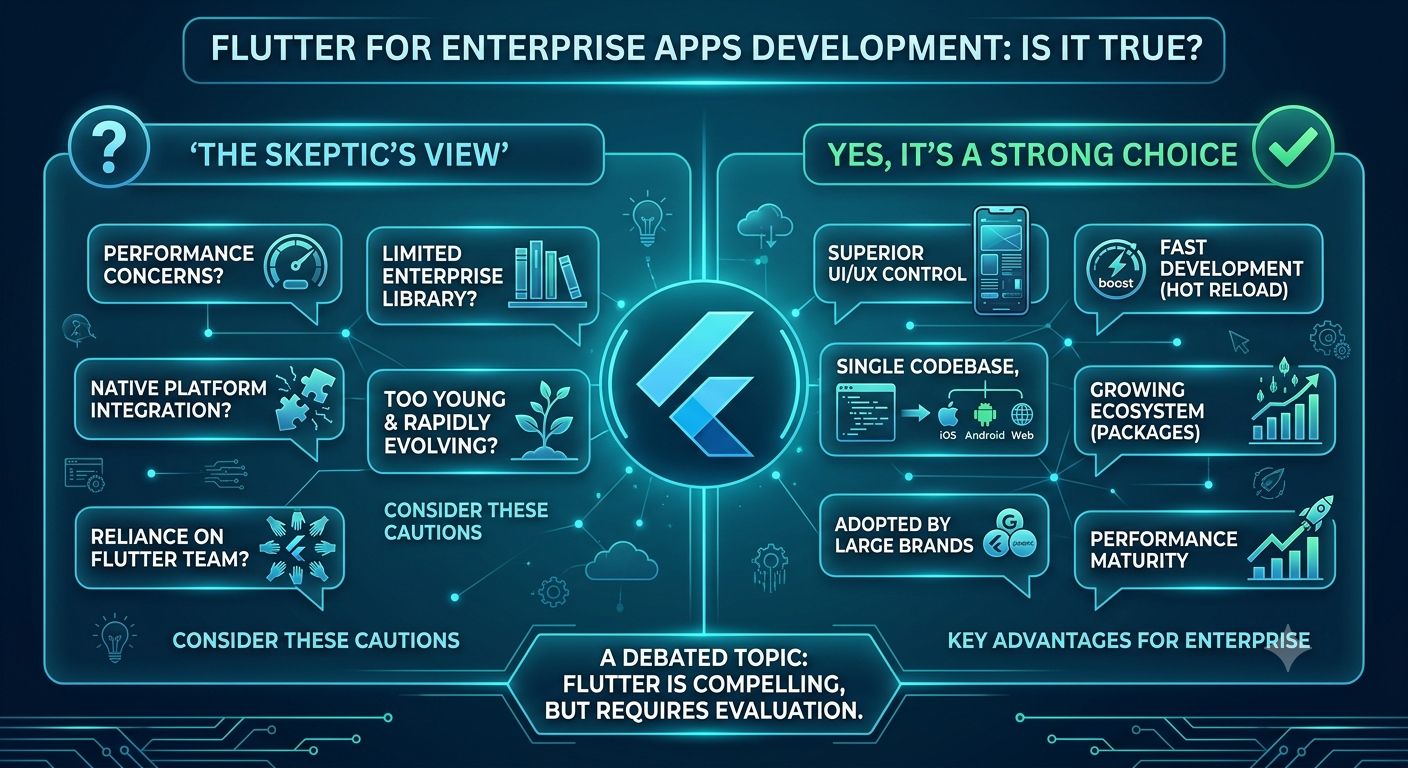
Many organizations are now using Flutter to build applications for Android, iOS, web, and desktop from a single codebase. This has led to a common question: Is Flutter truly the best choice for enterprise app development? The answer is often yes for many use cases—but not for every scenario.
What Is Flutter?
Flutter is Google's open-source UI framework that allows developers to build applications for multiple platforms using a single codebase.
Flutter supports:
Android applications
iOS applications
Web applications
Desktop applications
Its primary advantage is code sharing across platforms, helping organizations reduce development and maintenance efforts.
Why Enterprises Are Choosing Flutter
1. Single Codebase Across Platforms
One of Flutter's biggest advantages is the ability to maintain a single codebase for multiple platforms.
Benefits include:
Faster development
Reduced maintenance costs
Consistent functionality
Faster feature releases
Easier bug fixing
Instead of maintaining separate Android and iOS teams, businesses can often manage development with a unified team.
2. Faster Time To Market
Enterprise applications often operate under strict deadlines.
Flutter helps accelerate development through:
Hot Reload
Shared codebase
Rich widget library
Rapid prototyping
Faster testing cycles
This allows organizations to launch products and updates more quickly.
3. Consistent User Experience
Flutter uses its own rendering engine, allowing applications to maintain a consistent appearance across devices and platforms.
Benefits include:
Consistent UI behavior
Brand consistency
Predictable layouts
Smooth animations
Better design control
This can be particularly valuable for enterprise products that serve employees, partners, and customers across different devices.
4. Lower Development Costs
Developing separate applications for Android, iOS, web, and desktop can significantly increase costs.
Flutter helps reduce expenses through:
Shared business logic
Shared UI components
Shared testing efforts
Reduced maintenance overhead
For many enterprise projects, this can translate into substantial long-term savings.
5. Scalability For Enterprise Applications
Modern Flutter architectures support:
Clean Architecture
BLoC Pattern
Riverpod
Dependency Injection
Modular development
API-driven systems
These approaches help large applications remain maintainable as teams and requirements grow.
Enterprise Use Cases For Flutter
Flutter works particularly well for:
Business Management Applications
CRM systems
ERP dashboards
HR platforms
Inventory management
Internal enterprise tools
Customer-Facing Applications
Banking apps
eCommerce apps
Healthcare platforms
Travel applications
Subscription platforms
Field Service Applications
Logistics systems
Delivery tracking
Workforce management
Inspection apps
Offline-capable mobile solutions
SaaS Products
Many SaaS businesses use Flutter to provide a consistent experience across multiple platforms while minimizing development complexity.
Security Considerations
Enterprise applications often require strong security controls.
Flutter supports:
Biometric authentication
Secure storage
Encrypted communication
Role-based access
Multi-factor authentication
Enterprise identity integrations
However, security primarily depends on application architecture, backend design, infrastructure, and implementation practices rather than the framework alone.
When Flutter May Not Be The Best Choice
Despite its advantages, Flutter is not ideal for every enterprise project.
Highly Platform-Specific Applications
Native development may be preferable when applications rely heavily on:
Advanced AR/VR
Specialized hardware
Complex camera processing
Deep OS-level integrations
Immediate access to newly released platform features
Graphics-Intensive Applications
Certain gaming and high-performance graphical applications may benefit more from specialized native technologies.
Existing Native Teams
Organizations with large established Android and iOS teams may not always gain enough value from migrating to Flutter.
Flutter Vs Native Development
Area Flutter Native Development
Codebase Single Separate
Development Speed Faster Slower
Maintenance Easier More effort
Cost Lower Higher
UI Consistency Excellent Platform-specific
Performance Near-native Native
Platform Features Good Best
Time To Market Faster Slower
For most enterprise business applications, Flutter performance is often sufficient and provides significant productivity advantages.
Real Enterprise Adoption
Flutter is no longer limited to startups and prototypes.
Large organizations have used Flutter for production applications serving millions of users. Industry examples frequently cited include Google products and enterprise-scale applications from companies such as BMW and Alibaba.
This demonstrates that Flutter can support enterprise-grade workloads when implemented using appropriate architecture and engineering practices.
Best Practices For Enterprise Flutter Development
To build scalable enterprise applications with Flutter:
Use Clean Architecture.
Separate business logic from UI.
Implement proper state management.
Follow secure coding practices.
Automate testing.
Establish CI/CD pipelines.
Use modular code structures.
Monitor application performance.
Plan for scalability from the beginning.
Integrate with enterprise APIs and services using well-defined interfaces.
Conclusion
Flutter is not automatically the best solution for every enterprise application, but it is one of the strongest options available today for organizations that need cross-platform development, faster delivery, lower maintenance costs, and consistent user experiences.
For enterprise applications such as CRM systems, ERP platforms, SaaS products, logistics solutions, healthcare applications, and customer-facing business apps, Flutter often provides an excellent balance of performance, scalability, maintainability, and development efficiency. The best choice ultimately depends on the application's technical requirements, business goals, platform strategy, and long-term roadmap.