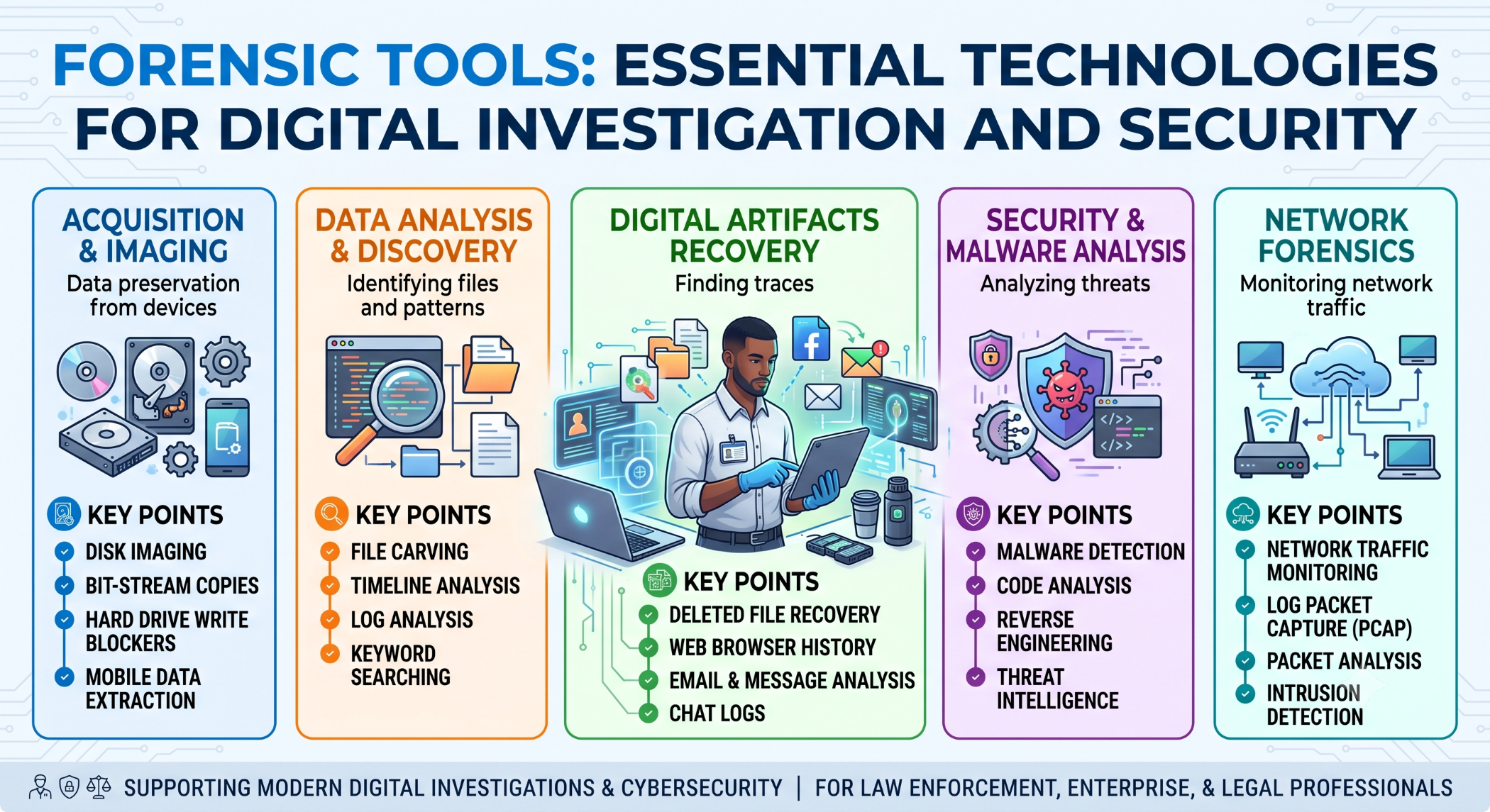
Forensic Tools: Essential Technologies for Digital Investigation and Security
As businesses increasingly depend on computers, mobile devices, cloud platforms, and digital communication, the amount of information involved in security investigations continues to grow. Forensic tools help cybersecurity professionals collect, preserve, analyze, and investigate digital evidence.
Digital forensics can be useful when investigating security incidents, unauthorized access, data theft, malware infections, and other technology-related incidents.
What Are Forensic Tools?
Forensic tools are software applications and technologies used to examine digital devices and data as part of an investigation.
They can help investigators work with:
Computer hard drives
Mobile devices
Network traffic
Memory
System logs
Deleted files
Email and application data
Cloud-based evidence
The appropriate tool depends on the type of evidence being investigated.
Why Are Forensic Tools Important?
Digital evidence can be difficult to analyze manually because modern systems generate large amounts of information.
Forensic tools can help investigators:
Identify suspicious activity.
Recover deleted or hidden information.
Analyze file systems.
Examine system artifacts.
Investigate malware behavior.
Review network activity.
Build timelines of events.
Automation and specialized analysis can significantly reduce the effort required to process large datasets.
Common Types of Forensic Tools
Disk and File System Analysis
These tools examine storage devices and file systems to identify existing, deleted, or modified information.
Investigators can use them to analyze file metadata, directory structures, deleted files, and other artifacts.
Memory Forensics
Memory-forensics tools analyze volatile data captured from system RAM.
This can help investigators identify running processes, network connections, loaded modules, and other information that may not be available from disk analysis alone.
Network Forensics
Network-forensics tools analyze captured network traffic and related records.
This can help identify suspicious connections, unusual traffic patterns, communication with external systems, and potential indicators of compromise.
Mobile Forensics
Mobile-forensics tools are designed to analyze smartphones and other mobile devices.
Depending on the device and acquisition method, investigators may examine application data, communications, media, system information, and other digital artifacts.
Popular Digital Forensics Tools
Some commonly recognized tools and platforms in digital forensics include:
Autopsy: An open-source digital forensics platform that provides a graphical interface for analyzing disk images and file-system evidence.
The Sleuth Kit: A collection of command-line tools and libraries used for forensic analysis of disk images and file systems.
Volatility: A memory-forensics framework used to analyze volatile memory captures.
Wireshark: A network protocol analyzer that can help investigators inspect captured network traffic.
The suitability of each tool depends on the investigation scope, evidence source, operating environment, and forensic requirements.
Digital Evidence Preservation
Forensic investigation is not simply about finding information. Evidence must also be handled carefully.
Investigators should maintain the integrity of evidence, document acquisition procedures, and ensure that analysis does not unnecessarily modify the original data.
Where investigations may have legal or regulatory implications, organizations should follow appropriate forensic procedures and maintain a clear chain of custody.
Forensics in Cybersecurity
Digital forensics is closely connected with incident response.
A typical investigation may follow this process:
Incident Detection
↓
Evidence Collection
↓
Evidence Preservation
↓
Analysis
↓
Timeline / Findings
↓
Incident Response
Combining forensic analysis with security monitoring can help organizations understand how an incident occurred and identify steps to prevent similar events.
Choosing the Right Forensic Tool
No single forensic tool can handle every investigation.
Consider:
Evidence type: Disk, memory, network, mobile, cloud, or application data.
Operating system: Different tools support different platforms and file systems.
Investigation goals: Recovery, malware analysis, timeline reconstruction, incident response, or another objective.
Evidence integrity: The tool should support appropriate acquisition and analysis procedures.
Reporting: Investigation results should be documented clearly and reproducibly.
Forensic Tools and Business Security
Businesses can use digital forensics as part of a broader cybersecurity strategy. When an incident occurs, forensic analysis can help determine what happened, which systems were affected, and what evidence remains available.
For organizations handling sensitive customer or business data, having a defined incident-response and evidence-handling process is particularly important.
Best Practices
Use trusted forensic tools, preserve original evidence, document every investigation step, and perform analysis on forensic copies rather than unnecessarily modifying source evidence.
Organizations should also define incident-response procedures before an incident occurs and ensure that security teams understand how evidence should be collected and preserved.
Conclusion
Forensic tools provide cybersecurity professionals with valuable capabilities for collecting, analyzing, and interpreting digital evidence.
From disk and memory analysis to network and mobile investigations, the right tools can help organizations understand security incidents and respond more effectively.
Digital forensics is most effective when combined with sound evidence-preservation practices, documented procedures, and a broader cybersecurity and incident-response strategy.