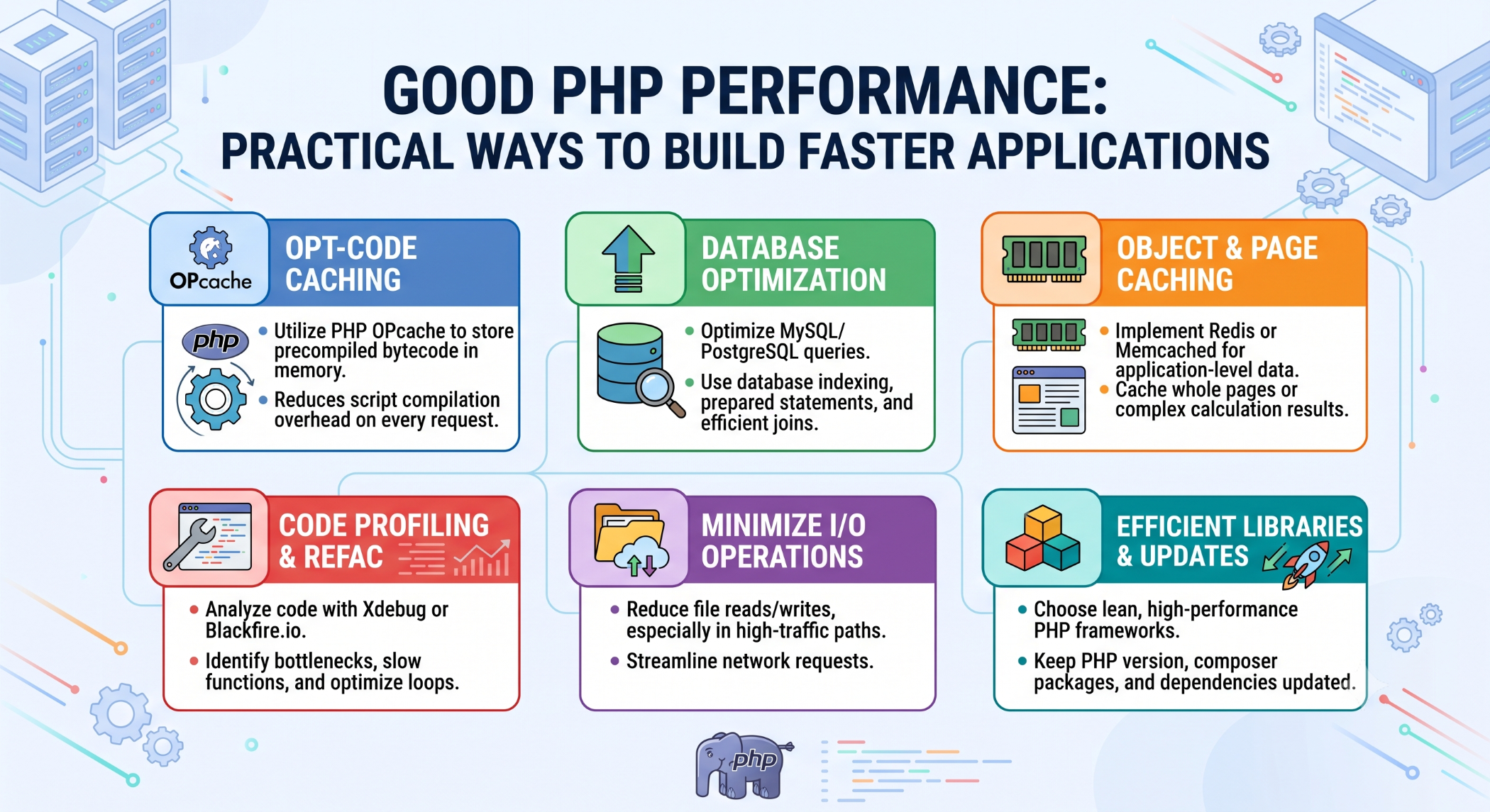
Good PHP Performance: Practical Ways to Build Faster Applications
PHP is widely used for websites, APIs, and business applications. As traffic and application complexity increase, performance becomes increasingly important.
Good PHP performance comes from a combination of efficient code, optimized database operations, caching, and appropriate server configuration.
Write Efficient Code
Avoid unnecessary calculations, repeated function calls, and inefficient loops.
Keep application logic simple and reuse results when the same operation is required multiple times. Clean and well-structured code is also easier to profile and optimize.
Optimize Database Queries
Database performance can have a major impact on a PHP application's response time.
Avoid unnecessary queries and retrieve only the data required by the application.
SELECT id, name, email
FROM users
WHERE status = 'active';
Use appropriate indexes and analyze slow queries to identify database bottlenecks.
Use Caching
Caching can reduce repeated processing and database requests.
Depending on the application, caching can be implemented for:
- Database results
- API responses
- Frequently accessed content
- Application data
Caching should be designed carefully so frequently changing data remains accurate.
Optimize PHP Configuration
PHP performance is also influenced by the server environment and PHP configuration.
Keep PHP updated, configure appropriate memory and execution limits, and monitor CPU and memory usage.
For production applications, use a suitable PHP runtime configuration rather than development settings.
Optimize Assets
For web applications, PHP is only one part of the overall performance picture.
Optimize images, CSS, JavaScript, and other static assets. A CDN can also help deliver static content more efficiently to users in different locations.
Profile Before Optimizing
Do not assume where the bottleneck is.
Use application profiling, server monitoring, database analysis, and performance testing to identify the operations that consume the most resources.
Make targeted changes and measure the result.
Best Practices
Keep PHP code clean, minimize unnecessary database requests, use caching appropriately, optimize server configuration, and monitor application performance regularly.
Always test performance improvements under realistic workloads before applying major changes to production.
Conclusion
Good PHP performance is achieved through multiple layers of optimization rather than one configuration change.
By combining efficient PHP code, optimized database queries, caching, proper server configuration, and continuous monitoring, developers can build applications that remain fast and reliable as usage increases.