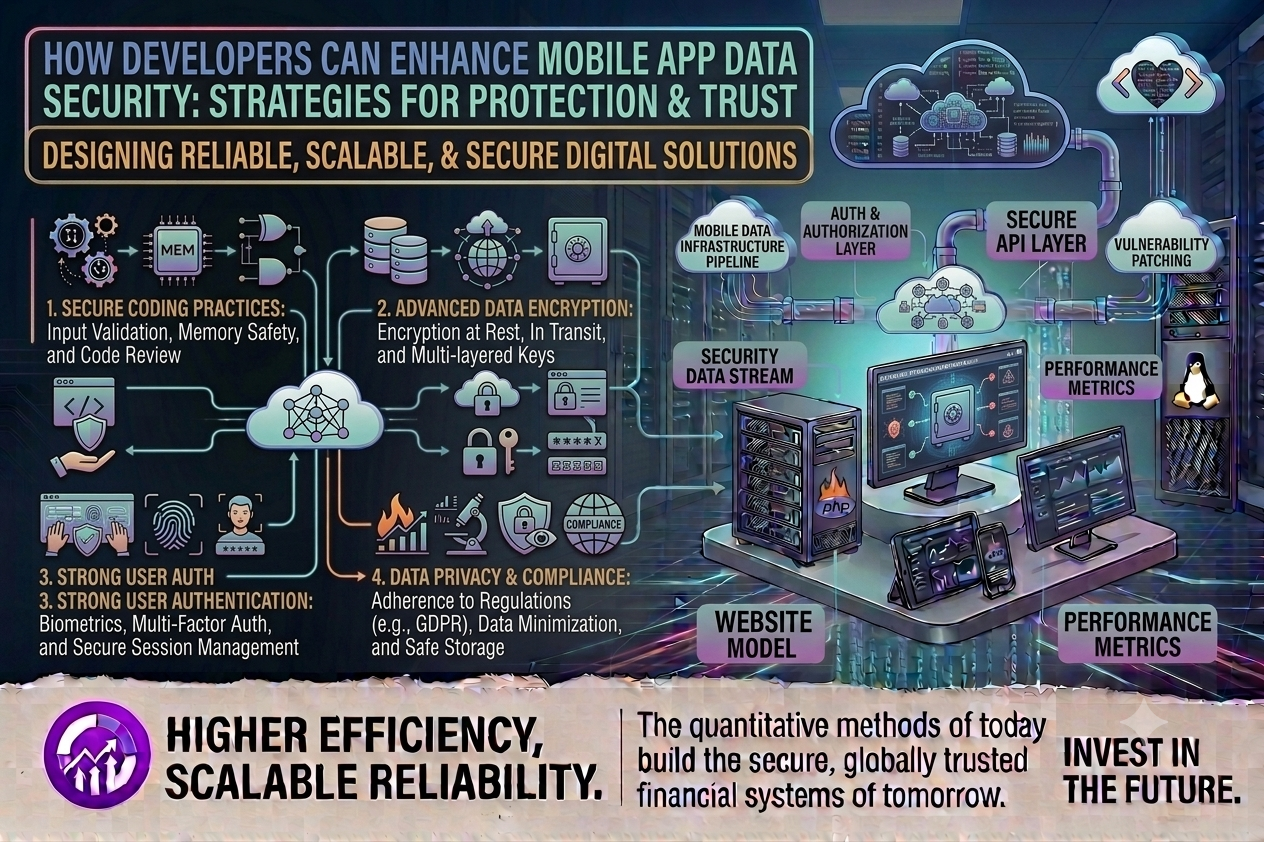
How Developers Can Enhance Mobile Apps Data Security
Mobile applications handle vast amounts of sensitive information, including personal details, financial records, location data, healthcare information, and business-critical data. As mobile usage continues to grow, protecting this information has become a major responsibility for developers and organizations.
A security breach can result in financial losses, reputational damage, legal consequences, and loss of customer trust. Therefore, implementing strong mobile app security measures throughout the development lifecycle is essential.
Why Mobile App Data Security Matters
Modern mobile applications often store and transmit sensitive information between devices, cloud platforms, APIs, and backend systems.
Without proper security controls, applications may become vulnerable to:
Unauthorized access
Data breaches
Malware attacks
API exploitation
Credential theft
Data tampering
Session hijacking
Reverse engineering
A proactive security approach helps reduce risks and improves user confidence in the application.
1. Implement Strong User Authentication
Authentication is one of the first layers of defense for mobile applications.
Developers should consider implementing:
Strong password policies
Multi-factor authentication (MFA)
Biometric authentication
Secure login workflows
Session management controls
Authentication mechanisms should be designed to verify user identity while maintaining a convenient user experience.
2. Encrypt Sensitive Data
Encryption helps protect data from unauthorized access during storage and transmission.
Important areas to encrypt include:
User credentials
Personal information
Financial data
Authentication tokens
Application data
Communication between systems
Developers should use modern encryption standards and avoid storing sensitive information in plain text.
3. Secure Data in Transit
Mobile applications frequently communicate with APIs, cloud services, and backend systems.
To secure data during transmission:
Use HTTPS connections
Enforce TLS encryption
Validate SSL certificates
Protect API communication
Prevent insecure network connections
Encrypted communication channels reduce the risk of interception and data exposure.
4. Use Secure Local Storage
Mobile devices may store application data locally for performance and offline functionality.
Developers should avoid storing sensitive information in:
Plain text files
Unsecured databases
Shared storage locations
Instead, use platform-provided secure storage mechanisms and encrypt sensitive data when necessary.
5. Protect APIs and Backend Services
APIs are often targeted because they provide access to application functionality and business data.
Developers should implement:
Authentication tokens
Authorization controls
API rate limiting
Input validation
Secure API gateways
Access monitoring
Every API endpoint should be designed with security considerations from the beginning.
6. Validate User Input
Input validation helps prevent common attacks that exploit application vulnerabilities.
Developers should validate:
Form submissions
Search inputs
File uploads
API requests
User-generated content
Proper validation can reduce risks associated with malicious input and unexpected application behavior.
7. Implement Role-Based Access Control
Not every user should have access to the same information or functionality.
Role-based access control allows organizations to define permissions based on user responsibilities.
Examples include:
Administrators
Managers
Employees
Customers
Support staff
Restricting access to only what is necessary helps minimize security risks.
8. Secure Authentication Tokens
Many mobile applications use tokens for user authentication and session management.
Developers should:
Use secure token generation
Set expiration periods
Refresh tokens appropriately
Protect tokens from unauthorized access
Store tokens securely
Poor token management can expose applications to unauthorized access.
9. Prevent Reverse Engineering
Attackers may attempt to analyze application code to identify vulnerabilities or extract sensitive information.
To reduce risks, developers can:
Obfuscate code
Remove debugging information
Protect API keys
Minimize hardcoded credentials
Monitor application integrity
While no application can be made completely resistant to reverse engineering, these measures can increase protection.
10. Keep Dependencies Updated
Mobile applications often rely on third-party libraries and frameworks.
Outdated dependencies may contain known security vulnerabilities.
Development teams should:
Monitor security advisories
Update libraries regularly
Remove unused dependencies
Evaluate third-party components
Dependency management should be part of ongoing application maintenance.
11. Perform Regular Security Testing
Security testing helps identify vulnerabilities before attackers do.
Testing approaches may include:
Vulnerability assessments
Penetration testing
Static code analysis
Dynamic application testing
API security testing
Security audits
Regular testing improves visibility into security risks and remediation priorities.
12. Minimize Data Collection
Applications should only collect information that is necessary for business operations and user functionality.
Benefits include:
Reduced security risk
Improved privacy compliance
Lower storage requirements
Better user trust
Collecting excessive data can increase both security and compliance responsibilities.
13. Monitor Security Events
Security monitoring allows organizations to identify unusual activity and respond quickly.
Monitoring may include:
Login attempts
Failed authentication events
API usage patterns
Suspicious user behavior
Unauthorized access attempts
Early detection can help reduce the impact of security incidents.
14. Follow Compliance Requirements
Depending on the industry, applications may need to comply with specific regulations and standards.
Examples include:
GDPR
HIPAA
PCI DSS
SOC-related security requirements
Regional data protection regulations
Compliance requirements should be considered during architecture, development, deployment, and maintenance.
Best Practices for Mobile App Security
Successful mobile app security strategies often include:
Security-first development practices.
Secure coding standards.
Data encryption.
Strong authentication mechanisms.
API protection.
Access control policies.
Security testing.
Monitoring and incident response.
Dependency management.
Ongoing security updates.
Security should be treated as a continuous process rather than a one-time implementation.
Conclusion
Mobile app security plays a critical role in protecting user data, business information, and application integrity. Developers can significantly enhance security through strong authentication, encryption, secure API design, access control, input validation, dependency management, and regular security testing.
By incorporating security into every stage of the development lifecycle, organizations can build mobile applications that provide better protection against evolving cyber threats while maintaining user trust and regulatory compliance.