innodb_log_buffer_size in MySQL
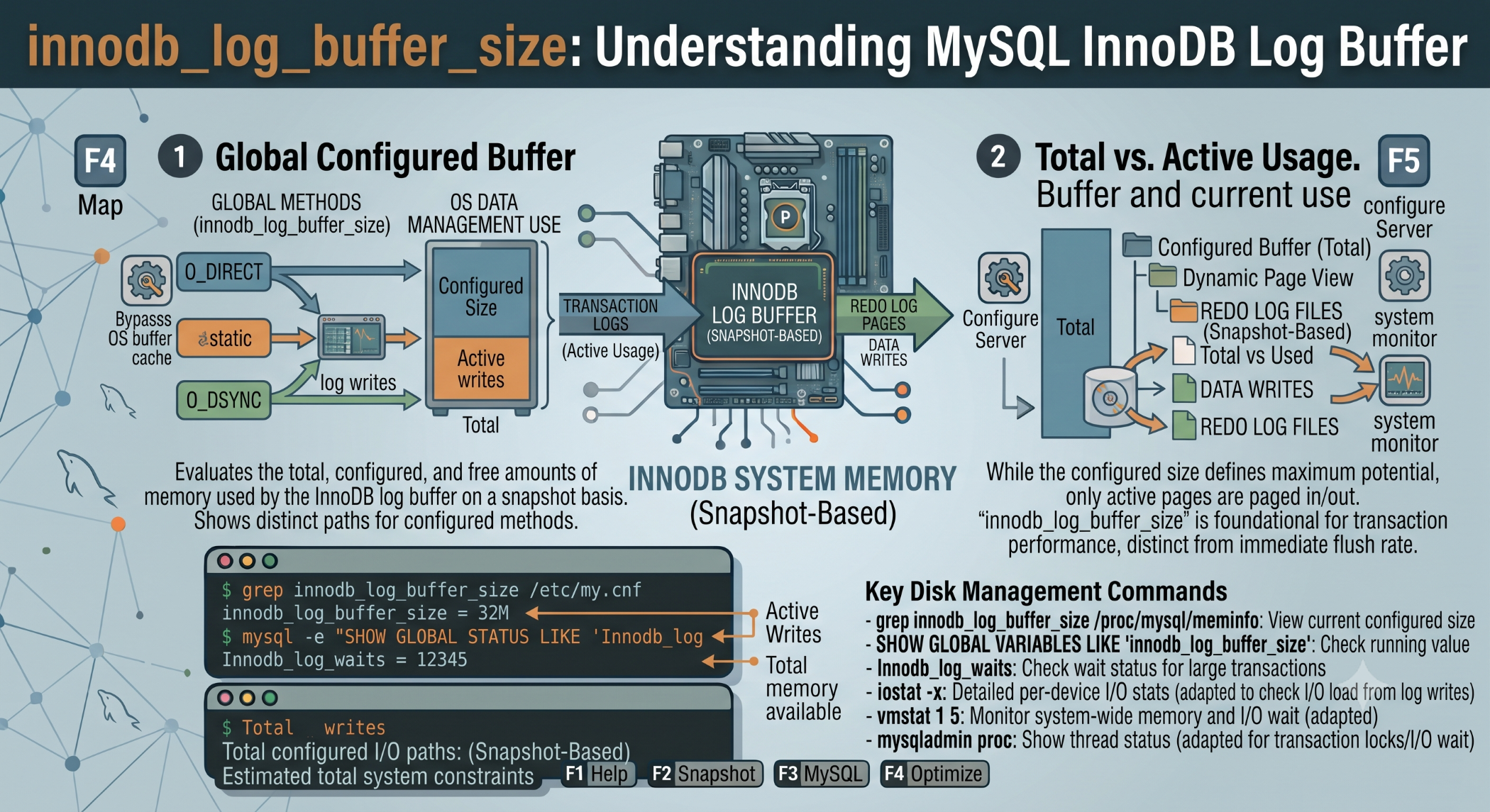
MySQL's InnoDB storage engine uses a log buffer to temporarily hold redo log information before it is written to log files on disk. The innodb_log_buffer_size variable controls the size of this memory area. (dev.mysql.com)
This setting can be particularly important for applications that perform large transactions or frequent write operations.
What Is innodb_log_buffer_size?
You can check the current value using:
SHOW VARIABLES LIKE 'innodb_log_buffer_size';The value is measured in bytes. MySQL 8.4 documents a default of 64 MB, while defaults can differ across MySQL versions. (dev.mysql.com)
Why Is the Log Buffer Important?
A transaction that performs many INSERT, UPDATE, or DELETE operations may generate a large amount of redo log data.
A sufficiently large log buffer allows more of that data to remain in memory before it needs to be written to disk. This can reduce disk I/O for large transactions. (dev.mysql.com)
When Should You Increase It?
Increasing the log buffer may be useful when your application frequently performs large transactions.
For example, a bulk data import or large batch update may generate substantial redo log activity.
However, simply increasing the value does not automatically make every MySQL workload faster. The setting should be adjusted based on actual workload and performance measurements.
Configure the Log Buffer
The setting can be configured in the MySQL configuration file:
[mysqld]
innodb_log_buffer_size=64M
Modern MySQL versions also allow this variable to be changed dynamically. (dev.mysql.com)
Log Buffer vs Buffer Pool
These two settings serve different purposes.
innodb_buffer_pool_size controls memory used to cache InnoDB table and index data.
innodb_log_buffer_size controls memory used for redo log data before it is written to disk.
Both are important, but increasing one does not replace the need to configure the other appropriately.
Best Practices
Do not allocate excessive memory to the log buffer without a clear reason. Monitor your workload and database behavior first, especially when large transactions are involved.
MySQL also provides the Innodb_log_waits status metric, which can help identify situations where the log buffer was too small and transactions had to wait for available space. (dev.mysql.com)
Conclusion
innodb_log_buffer_size is an important MySQL InnoDB configuration setting for write-heavy workloads and large transactions. A larger log buffer can reduce unnecessary disk I/O when transactions generate substantial redo log data.
The best value depends on your transaction size, workload, available memory, and performance requirements. Measure the workload before making changes rather than increasing the setting blindly.