Instant Messaging: Building Real-Time Communication Applications
Instant messaging has become an important part of modern digital communication. Businesses and consumers use messaging applications to exchange text, files, images, notifications, and other information in real time.
Building a reliable instant messaging application requires more than creating a chat interface. The system needs real-time communication, secure authentication, message storage, notifications, scalability, and reliable delivery.
What Is Instant Messaging?
Instant messaging allows users to exchange messages with minimal delay through an internet-connected application.
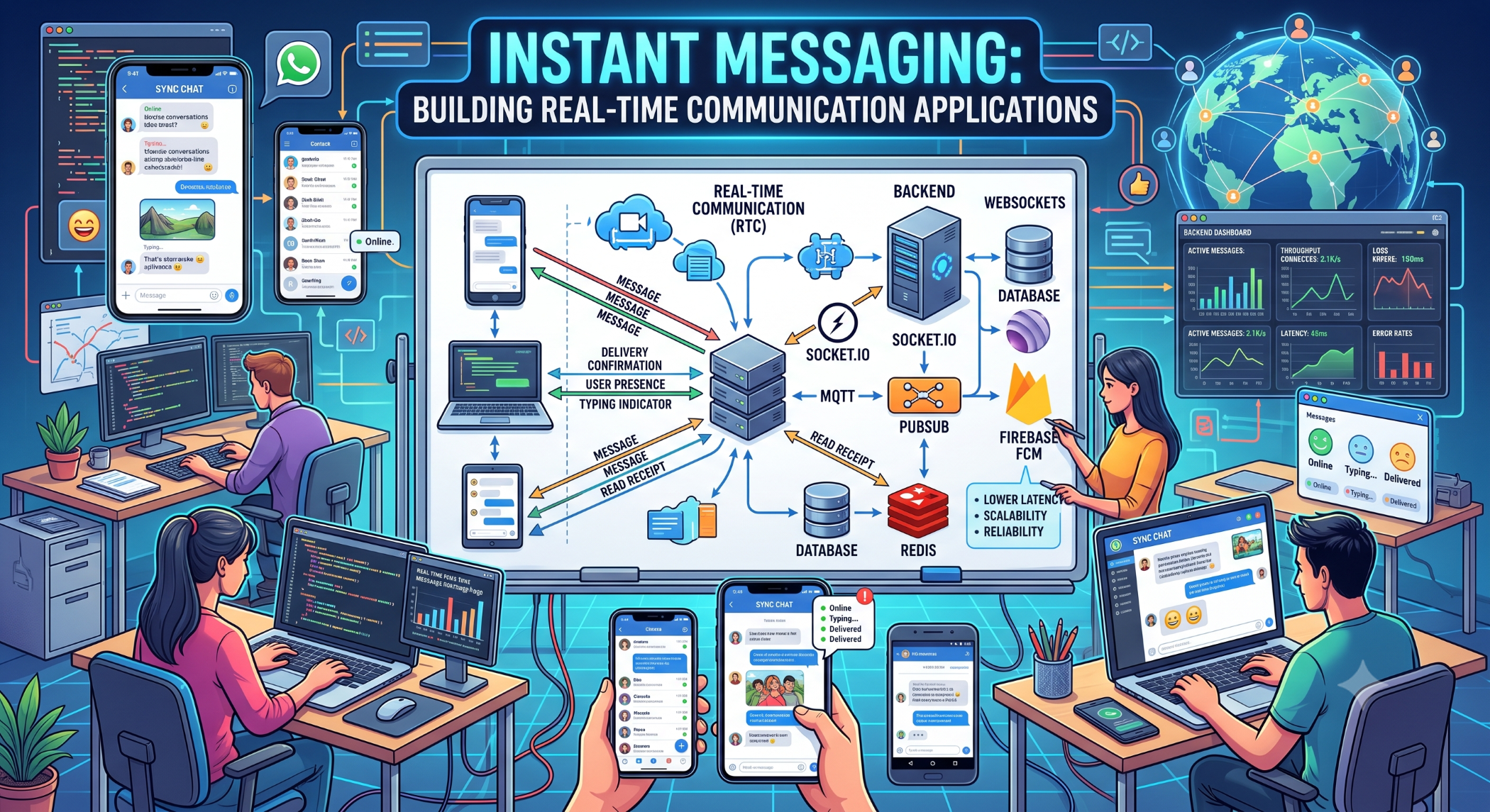
A typical messaging system includes:
User
↓
Mobile / Web Application
↓
Real-Time Communication Layer
↓
Backend Server
↓
Database / Storage
The backend manages users, conversations, messages, permissions, and other application functionality.
Key Features of Instant Messaging Applications
A messaging application can include many different features depending on the business requirements.
One-to-One Messaging
Users can communicate privately with another user through a dedicated conversation.
Group Chat
Multiple users can participate in a shared conversation.
Media and File Sharing
Modern messaging applications may support images, documents, videos, voice messages, and other files.
Notifications
Push notifications can alert users when they receive new messages while the application is running in the background.
Read and Delivery Status
Applications can provide indicators showing whether messages have been sent, delivered, or read.
User Presence
Some applications show whether users are online, offline, typing, or recently active.
Real-Time Communication
The most important technical requirement for instant messaging is the ability to deliver messages without requiring users to repeatedly refresh the application.
Technologies such as WebSockets can provide persistent two-way communication between the client and server.
A simplified flow looks like:
Sender
↓
WebSocket / Real-Time Connection
↓
Messaging Server
↓
Recipient
The exact architecture depends on the application's scale and requirements.
Mobile Push Notifications
Users may not keep a messaging application open continuously.
Push notification services can notify users when a new message arrives.
For example, Firebase Cloud Messaging can be integrated into supported Android, iOS, and web applications to deliver notifications.
Notifications should be designed carefully so they remain useful and respect user preferences.
Database and Message Storage
Messaging applications need reliable storage for conversations and messages.
Depending on the requirements, developers may use relational or NoSQL databases.
The data model may need to support:
Users
Conversations
Participants
Messages
Attachments
Delivery status
Read status
Timestamps
The database should be designed to support efficient retrieval as the number of conversations and messages increases.
Security in Instant Messaging
Security is critical because messaging applications can contain private or sensitive information.
Important security considerations include:
Secure authentication
Authorization
HTTPS/TLS
Access controls
Secure file storage
Input validation
Rate limiting
Secure session management
Applications should ensure that users can access only conversations and resources they are authorized to view.
End-to-End Encryption
Some messaging applications require end-to-end encryption so that only intended participants can decrypt message contents.
Implementing true end-to-end encryption is significantly more complex than simply encrypting communication between the application and server.
If strong privacy requirements exist, encryption architecture should be designed carefully from the beginning.
Scaling an Instant Messaging Application
As the number of users increases, a single messaging server may become a limitation.
A scalable architecture may include:
Users
↓
Load Balancer
↓
Multiple Messaging Servers
↓
Message Broker / Real-Time Layer
↓
Database + Cache + Storage
Technologies such as message queues, distributed caches, and horizontally scalable infrastructure can help support larger workloads.
Instant Messaging for Business
Businesses can use messaging applications for:
Customer support
Team communication
Sales conversations
Service coordination
Appointment communication
Notifications
Collaboration
For example, a customer-support platform can connect customers with support representatives and automatically route conversations to the appropriate team.
Instant Messaging at Solace Infotech
Solace Infotech can combine capabilities across web development, mobile application development, APIs, cloud infrastructure, real-time communication, databases, and push notifications to build customized messaging solutions.
The technology stack should be selected according to requirements such as expected user volume, message frequency, security needs, platform support, file sharing, and real-time performance.
Best Practices
Start with a clear communication model and determine whether the application requires one-to-one messaging, group conversations, media sharing, or advanced collaboration features.
Use secure authentication, protect message and file data, design the database for efficient message retrieval, and test the system under realistic concurrent-user loads.
Monitoring should also cover message delivery, server performance, connection health, and notification failures.
Conclusion
Instant messaging applications combine real-time communication, backend services, databases, notifications, security, and scalable infrastructure.
Whether the requirement is a customer-support chat, internal collaboration platform, or full-featured messaging product, the architecture should be designed around reliability, security, performance, and expected user growth.
A well-designed messaging solution can provide businesses with a fast and convenient way to connect people and deliver information in real time.