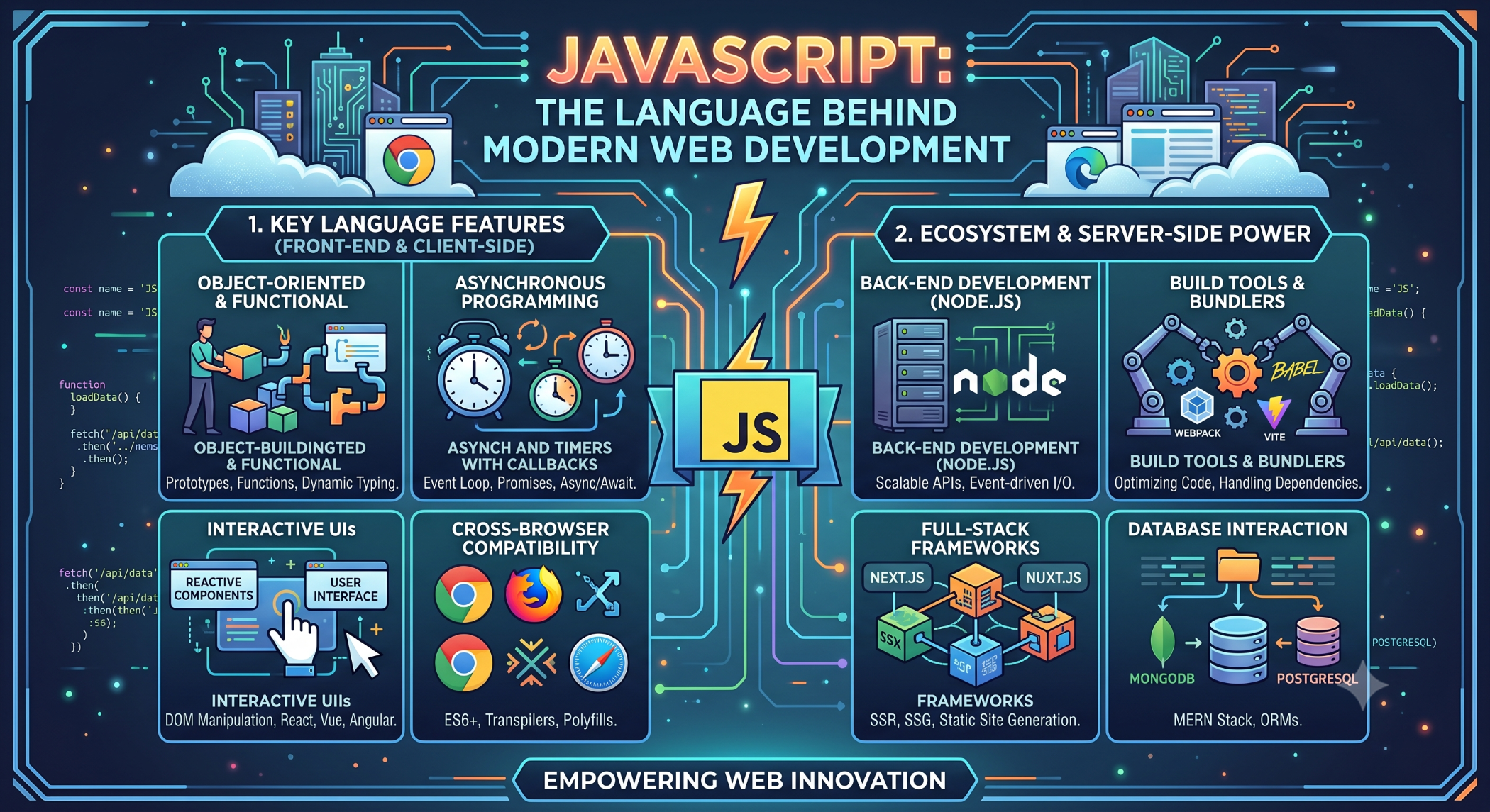
JavaScript is a core technology for building interactive and dynamic web applications. Learn how JavaScript works, its key features, common use cases, and how it supports modern frontend, backend, and mobile development.
Content
JavaScript: The Language Behind Modern Web Development
Modern websites are expected to do much more than display static information. Users interact with forms, menus, dashboards, shopping carts, notifications, and real-time features every day.
JavaScript is one of the core technologies that makes these interactive experiences possible. It runs in web browsers and can also be used on servers and in other application environments.
What Is JavaScript?
JavaScript is a programming language widely used to add behavior and interactivity to web applications.
A simple example is:
const message = "Hello World";
console.log(message);
JavaScript can respond to user actions, modify webpage content, communicate with backend services, and control application behavior.
JavaScript and HTML
HTML defines the structure of a webpage, while JavaScript can add dynamic behavior.
For example:
<button id="save">Save</button>
JavaScript can respond when the button is clicked:
document.getElementById("save").addEventListener("click", function () {
alert("Saved successfully");
});
This allows developers to create interactive interfaces.
JavaScript and CSS
JavaScript can also work with CSS to change the appearance or state of elements dynamically.
For example:
document.querySelector(".menu").classList.add("active");
This can be used for menus, modals, tabs, dropdowns, validation messages, and many other interface components.
Key Features of JavaScript
Dynamic Web Interfaces
JavaScript allows webpages to respond immediately to user actions without requiring a complete page reload.
Asynchronous Communication
JavaScript can communicate with backend services using technologies such as fetch() and other HTTP APIs.
fetch("/api/products")
.then(response => response.json())
.then(data => console.log(data));
This is commonly used for loading or submitting data asynchronously.
Event Handling
JavaScript provides event mechanisms for responding to actions such as clicks, keyboard input, form submissions, and other browser events.
Object-Oriented and Functional Programming
JavaScript supports multiple programming styles, including object-oriented, functional, and event-driven programming.
This flexibility makes it suitable for applications ranging from simple websites to large-scale software systems.
JavaScript for Frontend Development
JavaScript is a foundation for many modern frontend frameworks and libraries.
Common technologies include:
React
Angular
Vue
These tools provide structures for building large and interactive frontend applications.
JavaScript for Backend Development
JavaScript is not limited to browsers.
With Node.js, JavaScript can also be used for server-side development.
A typical backend can handle:
APIs
Authentication
Database operations
Business logic
Real-time communication
Background processing
This allows organizations to use JavaScript across different layers of an application.
JavaScript and APIs
Modern applications frequently communicate through APIs.
For example:
const response = await fetch("/api/users");
const users = await response.json();
The frontend can retrieve information from the backend and update the interface without reloading the entire page.
APIs also allow web applications to integrate with third-party services such as payment gateways, analytics platforms, communication systems, and business software.
JavaScript for Real-Time Applications
JavaScript can be used with technologies such as WebSockets to build real-time functionality.
Common examples include:
Instant messaging
Live dashboards
Delivery tracking
Collaborative applications
Real-time notifications
The architecture should be designed carefully when large numbers of users need simultaneous connections.
JavaScript in Mobile Development
JavaScript and related technologies can also support mobile application development.
Frameworks such as React Native allow development teams to create mobile applications using JavaScript and React concepts while targeting supported mobile platforms.
The best approach depends on the application's performance, platform-specific requirements, and device capabilities.
JavaScript Performance
As applications become more complex, JavaScript performance becomes increasingly important.
Developers should avoid unnecessary calculations, excessive DOM operations, large client-side payloads, and inefficient event handling.
Code splitting, lazy loading, caching, asset optimization, and appropriate rendering strategies can also improve application performance.
JavaScript Security
JavaScript applications must handle user input and external data carefully.
Important security practices include:
Validate untrusted input.
Encode output for its context.
Protect authentication and sessions.
Secure API endpoints.
Avoid unsafe DOM operations.
Keep dependencies updated.
Client-side validation should never be considered a replacement for server-side validation and authorization.
JavaScript vs TypeScript
TypeScript extends JavaScript with static typing and additional development features.
For example:
function add(a: number, b: number): number {
return a + b;
}
TypeScript can be especially useful for large applications where maintainability, team collaboration, and compile-time type checking are important.
JavaScript remains the runtime language after TypeScript is compiled.
JavaScript at Solace Infotech
JavaScript is a core technology across Solace Infotech's modern application development capabilities, including Angular, React, Node.js, AJAX, real-time applications, mobile development, and API-driven solutions.
The appropriate JavaScript technology stack should be selected according to project requirements, application complexity, platform targets, performance expectations, and long-term maintenance needs.
Best Practices
Use modern JavaScript features supported by your target environment, keep modules focused, handle asynchronous operations carefully, and avoid unnecessary client-side processing.
Use linting, testing, dependency management, and performance monitoring as part of the development lifecycle. For larger projects, TypeScript can also provide stronger compile-time checks and clearer contracts.
Conclusion
JavaScript is a fundamental technology for modern software development. It enables interactive web interfaces, API communication, real-time features, server-side applications, and cross-platform solutions.
Its flexibility and broad ecosystem make it suitable for projects ranging from simple websites to complex enterprise applications.
A strong JavaScript implementation combines clean architecture, efficient code, secure development practices, appropriate frameworks, and continuous performance improvement.