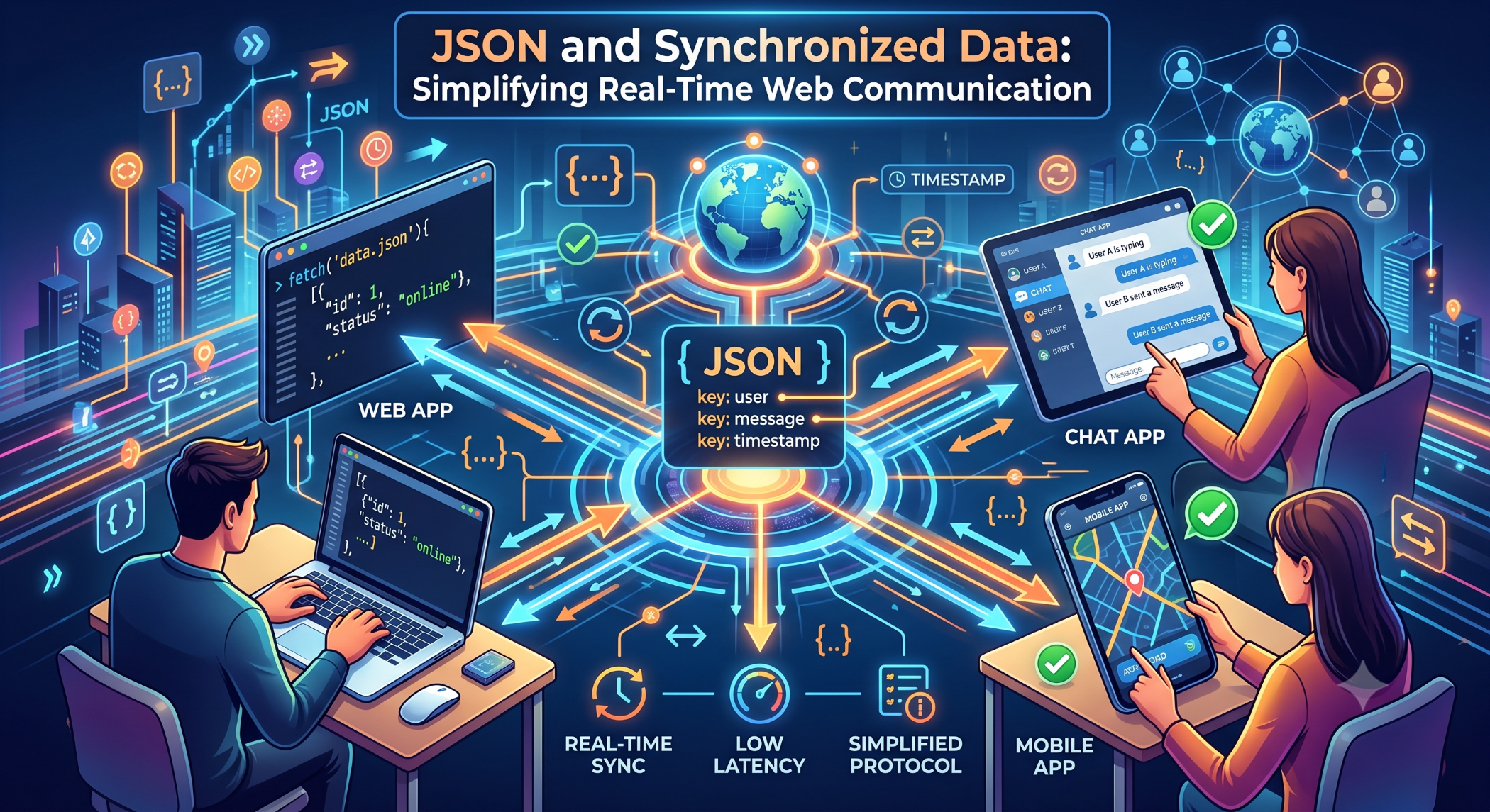
JSON and Synchronized Data: Simplifying Real-Time Web Communication
Modern web and mobile applications frequently need to exchange information between the frontend, backend, and multiple connected users. JSON (JavaScript Object Notation) provides a simple way to represent structured data, while synchronization techniques help keep that data updated across different parts of an application.
Together, JSON and data synchronization can support responsive and interactive digital experiences.
What Is JSON?
JSON is a lightweight text-based format used to exchange structured data between applications.
A simple JSON object looks like:
{
"id": 101,
"name": "John",
"status": "active"
}
Because JSON is easy for applications and developers to process, it is widely used in APIs and web application communication.
What Is Data Synchronization?
Data synchronization is the process of keeping information consistent between two or more systems, devices, or application components.
For example, when a user updates their profile on a mobile application, the updated information may need to be reflected in the backend database and other connected interfaces.
A simplified flow is:
User Update
↓
Application
↓
API / JSON
↓
Backend
↓
Database
↓
Synchronized Clients
JSON in API Communication
JSON is commonly used as the request and response format in APIs.
For example, a client can send:
{
"name": "John",
"email": "john@example.com"
}
The backend can validate the information, store it, and return a response in JSON format.
This makes communication between frontend applications, mobile apps, and backend services straightforward.
Real-Time Synchronization
Some applications need information to be updated immediately when changes occur.
Examples include:
Instant messaging
Live dashboards
Collaboration tools
Delivery tracking
Inventory systems
Notifications
Technologies such as WebSockets or other real-time communication mechanisms can be used to deliver updates without requiring the user to refresh the page.
JSON and JavaScript
JSON works naturally with JavaScript applications.
For example:
const data = JSON.parse(jsonResponse);
console.log(data.name);
JavaScript can also convert application data into JSON before sending it to a backend:
const payload = JSON.stringify({
name: "John",
status: "active"
});
This makes JSON especially useful in frontend applications.
JSON and PHP
PHP also provides native functions for working with JSON.
To convert PHP data into JSON:
$data = [
'name' => 'John',
'status' => 'active'
];
$json = json_encode($data);
To convert JSON into a PHP value:
$data = json_decode($json, true);
This is useful when building APIs and integrating PHP backends with web or mobile applications.
Challenges in Data Synchronization
Synchronizing data across multiple systems can introduce challenges.
Conflicting Updates
Two clients may attempt to update the same record at nearly the same time. The application needs a defined strategy for resolving conflicts.
Network Failures
A client may lose connectivity before an update reaches the server. Applications that support offline or intermittent connectivity need appropriate retry and synchronization mechanisms.
Data Consistency
Different systems should use consistent data structures and business rules to avoid one system displaying outdated or conflicting information.
Synchronization Strategies
Different applications require different synchronization approaches.
Real-time synchronization: Changes are transmitted immediately when events occur.
Polling: The client periodically asks the server whether new information is available.
Event-driven synchronization: A system event triggers updates across connected services or clients.
Offline synchronization: Changes are stored locally and synchronized when connectivity is restored.
The appropriate approach depends on the application's requirements and expected usage.
JSON and Real-Time Applications
A messaging application, for example, can use JSON to represent a new message:
{
"conversation_id": 25,
"sender_id": 101,
"message": "Hello",
"timestamp": "2026-09-14T10:30:00Z"
}
The backend can process the message and distribute it to the appropriate connected users.
This combination of structured JSON data and real-time communication provides a foundation for interactive applications.
Best Practices
Define consistent JSON structures across APIs, validate incoming data on the server, handle synchronization failures gracefully, and establish clear rules for conflicting updates.
Use versioning where appropriate, secure API communication with HTTPS, and avoid sending unnecessary data over the network.
For real-time applications, monitor connection health, delivery failures, and synchronization delays.
JSON and Synchronized Applications at Solace Infotech
Solace Infotech develops web applications, mobile apps, APIs, real-time solutions, and backend systems where structured data exchange and synchronization can be important parts of the architecture.
Depending on the project, JSON-based APIs can be combined with databases, WebSockets, cloud services, notifications, and other technologies to create connected application experiences.
Conclusion
JSON provides a simple and widely adopted format for exchanging structured information, while synchronization techniques help keep application data consistent across connected systems.
When combined effectively, they can support real-time communication, responsive interfaces, mobile applications, dashboards, and integrated business systems.
The right synchronization architecture depends on the business requirements, data volume, connectivity model, and level of real-time interaction required.