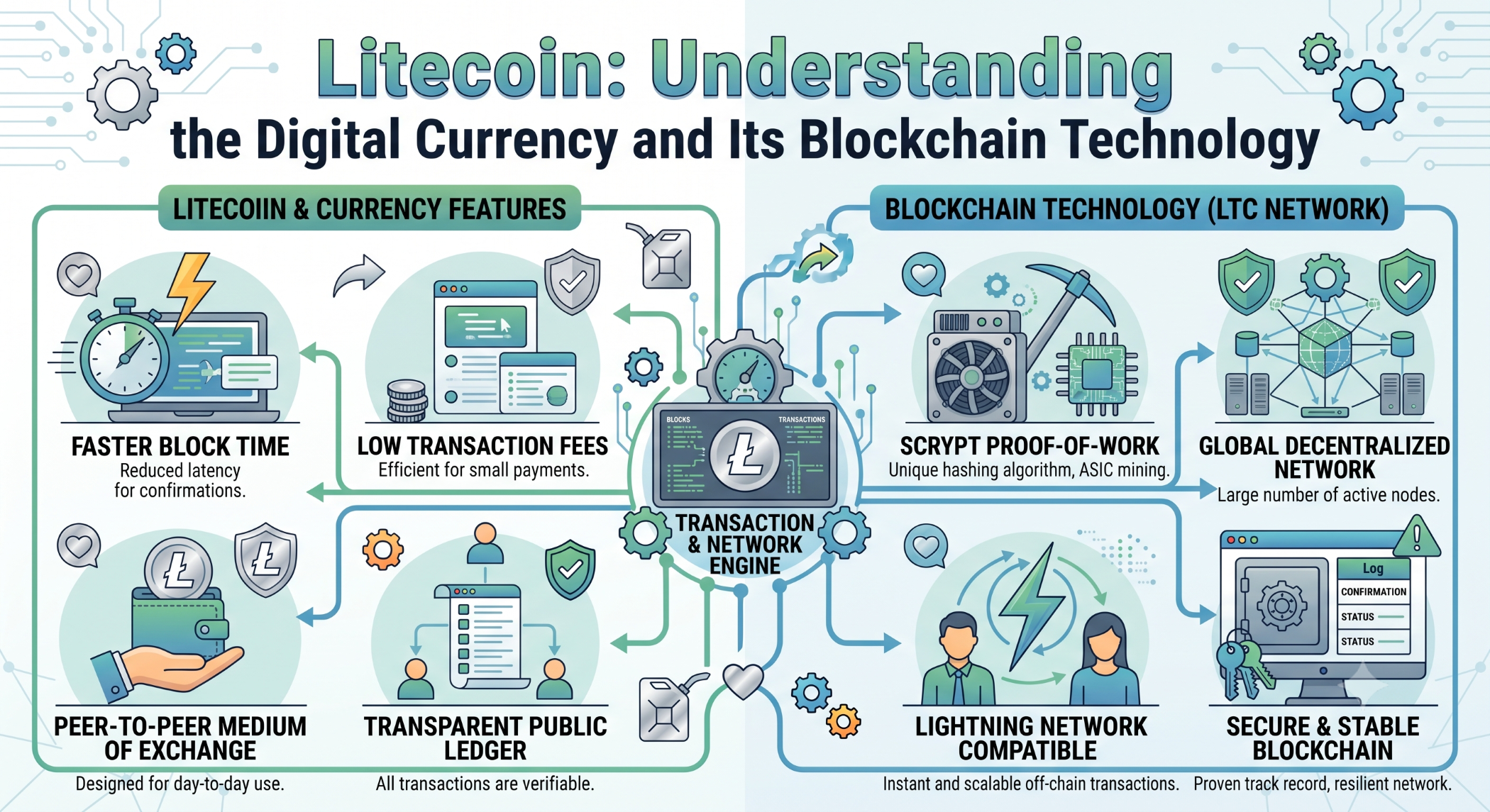
Litecoin: Understanding the Digital Currency and Its Blockchain Technology
The growth of cryptocurrency has introduced a range of digital assets designed for different purposes. Litecoin (LTC) is one of the early cryptocurrencies and was created as a peer-to-peer digital currency with an emphasis on efficient transactions.
Litecoin is based on blockchain technology and shares several design principles with Bitcoin while using different parameters and technical choices.
What Is Litecoin?
Litecoin is a decentralized cryptocurrency designed to allow users to send digital value directly over a peer-to-peer network.
It operates without a central authority controlling the transaction ledger.
A simplified transaction flow is:
User Creates Transaction
↓
Litecoin Network
↓
Transaction Verification
↓
Mining / Consensus
↓
Blockchain Confirmation
How Does Litecoin Work?
Litecoin uses a distributed blockchain to record transactions. Transactions are broadcast to network participants, validated according to protocol rules, and included in blocks by miners.
The Litecoin network uses Proof of Work as its consensus mechanism.
Litecoin Mining
Litecoin uses the Scrypt proof-of-work algorithm rather than Bitcoin's SHA-256 algorithm.
Mining involves specialized computing resources competing to produce valid blocks.
A simplified process is:
Transactions
↓
Mining
↓
Valid Block
↓
Network Verification
↓
Blockchain
Mining helps secure the network and maintain agreement about its transaction history.
Litecoin vs Bitcoin
Litecoin was designed using Bitcoin as a technical starting point, but the networks have several differences.
Some important differences include:
Litecoin → Scrypt Proof of Work
Bitcoin → SHA-256 Proof of Work
Litecoin → Faster block generation
Bitcoin → Slower block generation
Litecoin → Maximum supply of 84 million LTC
Bitcoin → Maximum supply of 21 million BTC
These differences affect transaction processing, mining, and monetary issuance.
Litecoin Transactions
Users can send LTC between compatible wallets through the Litecoin network.
Transactions are digitally signed and broadcast to the network. Once included in blocks and confirmed, they become part of the blockchain's transaction history.
As with other cryptocurrencies, users should understand that blockchain transactions can be difficult or impossible to reverse once confirmed.
Litecoin Wallets
A Litecoin wallet provides the tools and cryptographic credentials required to manage LTC.
Wallet options can include:
Hardware wallets
Software wallets
Mobile wallets
Desktop wallets
Custodial wallets
Private keys and recovery credentials should be protected carefully because they control access to the associated assets.
Benefits of Litecoin
Peer-to-Peer Payments
Litecoin allows users to transfer digital value directly through its decentralized network.
Faster Block Generation
Litecoin was designed with a shorter block interval than Bitcoin, which can allow transactions to be included in blocks more frequently.
Established Blockchain
Litecoin has been operating as a cryptocurrency network for many years, giving it an established blockchain ecosystem.
Low-Friction Digital Transfers
Litecoin can be used for digital asset transfers without requiring a traditional payment processor for every transaction.
Litecoin and Digital Payments
Litecoin's design makes it suitable for exploring cryptocurrency payment use cases.
A business payment flow could look like:
Customer
↓
LTC Wallet
↓
Litecoin Network
↓
Merchant Wallet
↓
Payment Confirmation
Businesses still need to consider exchange-rate volatility, accounting, custody, transaction handling, and applicable regulations.
Litecoin vs Traditional Payments
Traditional payment systems typically rely on banks, card networks, payment processors, or other centralized institutions.
Litecoin uses a decentralized blockchain network to process and record transactions.
This creates differences in:
Settlement mechanisms
Transaction control
Fees
Reversibility
Regulation
Custody
The appropriate payment method depends on the business and customer requirements.
Litecoin Risks
Litecoin, like other cryptocurrencies, involves risks such as:
Price volatility
Wallet and private-key loss
Security threats
Fraud and scams
Regulatory changes
Market and liquidity risks
Businesses should assess these risks before integrating LTC into financial or commercial processes.
Litecoin Security
Security is essential when managing cryptocurrency.
Organizations should protect private keys, restrict access to wallets and systems, use secure authentication, and carefully evaluate third-party exchanges and custody providers.
For higher-value transactions, additional approval and multi-signature controls may be appropriate.
Litecoin and Blockchain Development
Businesses exploring Litecoin-related applications may need supporting software components.
A solution could include:
Web / Mobile App
↓
Backend / API
↓
Wallet Integration
↓
Litecoin Network
Additional functionality may include transaction monitoring, payment notifications, reporting, and account management.
Litecoin and Business Applications
Businesses may explore Litecoin for:
Digital payments
Cryptocurrency payment gateways
Wallet applications
Digital-asset platforms
Blockchain integrations
The business case should be evaluated carefully rather than assuming that cryptocurrency automatically improves payment efficiency.
Litecoin Development at Solace Infotech
Solace Infotech works across blockchain, web applications, mobile applications, APIs, and product engineering, providing technical capabilities that can support cryptocurrency and blockchain-related application development.
The implementation approach should be based on the project's functional requirements, security model, integration needs, scalability, and regulatory environment.
Best Practices
Define the purpose of accepting or using LTC before beginning development. Select a secure wallet and custody strategy, protect private keys, monitor transactions, and evaluate third-party services carefully.
Businesses should also consider accounting, taxation, compliance, pricing volatility, and customer demand before introducing cryptocurrency payments.
Conclusion
Litecoin is a decentralized cryptocurrency designed for peer-to-peer digital payments and blockchain-based value transfer.
Its use of Scrypt Proof of Work, shorter block intervals, and larger maximum supply distinguish it from Bitcoin while maintaining several similarities in overall design.
For businesses, Litecoin can be considered for payment and blockchain-related applications, but successful implementation requires careful attention to security, volatility, custody, integration, and regulatory requirements.