Mobile App Maintenance Cost In 2026
Launching a mobile app is only the beginning of its lifecycle. Once an app is available to users, it needs continuous maintenance to remain secure, compatible, reliable, and useful.
Mobile operating systems evolve, third-party APIs change, dependencies become outdated, security vulnerabilities are discovered, and user expectations continue to change. As a result, businesses need to consider maintenance costs when planning the total cost of mobile app ownership.
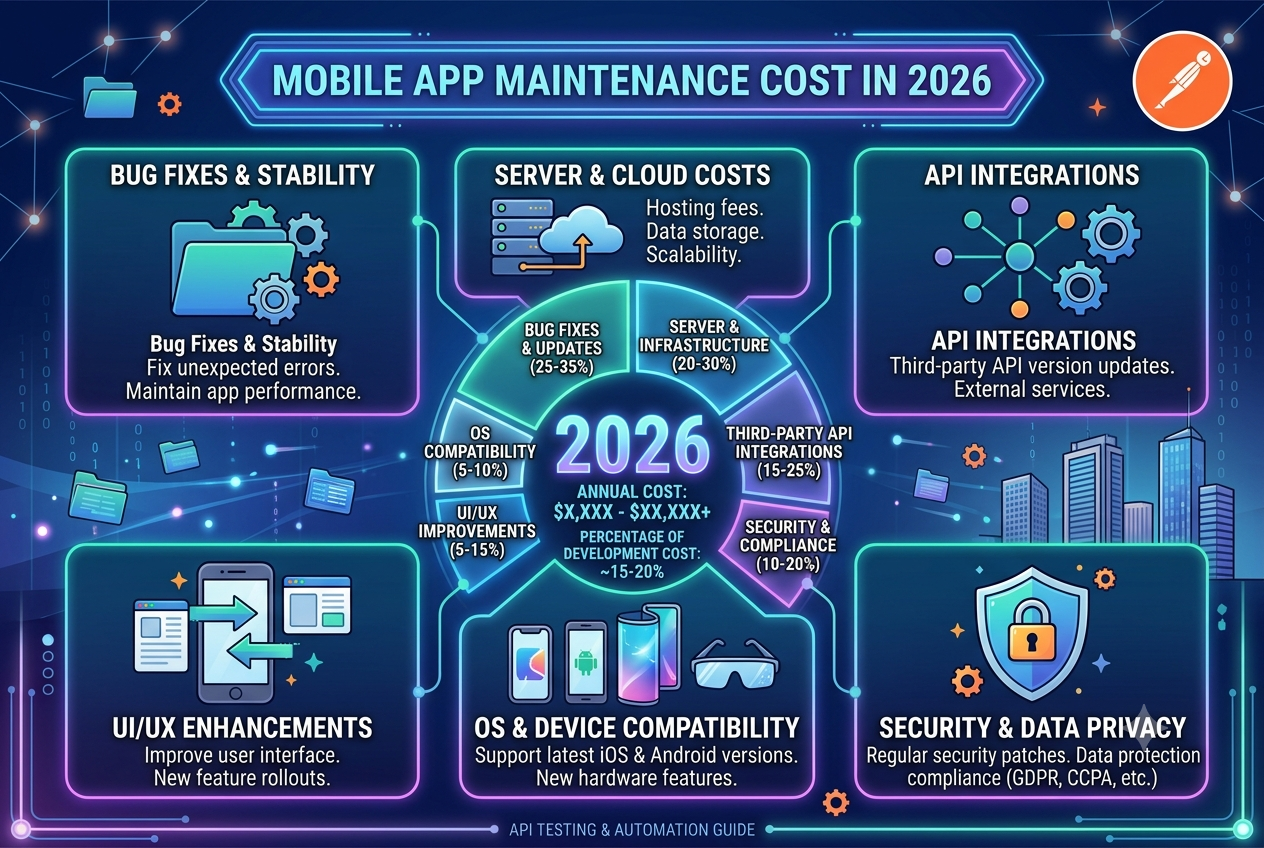
In 2026, a commonly used industry planning benchmark is around 15% to 25% of the original development cost per year for ongoing maintenance, although the actual amount varies considerably based on app complexity, infrastructure, integrations, platforms, and support requirements.
How Much Does Mobile App Maintenance Cost In 2026?
There is no single maintenance price that applies to every application.
As a general planning range, businesses can consider:
Basic apps: ₹8,000–₹40,000 per month
Mid-complexity apps: ₹40,000–₹1,50,000 per month
Enterprise, marketplace, fintech, AI, or high-traffic apps: ₹1,50,000–₹6,00,000+ per month
These are indicative market ranges rather than fixed industry prices. Infrastructure, support requirements, user volume, integrations, and application complexity can significantly change the final cost.
Another useful approach is to estimate annual maintenance at approximately 15%–25% of the original development cost. For example, an app that cost ₹10 lakh to develop could require roughly ₹1.5 lakh–₹2.5 lakh per year for ongoing maintenance, excluding major new features and certain third-party usage costs.
What Does Mobile App Maintenance Include?
Mobile app maintenance involves much more than fixing bugs. A typical maintenance plan can include the following activities.
1. Bug Fixes And Technical Support
Even well-tested applications can experience problems after launch because of different devices, OS versions, network conditions, user behavior, and third-party services.
Maintenance may include:
Identifying and fixing application bugs
Resolving crashes
Fixing UI problems
Addressing API errors
Investigating failed transactions
Resolving device-specific issues
Supporting production incidents
Regular monitoring can help identify problems before they affect a large number of users.
2. iOS And Android Compatibility
Apple and Google continuously update their mobile operating systems and development requirements.
An application may require changes when operating systems, SDKs, permissions, background processing behavior, storage mechanisms, or platform APIs change.
This is one reason mobile app maintenance cannot be treated as a one-time activity. Applications need to be tested and updated as the underlying platforms evolve.
3. Security Updates
Security maintenance is particularly important for applications that handle:
Personal information
Financial transactions
Authentication credentials
Healthcare information
Business data
Payment information
Maintenance may involve updating vulnerable libraries, improving authentication, applying security patches, reviewing dependencies, and addressing vulnerabilities discovered after launch.
Ignoring security updates can increase technical and business risk over time.
4. Third-Party API And SDK Updates
Modern mobile applications rarely operate independently.
An application may depend on:
Payment gateways
Google Maps or other mapping services
Firebase
Social login providers
Analytics platforms
SMS and OTP services
Email providers
AI APIs
Shipping APIs
Cloud services
When these providers change APIs, authentication methods, SDKs, pricing, or supported versions, the mobile application may also require updates.
The greater the number of external integrations, the greater the potential maintenance workload.
5. Backend And Cloud Infrastructure
The mobile application is usually only one part of the overall system.
A typical application may also require:
APIs
Databases
Cloud servers
File storage
CDN
Caching
Backup systems
Monitoring
Authentication services
These infrastructure costs generally increase as application traffic, storage, transactions, and users increase.
For example, an application with a few thousand users may require relatively modest infrastructure, while a high-traffic marketplace or real-time application can require considerably more computing and database resources.
6. Performance Optimization
Performance can deteriorate as an application grows.
Developers may need to investigate:
Slow API responses
Large database queries
Excessive network requests
Memory consumption
Large application bundles
Slow screen rendering
Battery consumption
Backend bottlenecks
Performance monitoring and optimization should therefore be considered part of the application's ongoing lifecycle.
7. App Store And Play Store Compliance
Mobile applications must continue to meet the publishing requirements of the platforms on which they are distributed.
Changes to platform policies, SDK requirements, privacy requirements, permissions, or technical submission requirements can require development and testing work.
Therefore, maintenance should include monitoring relevant platform changes rather than waiting until an application encounters a publishing problem.
8. Analytics And Crash Monitoring
Maintenance teams can use monitoring and analytics tools to understand how an application behaves after release.
Important areas include:
Crash rates
Application performance
API failures
Feature usage
User engagement
Conversion rates
Retention
Device-specific problems
This information allows businesses to prioritize maintenance work based on actual user behavior rather than assumptions.
Factors That Affect Mobile App Maintenance Cost
The maintenance cost of two applications with similar development budgets can be very different.
Several factors influence the final cost.
App Complexity
A simple information-based application generally requires less maintenance than an application with payments, real-time communication, complex workflows, and multiple user roles.
Number Of Platforms
Supporting both Android and iOS generally requires additional testing and platform-specific maintenance compared with supporting only one platform.
Cross-platform frameworks such as Flutter and React Native can reduce duplicated application code, but they do not eliminate platform-specific testing and maintenance requirements.
Number Of Integrations
Every external service creates another dependency that may need monitoring and updating.
An application connected to payment, maps, SMS, analytics, AI, and logistics services will generally have a larger maintenance workload than a standalone application.
Number Of Users
More users can mean:
Higher server usage
More transactions
More storage
More support requests
More performance requirements
Greater monitoring requirements
As the user base grows, infrastructure and operational costs may increase accordingly.
Frequency Of Releases
An application that receives frequent feature updates requires more development, testing, deployment, and monitoring than an application that changes only occasionally.
Code Quality And Technical Debt
The quality of the original architecture has a major impact on future maintenance.
Well-structured code, automated testing, documentation, modular architecture, and proper dependency management can make future updates easier.
Poorly maintained code can make even small changes expensive and risky.
Mobile App Maintenance Cost By App Type
Different applications have different maintenance requirements.
Simple Business Or Content App
These applications typically have limited functionality and few integrations.
Maintenance may focus on:
OS compatibility
Basic bug fixes
Security updates
Hosting
Minor content or UI changes
eCommerce App
eCommerce applications generally require additional maintenance because they involve:
Product catalogs
Payments
Orders
Inventory
Customer accounts
Notifications
Shipping integrations
Seasonal traffic and promotional campaigns can also increase infrastructure requirements.
On-Demand Or Booking App
These applications may include:
Real-time availability
Location services
Driver or service-provider tracking
Push notifications
Booking workflows
Payment processing
As a result, their maintenance requirements are usually higher than those of simpler applications.
Marketplace App
A marketplace can have multiple user roles, such as customers, sellers, administrators, and service providers.
Maintenance may involve:
Vendor management
Payments
Commission calculations
Messaging
Search
Reviews
Order management
Dispute workflows
FinTech Or AI-Powered App
Applications involving financial transactions, sensitive information, or AI services can require additional security, infrastructure, compliance, monitoring, and third-party service management.
Consequently, their maintenance requirements can be significantly higher than those of basic applications.
First-Year Maintenance Can Be Higher
Businesses should not always assume that maintenance will immediately settle into a fixed monthly amount.
The first year after launch can involve:
Production bug fixes
Performance optimization
User feedback improvements
OS compatibility work
Infrastructure scaling
Analytics implementation
Security updates
Store compliance changes
Several 2026 industry estimates therefore place first-year maintenance above the normal steady-state percentage, particularly for applications undergoing active stabilization and improvement.
How To Reduce Mobile App Maintenance Costs
Maintenance should be managed proactively rather than waiting for major failures.
1. Build With Maintainability In Mind
Use a clean architecture, modular components, proper documentation, and consistent coding standards from the beginning.
2. Automate Testing
Automated tests can reduce the effort required to verify that existing functionality still works after updates.
3. Monitor The Application
Use crash monitoring, performance monitoring, logs, and analytics to identify issues early.
4. Keep Dependencies Updated
Regularly review third-party libraries and SDKs instead of allowing several years of updates to accumulate.
5. Monitor OS And Platform Changes
Track upcoming iOS and Android releases so compatibility work can be planned rather than handled as an emergency.
6. Separate Maintenance From New Features
Bug fixes, security updates, compatibility work, and infrastructure maintenance should be clearly distinguished from new feature development when defining a maintenance contract.
7. Maintain Proper Documentation
Technical documentation makes it easier for development teams to understand the architecture, APIs, deployment process, third-party services, and business rules.
What Should A Mobile App Maintenance Contract Include?
A professional maintenance agreement should clearly define:
Included maintenance hours
Bug-fixing scope
OS compatibility updates
Security updates
Backend maintenance
Monitoring responsibilities
Third-party integration support
Response times
Severity levels
SLA requirements
Release management
Backup responsibilities
Hosting responsibilities
Excluded feature development
Emergency support charges
This helps prevent disagreements about whether a requested change is maintenance or new development.
Maintenance Vs New Feature Development
One of the most important distinctions is between maintenance and enhancement.
For example:
Maintenance:
Fixing a payment failure
Updating an outdated SDK
Fixing an Android compatibility issue
Resolving an application crash
Applying a security patch
New development:
Adding a new payment method
Creating a new user workflow
Adding a new dashboard
Introducing a new marketplace module
Building a new AI feature
Keeping these categories separate makes budgeting and project management much easier.
Conclusion
Mobile app maintenance is an ongoing cost of operating a digital product. In 2026, a practical starting point for budgeting is around 15%–25% of the original development cost per year, but the actual cost depends on the application's architecture, complexity, infrastructure, platforms, integrations, user base, and support requirements.
Businesses should therefore consider maintenance during the initial app planning stage rather than after launch. A proactive maintenance strategy can help keep the application secure, compatible, performant, and reliable while reducing the risk of expensive technical debt.