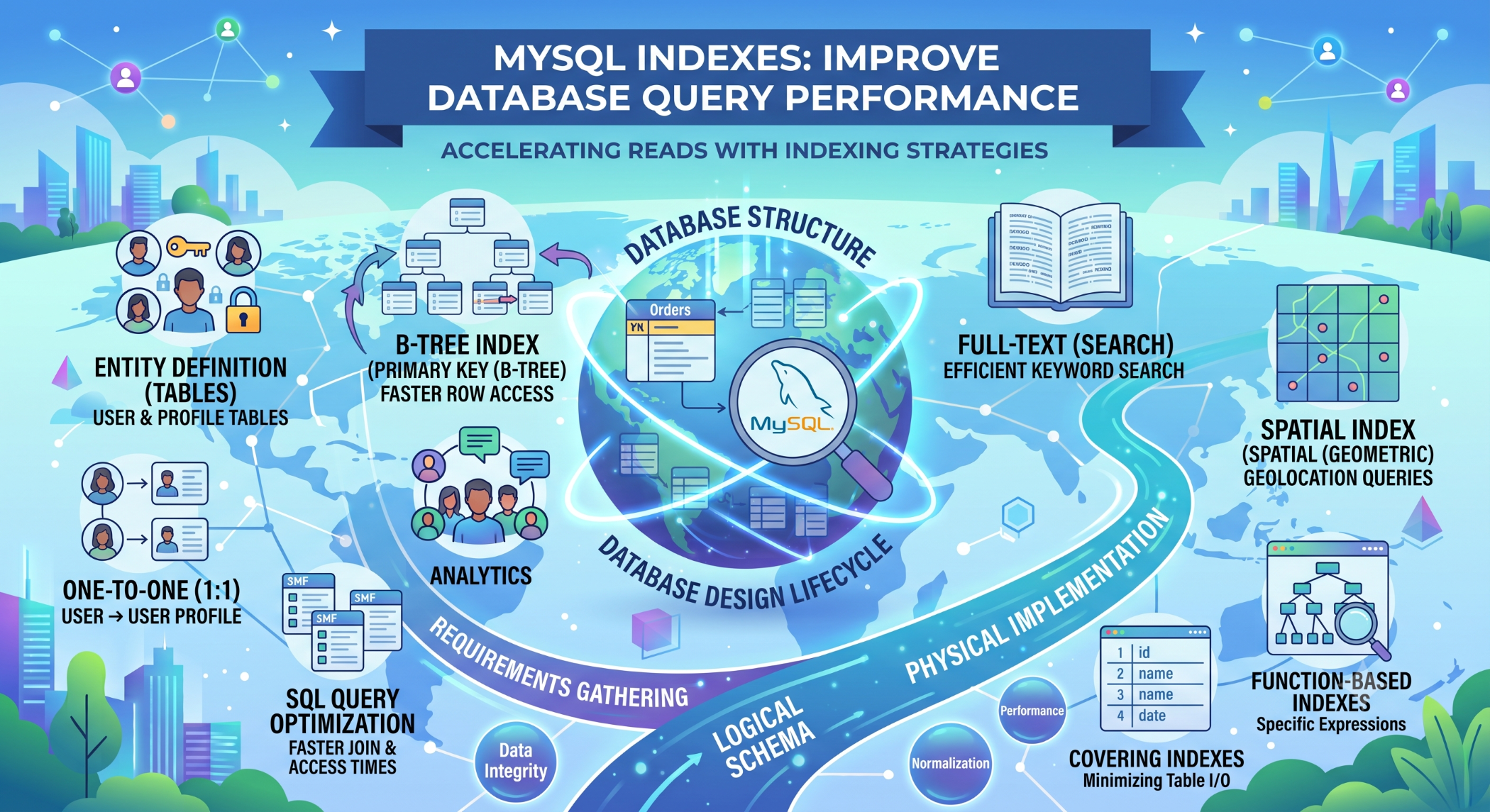
MySQL Indexes: Improve Database Query Performance
As a database grows, searching through every row of a table for each query can become inefficient. MySQL indexes provide a mechanism for locating records more efficiently and can significantly improve the performance of frequently executed queries.
Indexes are an important part of database design, but they should be created according to actual query patterns because unnecessary indexes can increase storage and write overhead.
What Is a MySQL Index?
An index is a data structure associated with one or more table columns that helps MySQL locate matching rows more efficiently.
Consider a users table containing thousands of records:
users
--------------------------------
id | name | email | status
An index on email can help MySQL find a specific user's record more efficiently.
Create an Index
A basic index can be created with:
CREATE INDEX idx_users_email
ON users(email);
You can also define an index when creating a table:
CREATE TABLE users (
id INT PRIMARY KEY AUTO_INCREMENT,
name VARCHAR(100),
email VARCHAR(150),
INDEX idx_users_email (email)
);
Primary Key Index
A primary key automatically provides an index for identifying records uniquely.
For example:
CREATE TABLE products (
id INT PRIMARY KEY AUTO_INCREMENT,
name VARCHAR(150)
);
The id column becomes the primary key and is indexed as part of that definition.
Unique Index
A unique index ensures that indexed values cannot contain duplicate non-null values according to MySQL's unique-index rules.
For example:
CREATE UNIQUE INDEX idx_users_email
ON users(email);
This can be useful when an email address must be unique for each account.
Composite Index
A composite index contains multiple columns.
For example:
CREATE INDEX idx_orders_customer_status
ON orders(customer_id, status);
This can be useful for queries that commonly filter by customer_id and status.
The column order matters. MySQL can use the leading columns of a composite index efficiently, so the index should be designed around actual query patterns.
Indexes and WHERE Clauses
Indexes are often useful for frequently searched columns.
For example:
SELECT id, name
FROM users
WHERE email = 'john@example.com';
An appropriate index on email can help MySQL locate matching rows more efficiently.
Indexes and JOIN Operations
Indexes can also improve queries that join related tables.
For example:
SELECT orders.id, customers.name
FROM orders
JOIN customers
ON orders.customer_id = customers.id;
An index on orders.customer_id can be useful for this type of query, depending on the execution plan and data distribution.
Use EXPLAIN to Check Index Usage
The EXPLAIN statement can help developers understand how MySQL plans to execute a query.
EXPLAIN
SELECT id, name
FROM users
WHERE email = 'john@example.com';
It can help identify whether MySQL is using an index, how tables are accessed, and whether a query may be performing an inefficient scan.
Too Many Indexes Can Hurt Performance
Indexes improve read operations, but they are not free.
When data is inserted, updated, or deleted, relevant indexes may also need to be maintained. Excessive indexing can therefore increase storage requirements and write overhead.
Do not create an index for every column simply because indexing is available.
Index Selectivity Matters
An index is generally more useful when it can narrow the search effectively.
For example, an index on a column containing many distinct email addresses may be more selective than an index on a column where most rows contain the same status value.
The usefulness of an index should always be evaluated using actual queries and data.
Indexes for ORDER BY
Indexes can sometimes help MySQL process sorting operations more efficiently.
For example:
SELECT id, name
FROM products
ORDER BY created_at DESC
LIMIT 20;
An appropriate index on created_at may help depending on the complete query and execution plan.
Check Existing Indexes
You can inspect the indexes on a table using:
SHOW INDEX FROM users;
Reviewing existing indexes helps identify duplicate, redundant, or missing indexes.
MySQL Index Best Practices
Create indexes based on actual query patterns rather than assumptions. Review frequently executed queries, use EXPLAIN, and consider columns involved in filtering, joins, sorting, and uniqueness constraints.
Avoid unnecessary indexes and periodically review indexes as the application and database workload evolve.
MySQL Database Optimization at Solace Infotech
Solace Infotech works with MySQL and database-driven applications, where indexing, query optimization, database design, and performance tuning are important parts of building scalable solutions.
For each project, indexes should be designed according to the application's data model, workload, query patterns, and expected growth.
Conclusion
MySQL indexes are an essential database optimization technique for improving data retrieval performance. Primary keys, unique indexes, single-column indexes, and composite indexes can all serve different purposes depending on application requirements.
The best indexing strategy is not to create as many indexes as possible. Instead, analyze real queries, understand the data, use tools such as EXPLAIN, and create indexes that provide measurable performance benefits.