MySQL: Understanding the Popular Relational Database
A reliable database is essential for applications that need to store, organize, and retrieve information. MySQL is a popular relational database management system that uses SQL to manage structured data.
MySQL is commonly used with PHP and other programming languages to build dynamic websites, APIs, e-commerce platforms, and business applications. Solace Infotech also provides MySQL development services and highlights MySQL's performance, security, transaction support, and compatibility with multiple development platforms.
What Is MySQL?
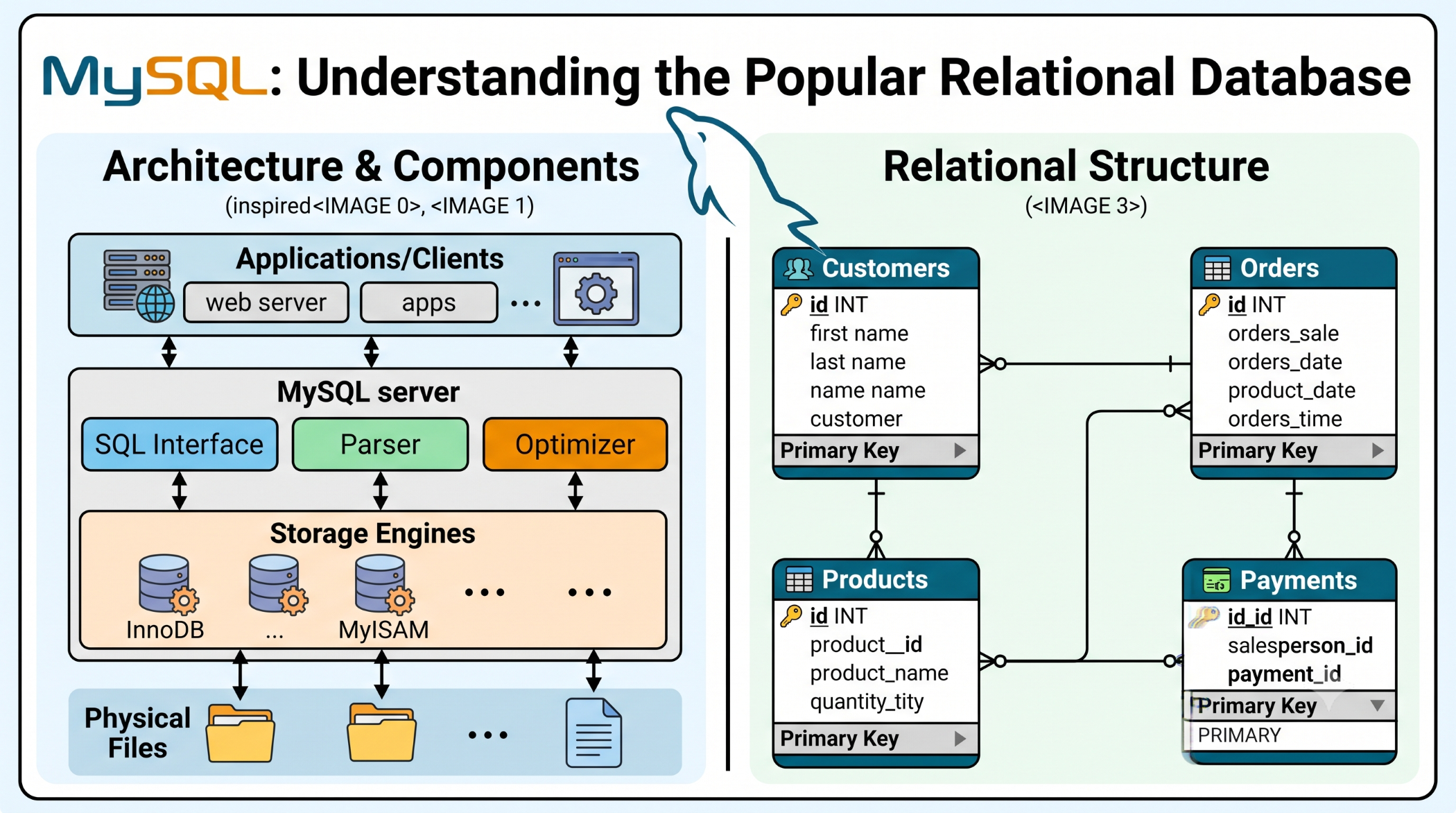
MySQL is a relational database management system where data is organized into tables containing rows and columns.
For example, an application may have tables for:
Users
Products
Orders
Payments
Customers
SQL queries can then be used to insert, update, retrieve, and delete data.
Key Features of MySQL
High Performance
MySQL is designed to efficiently handle database operations and can support applications ranging from small websites to large business systems.
Data Security
MySQL provides authentication, permissions, and other mechanisms to help protect database information.
Transaction Support
Transactional features are important for applications where data consistency matters, such as e-commerce and financial systems.
Wide Compatibility
MySQL can work with many programming languages and operating systems, making it suitable for different application architectures.
Why Use MySQL?
Businesses and developers choose MySQL because it offers a strong combination of performance, flexibility, and ease of integration.
It can be used for:
- Websites and web applications
- E-commerce platforms
- APIs and backend systems
- Business applications
- Data-driven software
Solace Infotech's current technology pages also list MySQL across web development, product engineering, cloud, and application projects.
MySQL and PHP
MySQL is frequently used with PHP for developing database-driven websites.
A simple PHP application can connect to MySQL, execute SQL queries, and display the resulting data to users.
This combination is commonly used for content management systems, e-commerce websites, portals, and custom business applications.
MySQL Performance Optimization
As a database grows, performance becomes increasingly important.
Developers can improve MySQL performance by using:
- Proper indexes
- Optimized SQL queries
- Appropriate database design
- Query monitoring
- Proper server configuration
- Efficient connection management
Configuration settings such as innodb_buffer_pool_size, max_connections, and other InnoDB parameters should be tuned according to the actual workload rather than changed blindly.
Best Practices
Keep database structures organized and use appropriate indexes for frequently searched or joined columns. Always protect database credentials, limit unnecessary permissions, and monitor database performance as the application grows.
Regular backups and a tested recovery strategy are also important for production databases.
Conclusion
MySQL remains an important database technology for building reliable, data-driven applications. Its performance, security features, transaction support, and broad compatibility make it suitable for websites, APIs, e-commerce platforms, and enterprise applications.
Choosing the right database design and maintaining it properly is just as important as selecting the database technology itself.