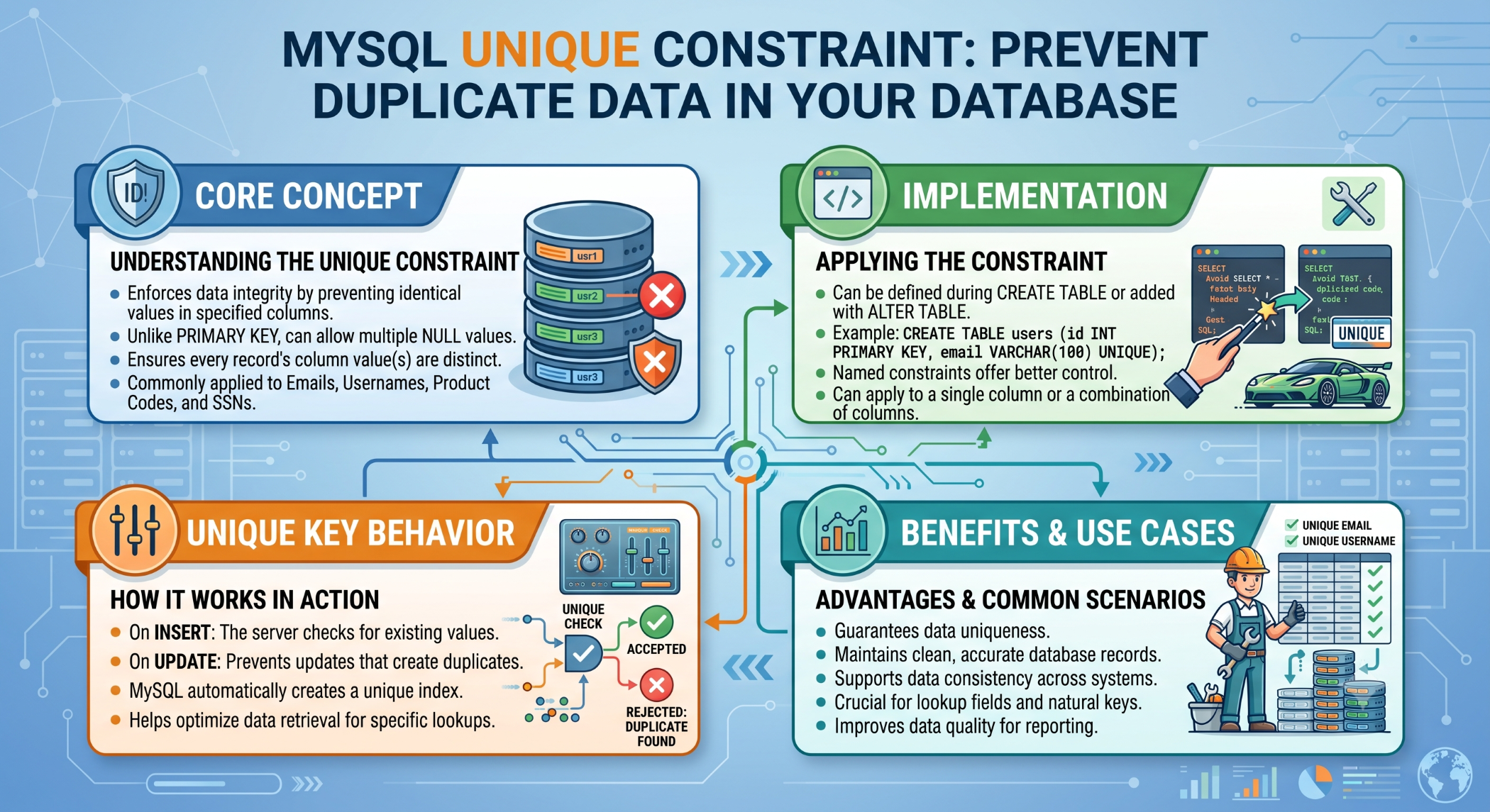
MySQL UNIQUE Constraint: Prevent Duplicate Data in Your Database
Maintaining accurate and consistent data is an important part of database development. Applications often need to prevent duplicate values for fields such as email addresses, usernames, order numbers, or product codes.
MySQL provides the UNIQUE constraint to help ensure that values in one or more columns remain unique.
What Is a UNIQUE Constraint?
A UNIQUE constraint ensures that duplicate values are not allowed for the constrained column or combination of columns.
For example:
CREATE TABLE users (
id INT PRIMARY KEY AUTO_INCREMENT,
name VARCHAR(100),
email VARCHAR(150) UNIQUE
);
In this example, two users cannot have the same email address.
Why Use UNIQUE?
A unique constraint helps maintain data integrity at the database level.
It is useful for values such as:
Email addresses
Usernames
Employee IDs
Product SKUs
Invoice numbers
External reference IDs
Database-level enforcement is valuable because it protects the data even when multiple applications or processes write to the same database.
Create a UNIQUE Constraint
You can define a unique constraint when creating a table:
CREATE TABLE products (
id INT PRIMARY KEY AUTO_INCREMENT,
sku VARCHAR(50) UNIQUE,
name VARCHAR(150)
);
You can also add one to an existing table:
ALTER TABLE products
ADD CONSTRAINT uk_products_sku UNIQUE (sku);
MySQL implements uniqueness using a unique index.
Composite UNIQUE Constraints
A unique constraint can contain multiple columns.
For example:
CREATE TABLE enrollments (
id INT PRIMARY KEY AUTO_INCREMENT,
student_id INT,
course_id INT,
UNIQUE (student_id, course_id)
);
This prevents the same student from being enrolled in the same course more than once while still allowing each student to enroll in multiple courses.
UNIQUE vs PRIMARY KEY
A primary key and a unique constraint both enforce uniqueness, but they have different purposes.
A primary key identifies the main record in a table and cannot contain NULL.
A UNIQUE constraint prevents duplicate values in the specified column or columns, but MySQL's handling of NULL permits multiple NULL values in a unique index under its normal rules.
For example:
CREATE TABLE users (
id INT PRIMARY KEY AUTO_INCREMENT,
username VARCHAR(100) UNIQUE
);
Here, id is the primary identifier, while username must be unique when a value is provided.
UNIQUE Index
You can explicitly create a unique index:
CREATE UNIQUE INDEX idx_users_email
ON users(email);
This provides uniqueness enforcement while also creating an index that can be used by the optimizer for suitable queries.
Check Existing UNIQUE Constraints
You can inspect a table's indexes with:
SHOW INDEX FROM users;
You can also examine the complete table definition:
SHOW CREATE TABLE users;
These commands help identify existing unique indexes and constraints.
Handling Duplicate Data
Suppose you add a unique constraint to an existing table that already contains duplicate values.
MySQL will not be able to create the constraint until the conflicting data is resolved.
A typical process is:
Find Duplicates
↓
Review Records
↓
Correct / Merge Data
↓
Add UNIQUE Constraint
This is especially important when introducing uniqueness to an existing production database.
UNIQUE Constraints and Applications
Application-level validation can provide a better user experience by checking for duplicates before submission.
However, application checks alone are not sufficient because two requests can arrive at nearly the same time.
The database should remain the final enforcement layer.
For example:
Application Validation
↓
Database UNIQUE Constraint
↓
Reliable Data Integrity
UNIQUE Constraint and Performance
Because MySQL uses a unique index to enforce uniqueness, the constraint also provides an indexed structure that can support suitable lookup queries.
However, every additional index has a maintenance cost for INSERT, UPDATE, and DELETE operations.
Use unique constraints for genuine business requirements rather than adding them to columns without a clear reason.
Common Use Case: Unique Email
A common example is user registration.
CREATE TABLE users (
id INT PRIMARY KEY AUTO_INCREMENT,
email VARCHAR(150) NOT NULL UNIQUE,
password_hash VARCHAR(255) NOT NULL
);
If an existing email is submitted again, the database rejects the duplicate value.
The application should catch the database error and return an appropriate message to the user.
Best Practices
Define uniqueness based on actual business rules and enforce it at the database level. Use NOT NULL where a value is mandatory, and review existing duplicates before adding a unique constraint to an established table.
Use meaningful constraint and index names, and make sure the application handles duplicate-key errors gracefully.
Conclusion
The MySQL UNIQUE constraint is an important database feature for preventing duplicate values and maintaining data integrity.
Whether you need to enforce a unique email address, username, product code, or combination of related fields, a unique constraint provides a reliable database-level solution.
By combining application validation with database-enforced uniqueness, developers can build applications that provide a better user experience while keeping critical data consistent and reliable.