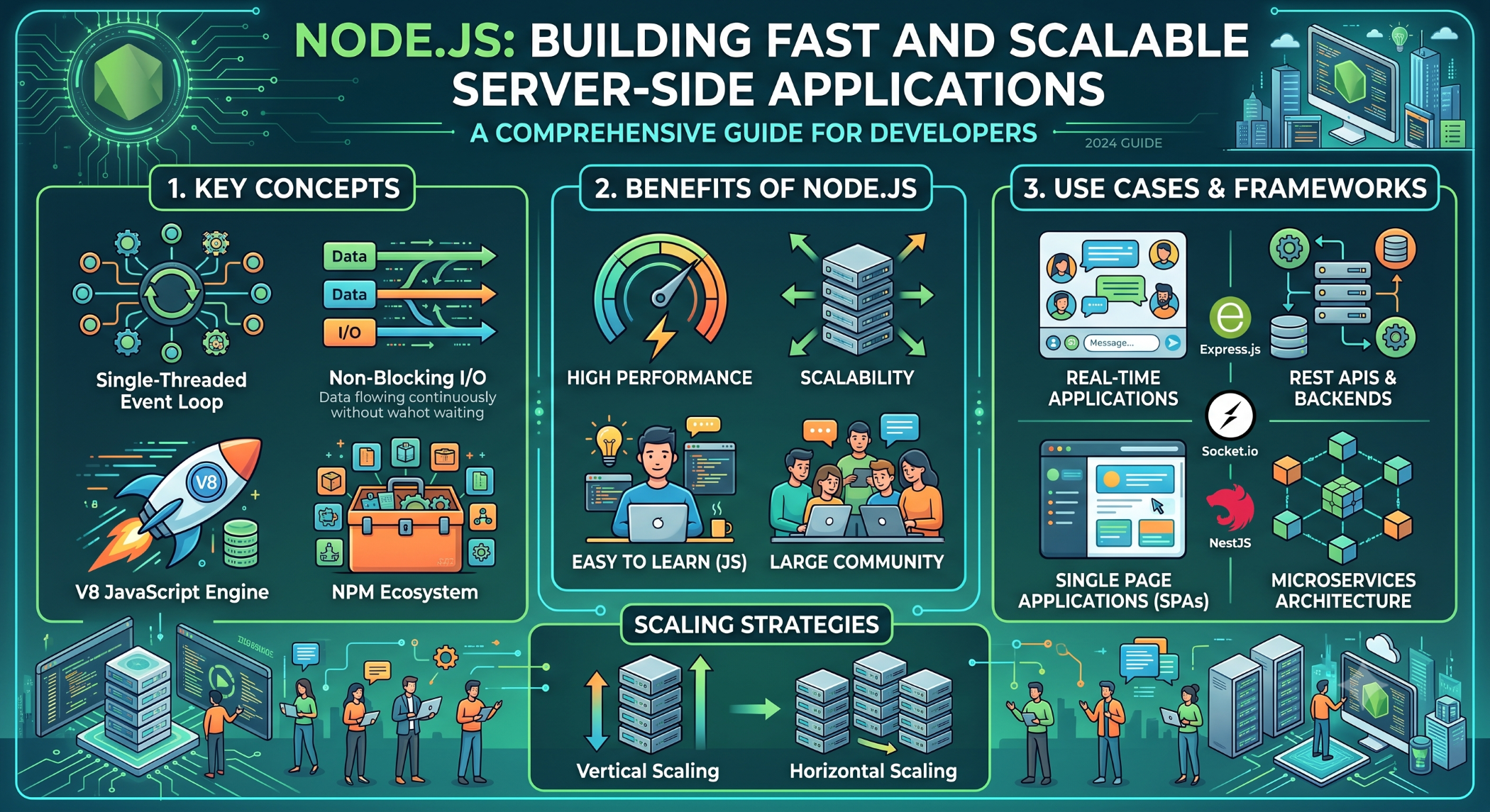
Node.js: Building Fast and Scalable Server-Side Applications
Modern applications need backend systems that can handle APIs, real-time communication, data processing, and increasing numbers of users. Node.js provides a JavaScript runtime that allows developers to build server-side applications using JavaScript.
Its event-driven and asynchronous programming model makes Node.js well suited to applications that handle many I/O operations, such as APIs, real-time applications, and network services.
What Is Node.js?
Node.js is a JavaScript runtime built on the V8 JavaScript engine. It allows JavaScript code to run outside the browser.
A basic Node.js program looks like:
const http = require("http");
const server = http.createServer((req, res) => {
res.end("Hello from Node.js");
});
server.listen(3000);
The server can receive HTTP requests and return responses without requiring a traditional browser-based JavaScript environment.
How Does Node.js Work?
Node.js uses an event-driven architecture and provides asynchronous APIs for many I/O operations.
A simplified request flow is:
Client Request
↓
Node.js Application
↓
Async Operation
↓
Database / API / File System
↓
Response
While an I/O operation is waiting, the runtime can continue handling other work rather than blocking the entire process.
Benefits of Node.js
JavaScript Across the Stack
Development teams can use JavaScript or TypeScript across frontend and backend applications.
Frontend → JavaScript / TypeScript
Backend → Node.js
This can simplify collaboration and allow teams to share programming knowledge and certain development practices.
Efficient I/O Handling
Node.js is designed around asynchronous, non-blocking I/O, which can be useful for applications handling many concurrent network or database operations.
Large Package Ecosystem
Node.js applications can use packages distributed through the npm ecosystem, providing access to a broad range of libraries and development tools.
Suitable for Real-Time Applications
Node.js is commonly used for applications requiring frequent communication, such as chat systems, live dashboards, collaborative applications, and notifications.
Node.js for API Development
Node.js is widely used to build REST APIs and other backend services.
For example:
const express = require("express");
const app = express();
app.get("/api/users", (req, res) => {
res.json([
{ id: 1, name: "John" },
{ id: 2, name: "Sarah" }
]);
});
app.listen(3000);
Frameworks such as Express can simplify routing, middleware, request handling, and API development.
Node.js and Databases
Node.js applications can connect to relational and NoSQL databases.
A typical architecture may look like:
Web / Mobile App
↓
Node.js API
↓
Database
Database performance still depends on query design, indexing, connection handling, and the overall application architecture.
Node.js for Real-Time Applications
Real-time applications can use Node.js with technologies such as WebSockets or Socket.IO.
For example:
User A
↕
Node.js Real-Time Server
↕
User B
This can support messaging, live status updates, collaboration, and other interactive features.
Node.js and TypeScript
TypeScript can be used with Node.js to provide static typing and stronger development tooling.
For example:
interface User {
id: number;
name: string;
}
function getUser(): User {
return {
id: 1,
name: "John"
};
}
TypeScript can be particularly useful for larger Node.js applications where maintainability and clear interfaces are important.
Common Node.js Use Cases
Node.js can be used for:
REST APIs
Backend web applications
Real-time applications
Microservices
SaaS platforms
Streaming services
Automation tools
Command-line applications
It is particularly effective for I/O-heavy workloads.
Node.js vs Traditional Server-Side Development
Node.js allows developers to use JavaScript on the server rather than restricting JavaScript to the browser.
Its asynchronous event-driven model can be beneficial for applications handling many concurrent I/O operations.
However, CPU-intensive workloads may require additional architectural considerations because long-running synchronous computation can block the event loop.
Node.js Performance
Good Node.js performance depends on more than the runtime itself.
Developers should optimize:
Database queries
API calls
Memory usage
Network communication
Event-loop behavior
Caching
Application architecture
Avoid blocking the event loop with expensive synchronous operations. For CPU-intensive processing, consider worker threads, background jobs, queues, or separate services where appropriate.
Node.js Security
Backend security should be designed from the beginning.
Important practices include:
Validate external input.
Authenticate and authorize users.
Protect API endpoints.
Secure sensitive configuration.
Keep dependencies updated.
Apply rate limiting where appropriate.
Use HTTPS for secure communication.
Dependencies should also be reviewed regularly because third-party packages are a major part of many Node.js projects.
Node.js at Solace Infotech
Node.js is part of Solace Infotech's modern application development capabilities and can be used for web applications, APIs, real-time systems, backend services, and scalable product development.
It can also be combined with technologies such as Angular, React, TypeScript, MySQL, cloud platforms, and other backend services depending on project requirements.
Best Practices
Keep Node.js services modular, use asynchronous APIs appropriately, validate incoming data, handle errors consistently, and monitor application performance.
Use environment variables or a secure configuration mechanism for sensitive settings, maintain dependencies regularly, and test applications under realistic workloads.
Conclusion
Node.js provides a flexible platform for building modern backend applications using JavaScript. Its event-driven architecture, asynchronous I/O, extensive npm ecosystem, and support for real-time applications make it suitable for many web and business use cases.
The technology is not automatically the best choice for every workload. Projects should consider application requirements, performance characteristics, team expertise, database architecture, and long-term maintenance.
When used with an appropriate architecture and development practices, Node.js can provide a strong foundation for fast, scalable, and maintainable applications.