Introduction
People are at the heart of every successful organization. Technology, processes, and infrastructure are important, but they can only create lasting value when skilled and motivated people know how to use them effectively.
This is why nurturing people should be an important part of workplace culture.
Nurturing means creating an environment where employees can learn, develop their skills, gain confidence, take responsibility, and grow professionally. It is not simply about training employees. It is about helping people become stronger contributors over time.
Solace Infotech publicly identifies “Nurturing people is our Back End” as one of its core values.
What Does Nurturing People Mean?
Nurturing people means helping employees develop their abilities and reach their potential.
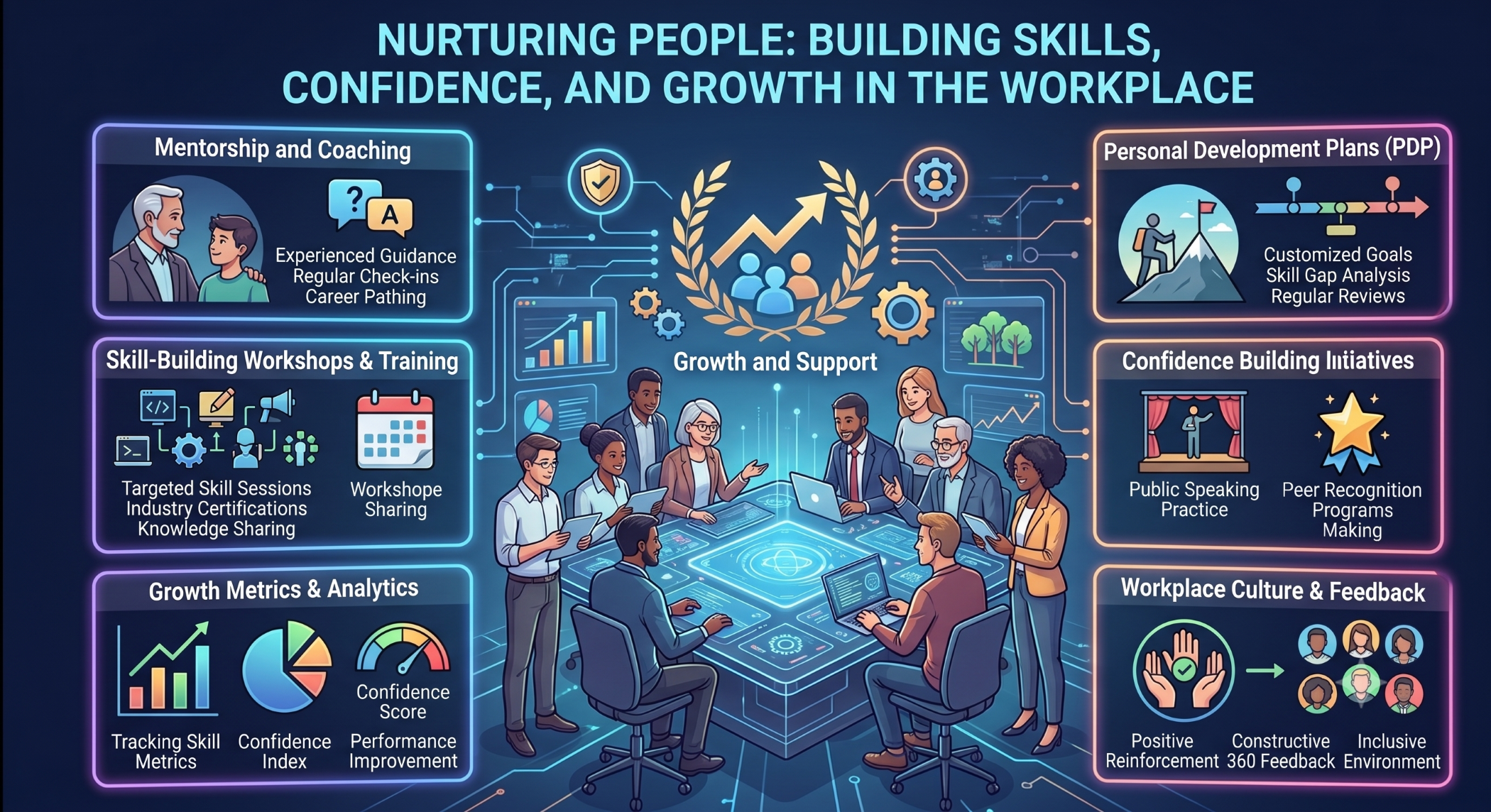
This can involve mentoring, training, knowledge sharing, constructive feedback, recognition, career opportunities, and exposure to challenging work.
A nurturing workplace does not expect employees to know everything immediately. Instead, it provides the support and opportunities needed to learn.
The objective is to create professionals who become increasingly capable and independent.
Why Nurturing Employees Matters
Organizations grow when their people grow.
Employees who receive opportunities to learn and take responsibility can develop stronger technical, communication, leadership, and problem-solving skills.
Nurturing people can also help organizations build internal capabilities rather than depending entirely on external hiring for every new requirement.
Over time, employee development can become an important part of organizational growth.
Learning Should Be Continuous
The technology industry changes quickly.
Programming frameworks, development tools, cloud services, artificial intelligence capabilities, security practices, and business models continue to evolve.
Employees therefore need opportunities to keep learning.
Learning can happen through formal training, project experience, technical discussions, mentoring, experimentation, documentation, and knowledge-sharing sessions.
A strong learning culture encourages employees to remain curious rather than becoming comfortable with only the skills they already possess.
Mentoring Helps People Grow
Mentoring is one of the most effective ways to nurture employees.
An experienced professional can help a less experienced colleague understand technical concepts, workplace expectations, problem-solving approaches, communication practices, and career opportunities.
Good mentoring is not about providing every answer.
It is about teaching people how to think, investigate problems, make decisions, and learn independently.
Give People Meaningful Responsibility
People grow when they are trusted with responsibility.
Employees should have opportunities to take ownership of tasks, modules, projects, customer interactions, or internal initiatives appropriate to their experience.
Responsibility creates practical learning.
For example, a developer who is given ownership of a module can learn not only coding but also estimation, testing, documentation, debugging, collaboration, and communication.
Constructive Feedback
Feedback is another important part of nurturing people.
Employees need to know what they are doing well and where improvement is required.
Effective feedback should be specific and actionable.
Instead of simply saying that someone's performance needs improvement, a manager can identify the particular behavior or outcome that needs attention and explain what better performance looks like.
Feedback should also happen regularly rather than only during formal performance reviews.
Recognition Matters
People want their contributions to be recognized.
Recognition does not always have to be financial. Appreciation, increased responsibility, opportunities to lead, public acknowledgment, or simply meaningful feedback can reinforce positive behavior.
Recognition should be genuine and connected to actual contributions.
When employees understand which behaviors the organization values, they have clearer signals about what good performance looks like.
Nurturing Technical Talent
Technology companies need professionals who continuously strengthen their technical capabilities.
Employees can be encouraged to explore new technologies, experiment with tools, participate in technical discussions, and apply new knowledge to real projects.
However, learning should remain connected to practical requirements.
The objective is not to collect certifications or learn every emerging technology. It is to develop skills that improve problem-solving and create value for customers and the organization.
Nurturing Soft Skills
Technical expertise is only one part of professional success.
Communication, teamwork, leadership, time management, accountability, adaptability, and problem-solving are equally important in many roles.
A technically strong developer may eventually need to communicate with customers or mentor junior developers. A project manager may need stronger technical understanding. A team lead may need to develop conflict-resolution and leadership skills.
Nurturing should therefore address the whole professional, not only technical knowledge.
Creating a Safe Environment for Questions
Employees learn more effectively when they feel comfortable asking questions.
New team members may hesitate to speak because they are afraid of appearing inexperienced. This can lead to assumptions, mistakes, and delayed problem solving.
A supportive workplace encourages people to ask questions when something is unclear.
Questions should be treated as opportunities for learning rather than as evidence of weakness.
Learning From Mistakes
Mistakes are inevitable in professional work.
A nurturing organization focuses on understanding what happened and how the individual or team can improve.
This does not mean ignoring accountability. It means separating constructive learning from unnecessary blame.
A production issue, missed requirement, or unsuccessful implementation can provide useful lessons when teams review the root cause and identify improvements.
Nurturing Future Leaders
Organizations need to develop future leaders before leadership positions become vacant.
Potential leaders can gradually receive opportunities to mentor others, coordinate activities, manage small initiatives, communicate with customers, or make decisions within defined areas.
Leadership development is often more effective when people gain practical experience rather than only attending leadership training.
Empowerment and Trust
Nurturing people also means giving them the freedom to make appropriate decisions.
Micromanagement can limit learning because employees become dependent on managers for every decision.
Empowerment encourages people to think independently and take ownership.
Managers still provide direction and support, but employees are given appropriate space to solve problems and make decisions.
Collaboration Supports Growth
People often learn from their colleagues.
A collaborative environment allows employees to exchange ideas, discuss technical challenges, review work, and learn from different approaches.
Solace Infotech identifies collaboration as one of its stated core values, connecting teamwork with its organizational culture.
Knowledge shared across teams becomes organizational knowledge rather than remaining limited to one individual.
Nurturing New Employees
The first few months of an employee's experience can have a significant impact on their development.
New employees should receive clear expectations, appropriate onboarding, access to documentation, opportunities to ask questions, and guidance from experienced colleagues.
The goal of onboarding should not simply be to explain company policies. It should help new employees understand how the organization works and give them a path toward becoming productive and independent.
Nurturing Through Challenging Projects
People often develop fastest when they encounter meaningful challenges.
Giving an employee slightly greater responsibility than their current comfort zone can encourage growth when appropriate support is available.
For example, a developer who has primarily worked on individual features may gradually take responsibility for a complete module. A QA engineer may begin contributing to test planning. A project coordinator may take ownership of a small client engagement.
The key is to balance challenge with adequate support.
Career Development
Employees need to understand where they can grow.
Career discussions can help identify strengths, development areas, future responsibilities, and relevant skills.
A clear development path can motivate employees to invest in their capabilities.
Career development should not be limited to promotions. Growth can also involve deeper technical specialization, broader responsibilities, mentoring, customer interaction, or involvement in strategic initiatives.
Nurturing and Accountability
Nurturing and accountability should work together.
Supporting employees does not mean lowering standards.
A healthy environment provides clear expectations, constructive feedback, opportunities to improve, and appropriate accountability for results.
Employees should know what success looks like and should receive support when they encounter challenges.
Nurturing People Benefits the Organization
Employee development creates value for the organization as well.
As employees become more capable, they can take on more complex work, support customers more effectively, mentor others, and contribute ideas for improvement.
This creates a cycle of organizational growth:
Learn → Practice → Take Responsibility → Improve → Share Knowledge → Help Others Grow
Over time, this can strengthen the organization's overall capabilities.
The Role of Managers
Managers are central to nurturing people.
A manager should understand each employee's strengths, development areas, interests, and responsibilities.
Regular one-to-one discussions can help identify obstacles and opportunities.
Managers should also provide clarity rather than simply assigning tasks. Employees perform better when they understand priorities, expected outcomes, and how their work contributes to the larger objective.
Nurturing People in a Technology Organization
Technology organizations operate in an environment where change is constant.
Employees may need to move between projects, learn different technologies, work with new customers, or adapt to new development practices.
A culture that supports learning makes these transitions easier.
Solace Infotech describes its approach as hiring like-minded developers and cultivating them further, reinforcing the idea that employee growth is part of its organizational culture.
How Companies Can Nurture People
Organizations can make employee development part of everyday work rather than treating it as a separate initiative.
Provide access to relevant learning resources.
Encourage mentoring and knowledge sharing.
Give employees meaningful responsibility.
Provide regular and constructive feedback.
Recognize contributions.
Create opportunities to work on new challenges.
Discuss career goals and development areas.
Encourage employees to share ideas and ask questions.
Most importantly, make development a shared responsibility between employees and managers.
Conclusion
Nurturing people is an investment in the future of an organization.
When employees are given opportunities to learn, supported by experienced colleagues, trusted with responsibility, and provided with constructive feedback, they can continue to develop their capabilities.
A strong organization does not simply hire skilled professionals. It creates an environment where those professionals can become even better.
For technology companies, this is particularly important because technical knowledge and business requirements are constantly changing.
When people grow, teams become stronger. When teams become stronger, organizations are better prepared to serve customers, solve complex problems, adapt to change, and achieve sustainable growth.