Object-Oriented Programming Language: Concepts, Benefits, and Applications
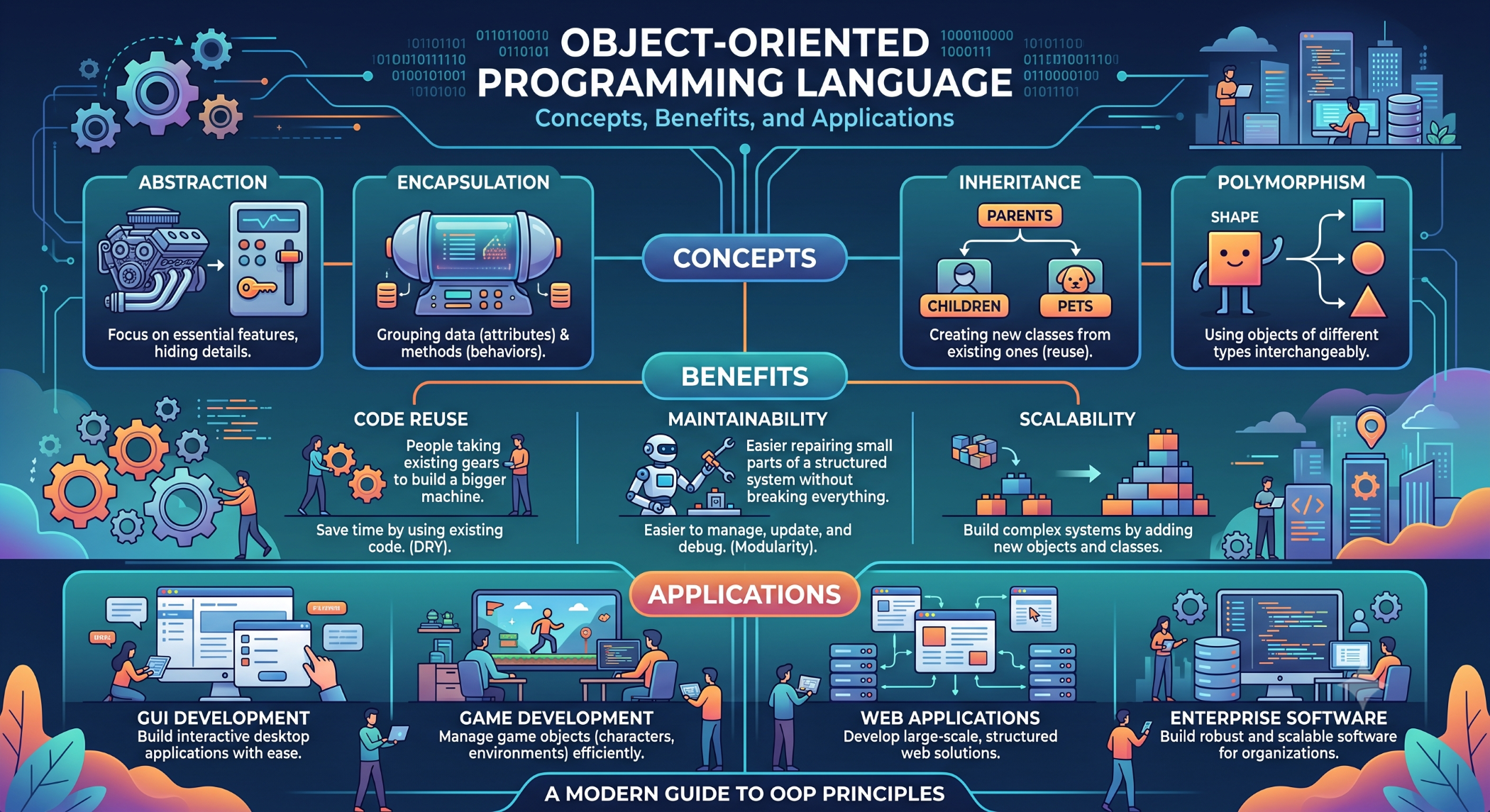
Software applications can become difficult to manage as their functionality and codebase grow. Object-oriented programming (OOP) provides a structured approach to software development by organizing code around objects that contain data and behavior.
OOP is used by many popular programming languages and is particularly useful for developing large, modular, and maintainable applications.
What Is Object-Oriented Programming?
Object-oriented programming is a programming approach in which software is modeled using objects and classes.
An object can represent a real-world or application concept such as:
Customer
Product
Order
Employee
Vehicle
Each object can contain data and behavior related to that entity.
What Is a Class?
A class acts as a blueprint for creating objects.
For example, in PHP:
class Customer
{
public string $name;
public function greet(): string
{
return "Hello " . $this->name;
}
}
An object can then be created from the class:
$customer = new Customer();
$customer->name = "John";
echo $customer->greet();
This approach keeps related data and functionality together.
Four Main Principles of OOP
Encapsulation
Encapsulation means keeping data and the operations that work with that data together while controlling how internal details are accessed.
For example:
class Account
{
private float $balance = 0;
public function deposit(float $amount): void
{
if ($amount > 0) {
$this->balance += $amount;
}
}
}
The balance cannot be changed directly from outside the class.
Inheritance
Inheritance allows a class to derive functionality from another class.
class Employee
{
public function work(): void
{
echo "Working";
}
}
class Developer extends Employee
{
public function writeCode(): void
{
echo "Writing code";
}
}
Developer inherits the behavior defined in Employee.
Polymorphism
Polymorphism allows different objects to respond to the same operation in different ways.
For example, different payment classes could implement the same pay() operation while handling payment processing differently.
This can make application architecture more flexible.
Abstraction
Abstraction focuses on exposing what an object does while hiding unnecessary implementation details.
Interfaces and abstract classes are commonly used to define these contracts.
interface PaymentGateway
{
public function pay(float $amount): bool;
}
Different payment providers can implement the same interface.
Benefits of Object-Oriented Programming
Code Reusability
Classes and reusable components can reduce duplicated code.
Maintainability
Well-structured objects can make large applications easier to understand and modify.
Scalability
Applications can be expanded by adding new classes and components without changing unrelated parts of the system.
Better Organization
OOP groups related data and behavior together, creating a clearer application structure.
Easier Testing
Individual classes and components can often be tested independently.
Popular Object-Oriented Programming Languages
Many commonly used programming languages support object-oriented programming, including:
Java
C++
C#
Python
PHP
Ruby
TypeScript
The exact OOP features and implementation details vary between languages.
OOP in PHP
PHP supports object-oriented programming and provides features such as classes, interfaces, traits, inheritance, visibility modifiers, and abstract classes.
For example:
class Product
{
public function __construct(
public string $name,
public float $price
) {}
public function getPrice(): float
{
return $this->price;
}
}
OOP is widely used in modern PHP frameworks and applications.
OOP in JavaScript and TypeScript
JavaScript supports object-oriented programming through objects and prototypes, while modern JavaScript also provides class syntax.
TypeScript adds features such as stronger type checking, interfaces, access modifiers, and other development capabilities.
For example:
class Product {
constructor(
public name: string,
public price: number
) {}
}
This can be useful when building larger TypeScript applications.
OOP and Real-World Applications
Object-oriented programming is particularly useful for applications with complex business logic.
For example, an e-commerce system can model:
Customer
↓
Order
↓
Order Item
↓
Product
Each entity can contain its own data and operations, creating a structured representation of the business domain.
OOP vs Procedural Programming
Procedural programming organizes software primarily around functions and sequential operations.
Object-oriented programming organizes software around objects that combine data and behavior.
Neither approach is universally better. The most suitable design depends on the project's requirements, complexity, language, and development team.
Best Practices for OOP
Keep classes focused on a clear responsibility and avoid creating unnecessarily large classes.
Use interfaces and abstraction when they genuinely improve flexibility. Prefer composition when inheritance does not represent a meaningful relationship.
Keep internal state protected where appropriate and design public interfaces carefully.
Object-Oriented Development at Solace Infotech
Object-oriented programming can support Solace Infotech projects involving PHP, Java, C#, TypeScript, web applications, APIs, and enterprise software.
Using appropriate OOP principles can help development teams create modular codebases that are easier to maintain, test, extend, and reuse.
Conclusion
Object-oriented programming provides a structured approach to software development by organizing applications around classes, objects, encapsulation, inheritance, polymorphism, and abstraction.
It can be particularly valuable for large applications where maintainability, code reuse, and scalability are important.
The best OOP design is not about using every language feature. It is about creating a clear and practical structure that makes the application easier to understand, maintain, and evolve.