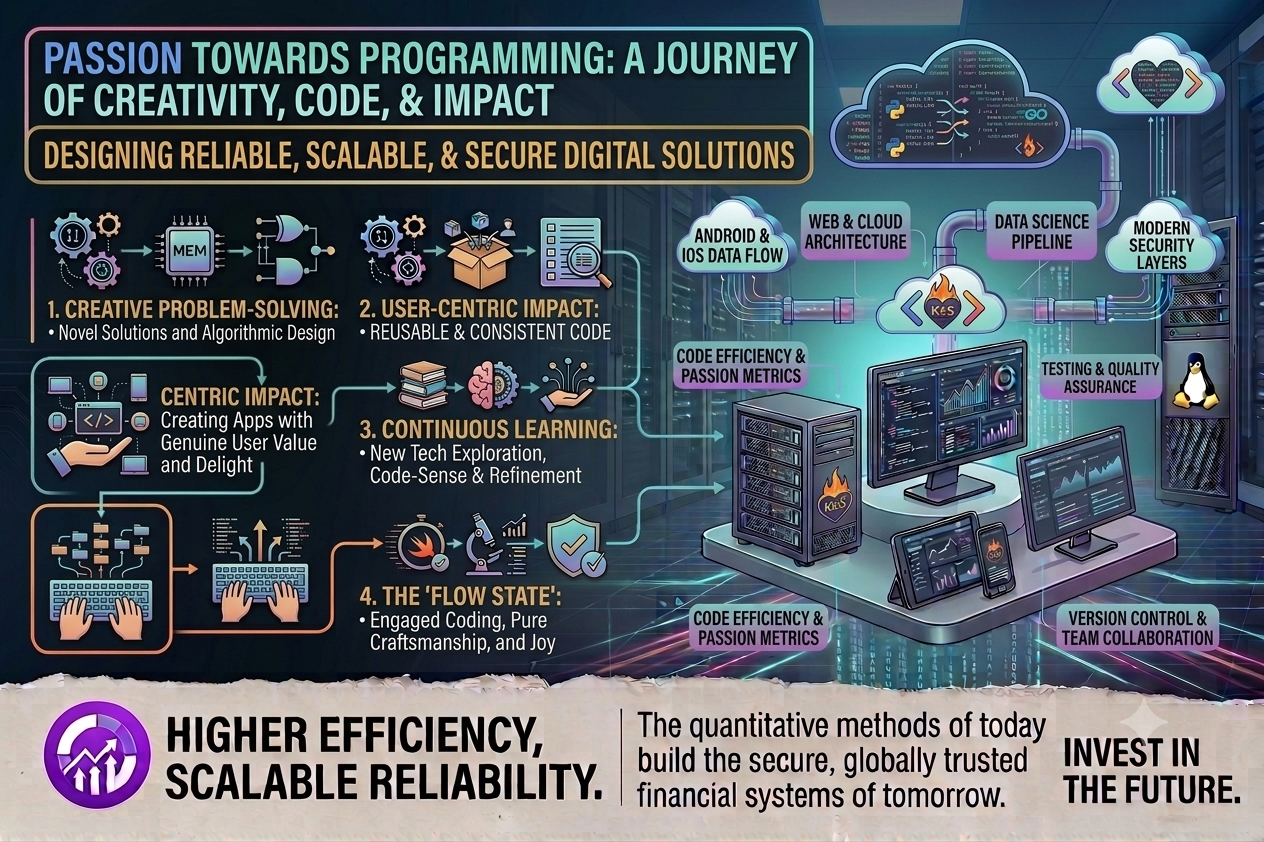
Passion Towards Programming
Programming is often viewed as a technical skill involving coding languages, frameworks, databases, and software tools. However, behind every successful developer lies something much deeper than technical knowledge—a genuine passion for programming.
Technology evolves rapidly, and developers constantly face new challenges, changing requirements, and emerging technologies. Passion helps programmers remain curious, motivated, and committed to continuous improvement throughout their careers.
What Does Passion for Programming Mean?
Passion for programming is the desire to create, learn, experiment, and solve problems using technology.
It is the excitement developers feel when:
Solving complex problems
Building innovative applications
Learning new technologies
Optimizing system performance
Creating better user experiences
Automating repetitive tasks
Turning ideas into reality
For passionate programmers, coding is not simply a job responsibility. It becomes a continuous journey of learning and creation.
Why Passion Matters in Software Development
Software development is not always easy. Projects can involve tight deadlines, technical challenges, changing requirements, and unexpected issues.
Passion helps developers:
Stay motivated during difficult projects
Learn new technologies faster
Adapt to industry changes
Continuously improve skills
Build higher-quality solutions
Solve problems creatively
Developers who enjoy what they do are often more willing to explore better approaches and innovative solutions.
Programming Is About Problem Solving
Many people assume programming is primarily about writing code. In reality, programming is fundamentally about solving problems.
A developer may be required to:
Improve application performance
Design scalable systems
Automate business processes
Enhance security
Create better customer experiences
Integrate complex technologies
Programming languages are simply tools used to solve these challenges.
Passionate developers enjoy the process of identifying problems, exploring solutions, and implementing improvements.
Continuous Learning in Programming
Technology changes continuously. New frameworks, programming languages, cloud platforms, AI tools, and development practices emerge every year.
Successful developers understand that learning never truly ends.
Areas that often require ongoing learning include:
Web development
Mobile development
Cloud computing
Artificial Intelligence
Cybersecurity
Data analytics
DevOps
Software architecture
Passion makes this continuous learning process enjoyable rather than burdensome.
Creativity and Programming
Programming combines technical skills with creativity.
Developers frequently design:
User interfaces
Application workflows
System architectures
Business solutions
Automation processes
Digital products
Building software often requires creative thinking to develop efficient, scalable, and user-friendly solutions.
Passionate programmers enjoy experimenting with different approaches and exploring new possibilities.
Challenges That Shape Great Developers
Every programmer encounters challenges throughout their career.
Common challenges include:
Debugging complex issues
Performance optimization
Security vulnerabilities
Scalability concerns
Technology migrations
Legacy system maintenance
These challenges help developers gain experience and improve their problem-solving abilities.
Rather than avoiding challenges, passionate programmers often view them as opportunities to learn and grow.
Building Real-World Impact
Software influences almost every industry today.
Applications help businesses:
Improve productivity
Serve customers better
Automate operations
Manage data
Increase efficiency
Drive innovation
Developers contribute to creating solutions that can impact thousands or even millions of users.
Knowing that technology can solve real-world problems often becomes a strong source of motivation.
Habits of Passionate Programmers
Many successful developers share common habits:
Reading technical articles
Exploring new technologies
Building side projects
Participating in developer communities
Learning from open-source projects
Experimenting with new tools
Continuously improving coding practices
These activities help expand both technical skills and industry knowledge.
Passion and Career Growth
Technical skills are important, but long-term growth often depends on maintaining curiosity and enthusiasm for learning.
Passionate developers frequently grow into roles such as:
Senior Developer
Technical Lead
Solution Architect
Engineering Manager
Product Developer
Technology Consultant
Entrepreneur
Their willingness to continuously learn and improve often creates new opportunities throughout their careers.
Programming Beyond Technology
Programming is not only about software development. It teaches valuable skills that apply across many areas of life and business:
Logical thinking
Problem solving
Creativity
Analytical reasoning
Attention to detail
Continuous improvement
These skills can contribute to both personal and professional development.
Conclusion
Passion towards programming is one of the strongest drivers of long-term success in technology. While programming languages, frameworks, and tools continue to evolve, curiosity, learning, and problem-solving remain at the heart of great software development.
Developers who genuinely enjoy building solutions, exploring new technologies, and overcoming challenges are often better equipped to adapt, innovate, and create meaningful impact through technology.