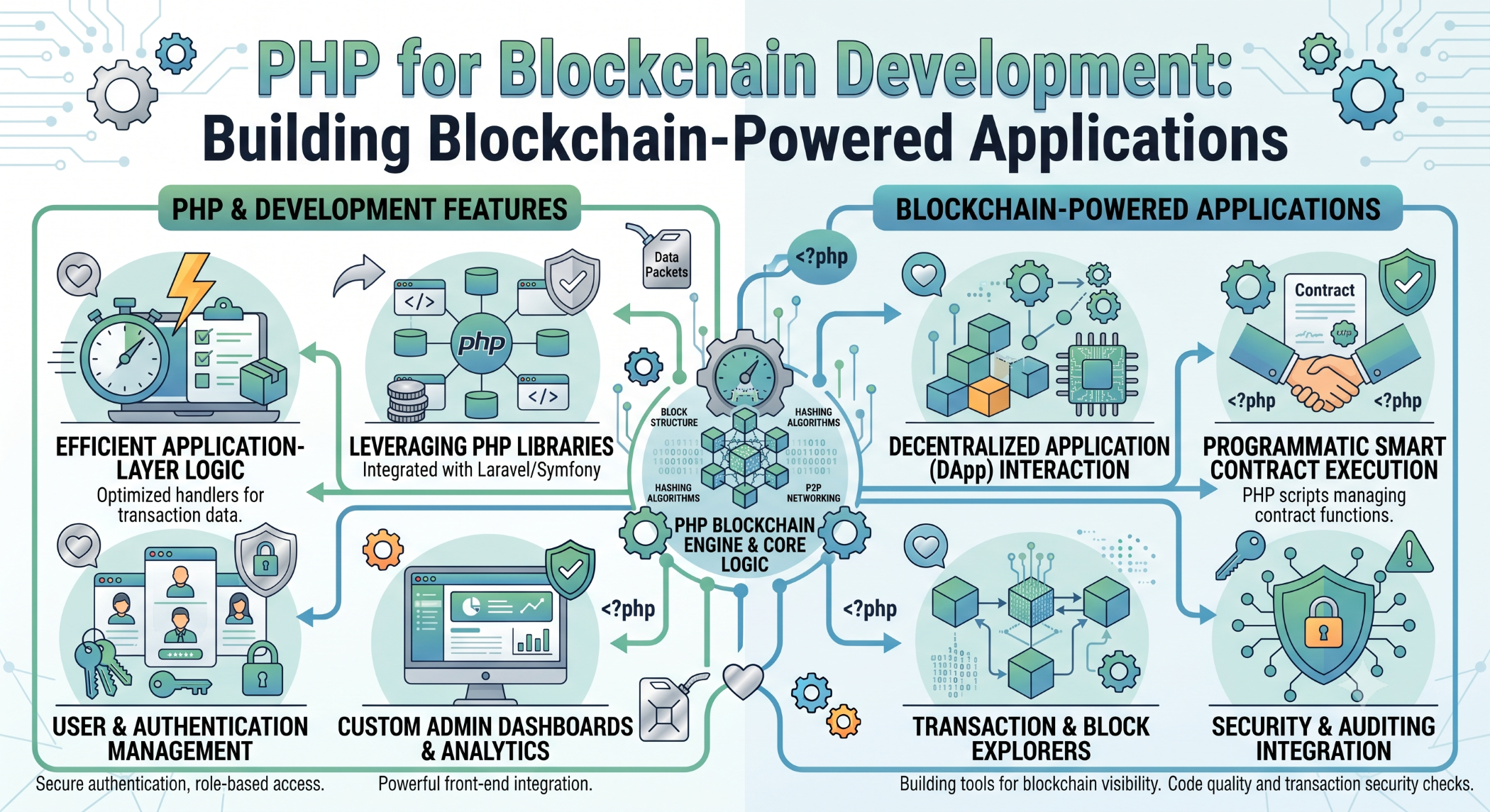
PHP for Blockchain Development: Building Blockchain-Powered Applications
Blockchain development is no longer limited to creating cryptocurrencies. Businesses are exploring blockchain for digital assets, payment systems, smart contracts, decentralized applications, and secure transaction workflows.
Although blockchain platforms often use specialized languages for smart contracts, PHP can play an important role in the application layer by connecting web applications and backend systems with blockchain networks.
Can PHP Be Used for Blockchain Development?
Yes. PHP can be used to build the web and backend components of blockchain-based applications.
PHP is particularly useful for:
Building blockchain-enabled web applications.
Creating backend APIs.
Connecting applications with blockchain nodes or third-party services.
Managing users and application data.
Processing blockchain transaction information.
Building cryptocurrency-related dashboards and platforms.
PHP does not need to replace the blockchain platform itself. It can work as part of a larger architecture.
PHP and Blockchain Architecture
A PHP blockchain application may follow an architecture such as:
Web / Mobile Application
↓
PHP API
↓
Blockchain Integration Layer
↓
Blockchain Network
↓
Smart Contract / Transaction
The PHP backend can handle application logic while the blockchain handles selected transactions or records.
Connecting PHP With Blockchain Networks
PHP applications can interact with blockchain networks through APIs, RPC endpoints, SDKs, or third-party blockchain services.
A PHP application may request information such as:
Wallet Balance
Transaction Status
Block Information
Token Data
Transaction History
The exact integration method depends on the blockchain network being used.
PHP for Cryptocurrency Applications
PHP can be used to build applications around cryptocurrency networks.
For example, a cryptocurrency platform may contain:
User Registration
↓
Authentication
↓
Wallet Management
↓
Transaction Request
↓
Blockchain Integration
↓
Transaction Status
The PHP backend can manage users, business rules, transaction records, notifications, and reporting while the blockchain handles the actual network transaction.
PHP and Smart Contracts
Smart contracts are generally written in languages supported by the target blockchain, such as Solidity for Ethereum-compatible networks.
PHP can interact with deployed smart contracts through the blockchain's available APIs or communication interfaces.
A simplified flow is:
PHP Application
↓
Smart Contract Call
↓
Blockchain Network
↓
Contract Execution
↓
Transaction Result
This allows PHP applications to provide a familiar web-based interface for blockchain functionality.
PHP for Blockchain APIs
APIs are an important part of blockchain application development.
A PHP backend can expose APIs for frontend or mobile applications while managing blockchain interactions internally.
For example:
Mobile App
↓
PHP REST API
↓
Business Logic
↓
Blockchain
This architecture can prevent clients from directly handling sensitive backend operations.
PHP and Blockchain Wallets
Wallet functionality can be integrated into PHP-based applications depending on the blockchain and wallet technology being used.
A PHP backend may manage wallet-related information, transaction requests, balances, and application-level records.
Private keys should be handled with extreme care. They should not be stored in plain text or exposed through frontend applications.
PHP for Blockchain-Based Payment Systems
Businesses can use PHP to build payment platforms that interact with blockchain networks.
For example:
Customer
↓
PHP Payment Application
↓
Blockchain Transaction
↓
Network Confirmation
↓
Payment Status
The application can track transaction status and update the business system after the blockchain transaction reaches the required state.
PHP and Blockchain Databases
Blockchain should not necessarily store all application data.
A hybrid architecture can keep normal application information in a traditional database while storing selected transactions or proofs on the blockchain.
For example:
PHP Application
↙ ↘
MySQL Blockchain
↓ ↓
User Data Transactions
Products Ownership
Orders Verification
This can improve application performance and avoid unnecessary blockchain storage costs.
Benefits of Using PHP for Blockchain Applications
Existing PHP Expertise
Businesses that already use PHP can leverage existing development skills when building the application layer.
Rapid Web Development
PHP frameworks and libraries can help teams build dashboards, APIs, administration panels, and customer-facing interfaces efficiently.
Database Integration
PHP works well with traditional databases such as MySQL, making it suitable for hybrid blockchain applications.
Flexible Architecture
PHP can act as the connection between users, traditional business systems, and blockchain networks.
Challenges of PHP Blockchain Development
Blockchain applications introduce technical challenges beyond conventional web development.
These include:
Blockchain integration: Each network may have its own APIs, transaction models, and tooling.
Transaction delays: Blockchain confirmations can take time depending on the network.
Transaction costs: Fees can vary based on network activity and blockchain design.
Security: Wallet credentials, private keys, and transaction signing require careful protection.
Data consistency: Blockchain state and application databases need clear synchronization rules.
PHP Frameworks for Blockchain Applications
Popular PHP frameworks such as Laravel and Symfony can be used to build blockchain application layers.
For example, Laravel can provide:
Authentication
API development
Database integration
Queue processing
Administrative functionality
Application business logic
Blockchain-specific integration can then be added through suitable APIs or libraries.
PHP and Ethereum
PHP can be used to build web applications that interact with Ethereum-compatible networks.
A typical architecture might be:
PHP / Laravel
↓
Blockchain API / RPC
↓
Ethereum-Compatible Network
↓
Smart Contract
The PHP backend can manage application logic, while smart contracts handle blockchain-specific operations.
Security Best Practices
Security is especially important for blockchain applications.
Developers should:
Protect private keys and credentials.
Use secure authentication.
Validate all external input.
Secure blockchain API endpoints.
Apply strict access controls.
Monitor transactions.
Avoid exposing sensitive blockchain credentials to client applications.
Smart contracts should also be reviewed and tested independently when they are part of the solution.
PHP for Enterprise Blockchain Solutions
Businesses may combine PHP applications with blockchain technology for areas such as:
Digital asset platforms
Payment systems
Supply-chain applications
Transaction management
Asset tracking
Blockchain-based verification
The blockchain should be introduced only where its decentralized or tamper-resistant characteristics provide a meaningful advantage.
Blockchain Development at Solace Infotech
Solace Infotech works across PHP, Laravel, blockchain, APIs, web applications, mobile applications, and product development.
These technologies can be combined to create blockchain-enabled business applications where the PHP layer handles user experiences, APIs, business rules, databases, and integrations with blockchain networks.
Best Practices
Start by defining which parts of the application actually need blockchain technology. Keep conventional application data in an appropriate database and use the blockchain for transactions, ownership, verification, or other functionality that benefits from a distributed ledger.
Choose the target blockchain carefully, define secure transaction workflows, and test integration thoroughly before deployment.
Conclusion
PHP can play an important role in blockchain development, particularly at the web application, API, integration, and business-logic layers.
It can work alongside blockchain networks, smart contracts, wallets, traditional databases, and frontend applications to create complete blockchain-powered solutions.
The most effective approach is not to put the entire application on a blockchain. Instead, combine PHP and traditional application technologies with blockchain where it provides clear business value, while giving particular attention to security, transaction handling, scalability, and integration.