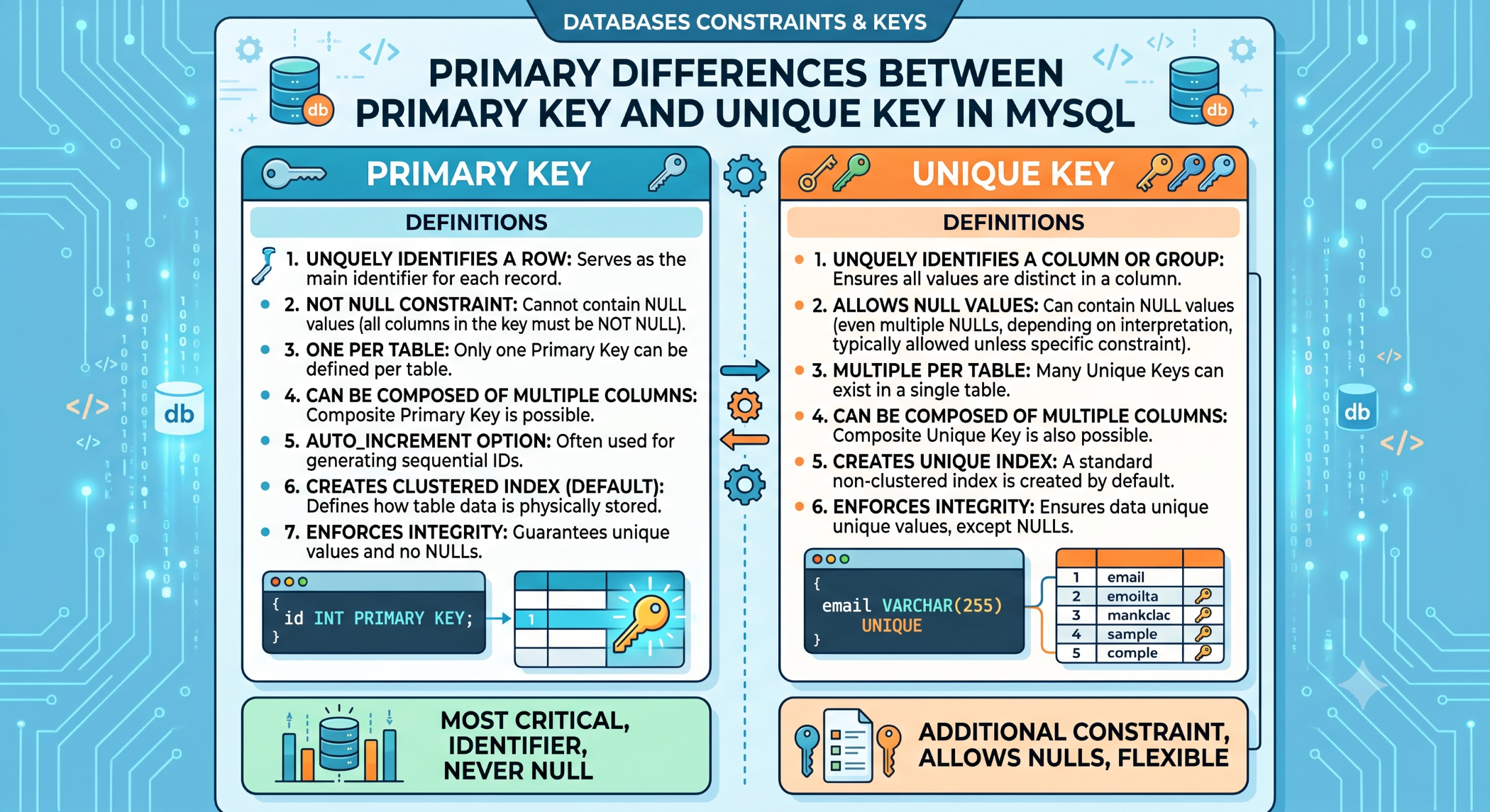
Primary Differences Between Primary Key and Unique Key in MySQL
Database tables often need constraints to ensure that data remains accurate and consistent. Two commonly used MySQL constraints are the PRIMARY KEY and UNIQUE KEY.
Both can enforce uniqueness, but they are not interchangeable. Understanding the primary differences between them helps developers design better relational databases.
What Is a Primary Key?
A primary key uniquely identifies each record in a table.
For example:
CREATE TABLE customers (
id INT PRIMARY KEY AUTO_INCREMENT,
name VARCHAR(100),
email VARCHAR(150)
);
Here, id uniquely identifies every customer.
A table can have only one primary key definition, although that primary key can contain multiple columns.
What Is a Unique Key?
A unique key ensures that duplicate values are not allowed within the constrained column or combination of columns.
For example:
CREATE TABLE users (
id INT PRIMARY KEY AUTO_INCREMENT,
email VARCHAR(150) UNIQUE
);
Here, id is the primary key, while email has a unique constraint.
A table can have multiple unique constraints.
Primary Differences
1. Number of Keys
A table can have only one primary key definition.
A table can have multiple unique keys.
Primary Key → One per table
Unique Key → Multiple allowed
2. NULL Values
A primary key cannot contain NULL.
A unique key can generally allow NULL values in MySQL, subject to the column definition and MySQL's unique-index behavior.
For example:
CREATE TABLE employees (
id INT PRIMARY KEY,
email VARCHAR(150) UNIQUE
);
The id column must always have a value, while email can be nullable unless NOT NULL is also specified.
3. Purpose
A primary key is primarily used to identify a record.
A unique key is primarily used to enforce uniqueness for a value that should not be duplicated.
For example:
Customer ID → Primary Key
Email → Unique Key
4. Relationships
Primary keys are commonly referenced by foreign keys to establish relationships between tables.
For example:
CREATE TABLE orders (
id INT PRIMARY KEY,
customer_id INT,
FOREIGN KEY (customer_id)
REFERENCES customers(id)
);
A unique key can also be referenced by a foreign key when the referenced columns satisfy the required uniqueness rules, but the primary key is the conventional identifier for a table.
5. Business Meaning
A primary key normally represents the table's main identity.
A unique key often represents a business rule.
For example, in a customer table:
id → Record identity
email → Must be unique
employee_code → Must be unique
Composite Primary Key
A primary key can contain multiple columns.
For example:
CREATE TABLE enrollments (
student_id INT,
course_id INT,
PRIMARY KEY (student_id, course_id)
);
Together, student_id and course_id uniquely identify an enrollment.
Composite Unique Key
A unique constraint can also contain multiple columns:
CREATE TABLE bookings (
customer_id INT,
booking_date DATE,
UNIQUE (customer_id, booking_date)
);
This can enforce a business rule where the same customer cannot have duplicate records for the same date.
Primary Key vs Unique Key Example
Consider an e-commerce application:
Products
---------------------------------
id → Primary Key
sku → Unique Key
barcode → Unique Key
The product ID identifies the database record, while the SKU and barcode must not be duplicated.
This demonstrates why both types of constraints may be required in the same table.
Primary Key vs Unique Key and Indexes
MySQL uses indexes to enforce uniqueness.
A primary key is implemented as the table's primary index structure, while a unique constraint is supported by a unique index.
These indexes can also help queries locate matching records efficiently.
However, indexes have a maintenance cost, so they should be created based on genuine application and business requirements.
Which One Should You Use?
Use a primary key when you need a unique identifier for every record.
Use a unique key when a column or combination of columns must not contain duplicate values but is not the table's primary identifier.
For example:
CREATE TABLE customers (
id INT PRIMARY KEY AUTO_INCREMENT,
email VARCHAR(150) NOT NULL UNIQUE,
phone VARCHAR(30) UNIQUE
);
Here:
id identifies the customer.
email must be unique.
phone must be unique when a value is provided.
Best Practices
Every important table should have a clear primary key unless there is a deliberate reason for another design.
Use unique constraints to enforce real business rules such as unique email addresses, usernames, SKUs, or external reference numbers.
Combine these constraints with appropriate NOT NULL definitions when a value is mandatory.
Conclusion
The primary difference between a primary key and a unique key is their purpose.
A primary key provides the main identity of a record and a table can have only one primary key definition. A unique key prevents duplicate values and a table can have multiple unique constraints.
Using both appropriately helps developers create consistent, reliable, and well-structured MySQL databases.