Introduction
Problems are a natural part of every profession and every business. A technical issue, a missed deadline, a customer complaint, an inefficient process, or an unexpected business challenge can require people to think carefully and act decisively.
This is why problem-solving skills are among the most valuable skills a professional can develop.
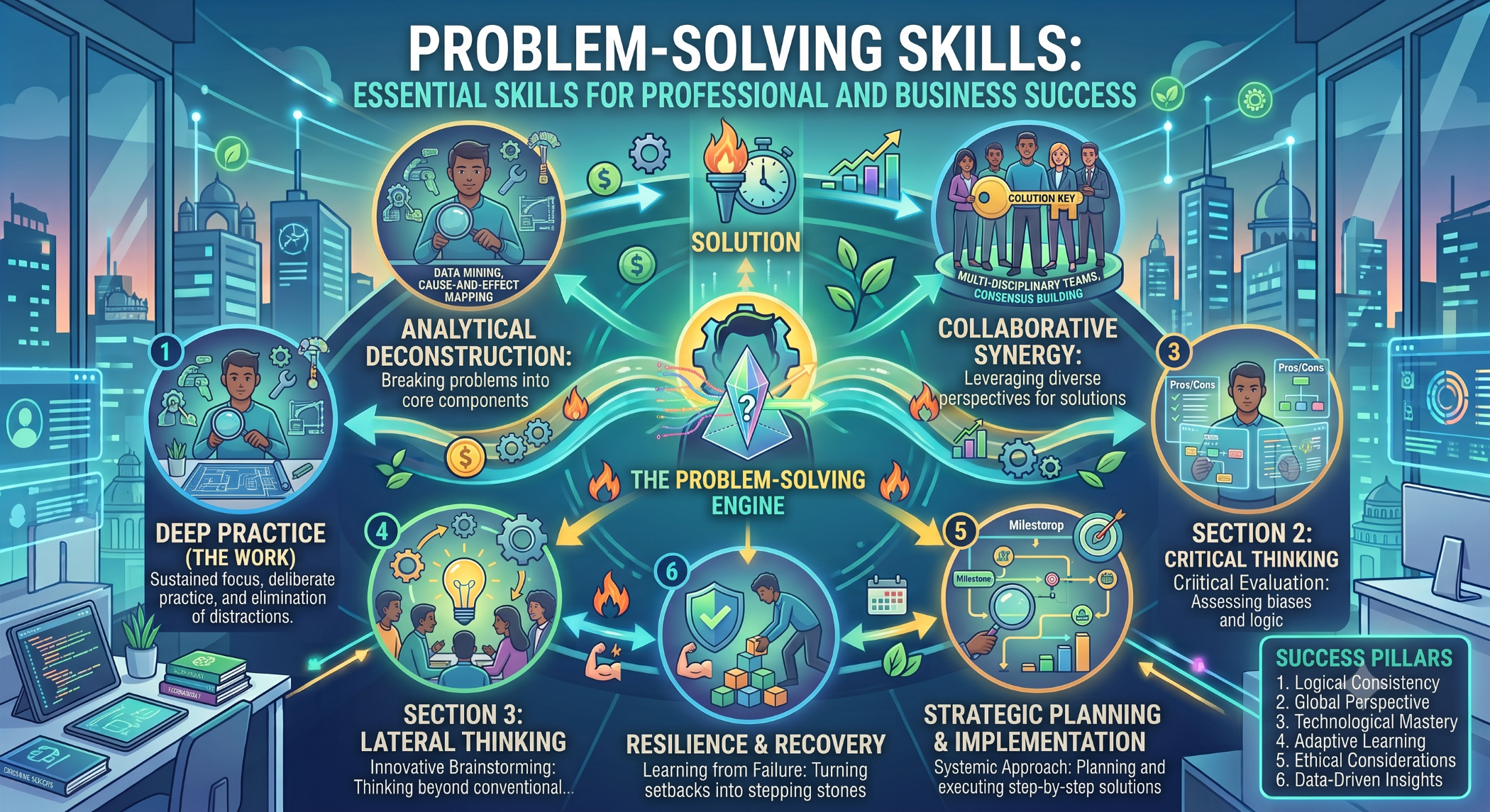
Problem-solving is not simply about finding a quick answer. Effective problem-solving involves understanding the actual issue, identifying its root cause, considering possible solutions, evaluating trade-offs, and implementing the most appropriate option. Modern guidance for software professionals similarly emphasizes breaking complex issues into manageable parts, structured debugging, critical thinking, and communication.
What Are Problem-Solving Skills?
Problem-solving skills are the abilities that help a person recognize a problem, analyze available information, develop possible solutions, and determine the best course of action.
A strong problem solver does not immediately jump to conclusions. Instead, they ask questions such as:
What exactly is happening?
Why is it happening?
What information do we have?
What alternatives are available?
What could happen after each possible solution?
This structured approach helps professionals make better decisions and avoid repeatedly treating symptoms instead of addressing the underlying cause.
Why Problem-Solving Skills Matter
Almost every role requires some degree of problem-solving.
Developers solve technical issues. Project managers resolve delivery challenges. Sales teams handle customer objections. HR teams address employee concerns. Business leaders make decisions involving budgets, resources, risks, and growth.
Professionals with strong problem-solving abilities can respond to these situations more effectively.
They are also better prepared to work independently because they do not always need someone else to tell them exactly what to do when they encounter an obstacle.
Identify the Problem Clearly
The first step in solving any problem is to define it accurately.
A vague statement such as “the application is slow” is not enough for a development team. The team needs to determine which page is slow, under what conditions the issue occurs, which users are affected, and whether the problem originates in the frontend, backend, database, network, or infrastructure.
Defining the problem precisely makes investigation more focused. Workplace problem-solving guidance also recommends clearly identifying and describing the problem before attempting to generate solutions.
Understand the Root Cause
One of the most common mistakes in problem-solving is addressing only the visible symptom.
Suppose a website becomes unavailable several times a day. Restarting the server may make the website available again, but that does not necessarily solve the real problem.
The underlying cause could be excessive memory usage, a database bottleneck, a configuration issue, a traffic spike, or a software defect.
Root cause analysis helps teams move beyond temporary fixes and identify why the problem occurred in the first place. Structured debugging commonly involves reproducing the issue, isolating variables, verifying the fix, and documenting the outcome.
Analyze Before Acting
Good problem solvers gather information before making decisions.
For a software problem, this might include application logs, database queries, error messages, system metrics, user reports, and recent code changes.
For a business problem, relevant information might include sales data, customer feedback, operational costs, employee performance, or market conditions.
The objective is to replace assumptions with evidence.
This can prevent teams from wasting time on solutions that appear logical but do not address the actual problem.
Break Complex Problems Into Smaller Parts
Large problems can often seem overwhelming because multiple issues are connected.
Breaking a complex problem into smaller components makes it easier to understand.
For example, an e-commerce platform experiencing poor performance may actually have several independent issues:
Frontend performance may be affected by large images or excessive JavaScript.
Backend performance may be affected by inefficient application logic.
Database performance may be affected by missing indexes or expensive queries.
Infrastructure performance may be affected by insufficient resources.
Once the larger problem has been divided into smaller areas, each component can be investigated systematically.
This ability to decompose a complex problem into manageable parts is a foundational problem-solving skill for software professionals.
Think Critically
Critical thinking is closely connected with problem-solving.
Professionals need to question assumptions, compare evidence, identify inconsistencies, and consider consequences before making decisions.
For example, if a particular feature is causing customer complaints, the solution may not necessarily be to remove the feature. The underlying issue could be poor usability, unclear instructions, insufficient performance, or an unexpected workflow.
Critical thinking helps professionals look beyond the first explanation and consider alternative possibilities.
Develop Multiple Solutions
There is often more than one way to solve a problem.
A software performance issue could potentially be addressed through query optimization, caching, code improvements, architectural changes, or infrastructure scaling.
The best approach depends on factors such as cost, complexity, risk, performance requirements, and long-term maintainability.
Generating multiple alternatives gives decision-makers the opportunity to compare solutions rather than automatically choosing the first idea.
Creative thinking can be particularly useful at this stage because reframing a problem as a question can encourage teams to explore more possibilities.
Evaluate Trade-Offs
Every solution has advantages and disadvantages.
A quick solution may resolve an immediate issue but create technical debt. A highly scalable solution may require more time and investment. A low-cost option may introduce limitations later.
Effective problem solving therefore requires evaluating trade-offs.
Professionals should consider:
Cost
Time
Risk
Quality
Scalability
Security
Maintainability
User impact
Business impact
The goal is not always to find the perfect solution. The goal is to find the most appropriate solution for the situation.
Make Decisions With Confidence
After analyzing the problem and evaluating alternatives, a decision must be made.
Indecision can itself become a business problem when delays increase costs or affect customers.
A strong problem solver makes decisions based on the available evidence, clearly communicates the reasoning, and remains prepared to adjust the approach when new information becomes available.
Good decision-making is therefore a combination of analysis and judgment.
Communication Is Part of Problem Solving
Complex problems are rarely solved in isolation.
Developers work with testers and project managers. Project managers communicate with clients. Business leaders work with finance, sales, operations, and technical teams.
Clear communication ensures that everyone understands:
What the problem is
What caused it
What solution is being proposed
What action is required
What outcome is expected
Communication is especially important when explaining technical problems to non-technical stakeholders. Modern software-development guidance identifies communication and collaboration as important parts of effective problem-solving.
Problem Solving in Software Development
Software development provides many examples of practical problem-solving.
A developer may encounter a failing API, an application crash, a database issue, a memory leak, a security vulnerability, or unexpected user behavior.
A structured approach can involve reproducing the problem, examining relevant evidence, isolating the source, developing a fix, testing it, and monitoring the result.
Importantly, good developers do not simply fix defects. They also consider whether the solution could introduce other problems elsewhere in the system.
This broader perspective is particularly important in complex applications and distributed systems.
Problem Solving and Artificial Intelligence
AI-assisted development has made it easier to generate code, summarize information, explore alternatives, and automate routine development tasks.
However, AI-generated output still needs to be evaluated.
The professional must determine whether an AI-generated solution actually addresses the business requirement, whether it is secure, whether it performs well, and whether it fits the application's architecture.
As AI takes on more routine coding tasks, the ability to define problems precisely, evaluate proposed solutions, and exercise sound judgment becomes even more important.
How to Improve Problem-Solving Skills
Problem-solving improves through practice.
Start by becoming more curious about problems instead of immediately looking for quick fixes. Ask why something happened and what evidence supports the current explanation.
Practice breaking complicated issues into smaller components.
When possible, document problems, solutions, and lessons learned. Reviewing previous decisions can reveal patterns and improve future responses.
Work on projects that require investigation rather than only repetitive tasks. Real-world experience exposes professionals to ambiguity, competing priorities, and unexpected situations.
Collaboration also helps because other people may identify possibilities that one person overlooks.
Learn From Mistakes
A failed solution does not necessarily mean failure in problem-solving.
Sometimes an incorrect approach provides information that helps narrow down the actual cause.
The important thing is to learn from the result.
After resolving a significant problem, teams can ask:
What happened?
Why did it happen?
What did we do?
What worked?
What did not work?
What should we change to prevent recurrence?
This turns individual incidents into organizational learning.
Building a Problem-Solving Culture
Organizations can benefit significantly when problem-solving becomes part of the workplace culture.
Employees should be encouraged to raise issues early rather than hide them. Teams should focus on root causes instead of assigning blame. Managers should create an environment where people can discuss failures and lessons openly.
A strong problem-solving culture also values documentation, collaboration, experimentation, and continuous improvement.
The objective is not to create a workplace without problems. That is unrealistic. The objective is to create a workplace capable of solving problems quickly and intelligently.
Conclusion
Problem-solving skills are essential for professional growth, effective teamwork, and business success.
They help people move from identifying a problem to understanding its cause, evaluating alternatives, making informed decisions, and implementing sustainable solutions.
For technology professionals, problem-solving is particularly important because software systems, customer requirements, and business environments are constantly changing. Technical knowledge provides the tools, but problem-solving skills determine how effectively those tools are used.
The strongest professionals are not necessarily those who encounter the fewest problems. They are the people who can analyze difficult situations, remain objective, collaborate with others, and consistently find practical ways forward.