Progressive Web App (PWA): The Future of Modern Web Experiences
Businesses increasingly need digital experiences that work seamlessly across smartphones, tablets, and desktops. A Progressive Web App (PWA) provides an approach that combines the accessibility of a website with several capabilities commonly associated with mobile applications.
PWAs are built using web technologies and can provide features such as responsive interfaces, offline functionality, caching, and installation on supported devices.
What Is a Progressive Web App?
A Progressive Web App is a web application designed to provide an app-like experience through a browser.
Unlike a traditional native mobile application, users can access a PWA through a web URL. Depending on browser and platform support, the application can also be installed on a device.
A typical PWA uses technologies such as:
HTML
CSS
JavaScript
Service Workers
Web App Manifest
How Does a PWA Work?
A PWA typically uses a service worker to handle selected background tasks such as caching resources and intercepting network requests.
A simplified flow is:
User
↓
Web Browser
↓
PWA
↓
Service Worker
↓
Cache / Server
The exact behavior depends on the application's architecture and caching strategy.
Key Features of PWAs
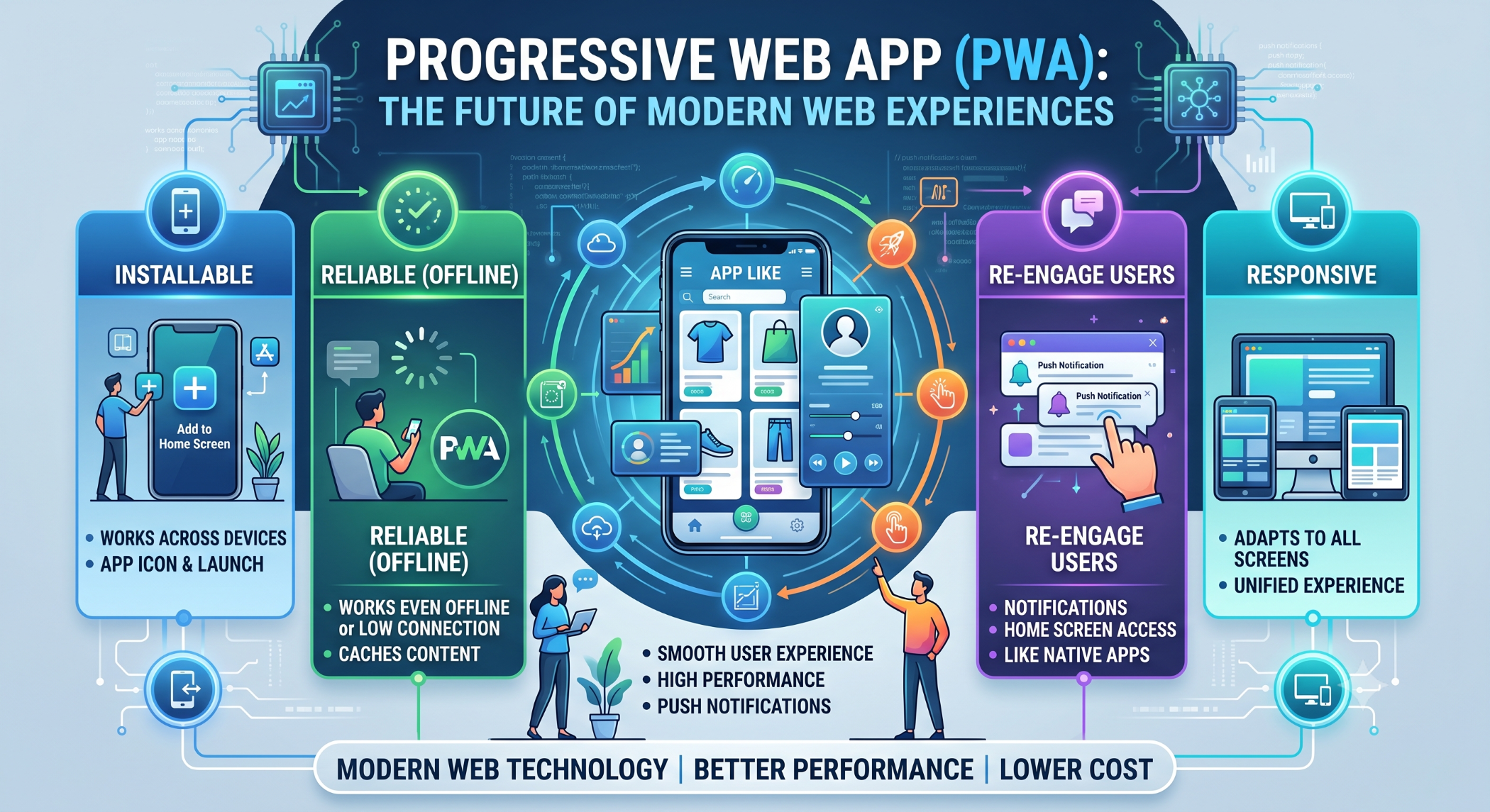
Responsive Design
A PWA should adapt to different screen sizes and provide a consistent experience across mobile and desktop devices.
Offline Support
Service workers can cache selected resources, allowing parts of an application to remain available when the network connection is unavailable or unreliable.
The amount of functionality available offline depends on how the application is designed.
Installability
On supported browsers and platforms, users may be able to install a PWA and launch it like an application.
Fast Loading
Caching and optimized web resources can help improve loading performance, particularly for repeat visits.
Web Accessibility
A PWA can be accessed through a standard web URL, making it easy to share through search engines, links, social media, and other channels.
Benefits of Progressive Web Apps
PWAs can offer several advantages for businesses.
Single web-based experience: One application can serve users across multiple device types.
Lower development duplication: Businesses may avoid maintaining completely separate implementations for every platform, depending on the required functionality.
Easy distribution: Users can access the application through the web without necessarily going through an app-store installation process.
Simplified updates: Changes can be deployed through the web rather than requiring users to manually install every application update.
PWA vs Native App
Native applications are developed specifically for platforms such as Android and iOS and can provide deep access to platform capabilities.
A PWA is primarily web-based and focuses on accessibility, cross-platform delivery, and app-like web experiences.
Native development may be more appropriate when an application depends heavily on advanced platform-specific capabilities. A PWA may be more suitable when broad web accessibility and a shared application experience are higher priorities.
PWA Use Cases
Progressive Web Apps can be useful for:
E-commerce platforms
News and publishing websites
Customer portals
Business applications
Booking platforms
Content-driven applications
For example, an e-commerce PWA can provide product browsing, search, shopping-cart functionality, and responsive checkout through a web-based experience.
PWA Limitations
PWAs do not provide identical capabilities across every browser and operating system.
Access to certain hardware features, background functionality, notifications, and installation behavior can vary by platform.
Businesses should therefore evaluate the required features against the capabilities of their target users' devices and browsers before selecting a PWA approach.
Best Practices for PWA Development
Start with a mobile-first responsive design and identify which features need to work during poor or unavailable connectivity.
Use HTTPS, configure service-worker caching carefully, optimize images and other assets, and test the application across different browsers, devices, and network conditions.
Avoid caching sensitive or highly dynamic content without carefully considering security and data freshness.
Progressive Web Apps at Solace Infotech
Solace Infotech works with mobile and web application technologies and has expertise in developing solutions that can be adapted to different business and platform requirements.
For businesses evaluating a PWA, the technology selection should be based on the product's target audience, required device capabilities, performance expectations, distribution strategy, and long-term maintenance needs.
Conclusion
Progressive Web Apps provide an effective way to combine the broad accessibility of the web with selected app-like capabilities.
With responsive design, service-worker-based caching, offline support, and installability on supported platforms, PWAs can provide a strong option for many modern business applications.
The right choice ultimately depends on the product requirements. When web reach, cross-platform accessibility, and a streamlined development model are priorities, a Progressive Web App can be a practical solution.