What Is a Quick Learner?
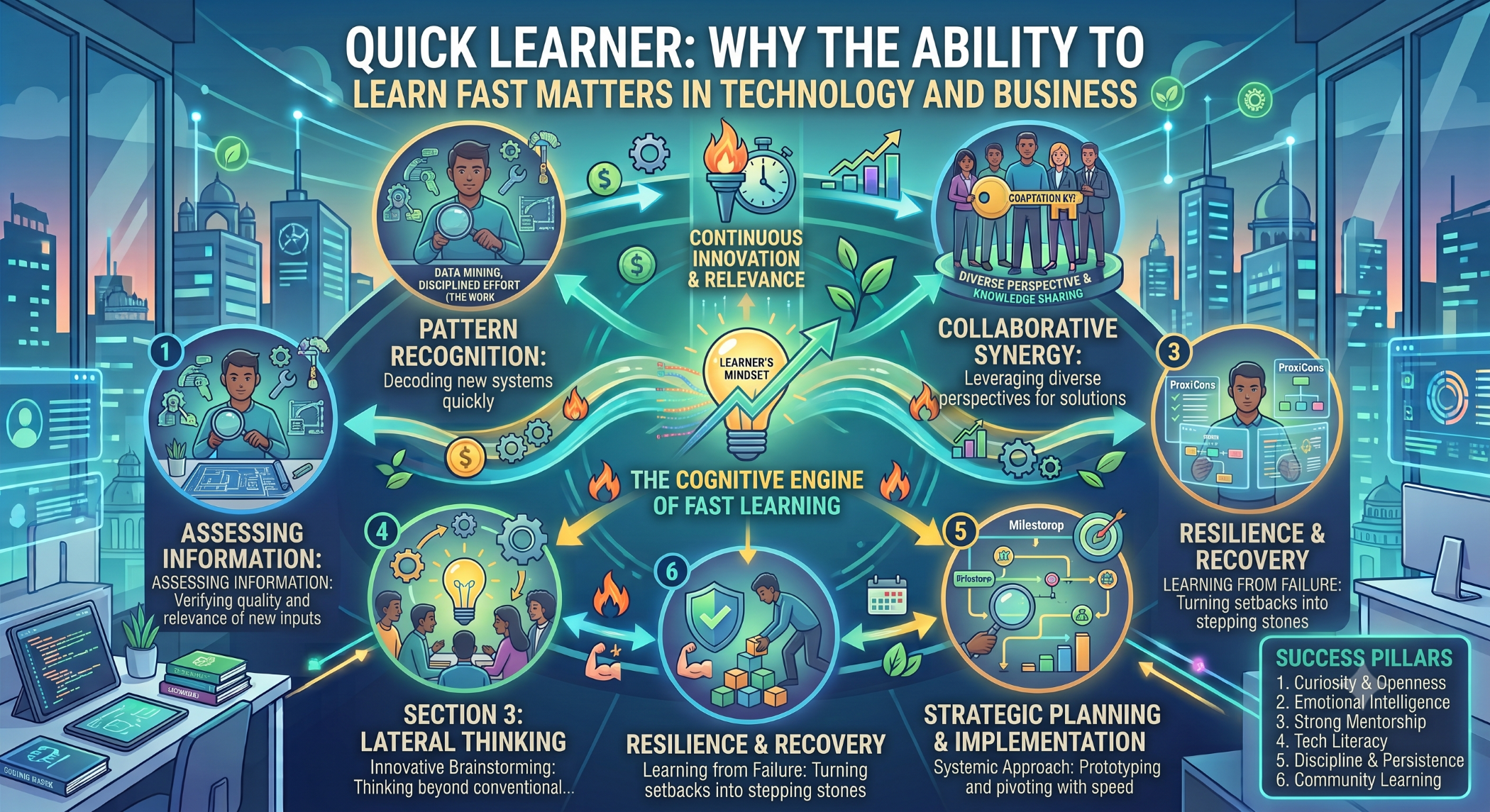
A quick learner is someone who can understand new concepts, acquire skills, adapt to change, and apply new knowledge effectively in a relatively short period.
Being a quick learner does not mean memorizing information quickly. It means being able to understand the underlying concept, connect it with existing knowledge, and use it in a practical situation.
This ability is particularly valuable in the technology industry, where tools, frameworks, programming languages, development practices, and business requirements continuously evolve.
Why Being a Quick Learner Matters
Organizations operate in constantly changing environments. New technologies emerge, customer expectations change, and businesses regularly adopt new ways of working.
A professional who can learn quickly can adapt without requiring a completely new training cycle for every change.
For example, a developer who understands fundamental programming and software-design concepts can often transition more easily to a new language or framework because the underlying principles remain familiar.
Learning agility therefore becomes a long-term professional advantage.
Quick Learning and Career Growth
Career growth depends not only on current skills but also on the ability to develop new ones.
A professional may begin with expertise in one technology and eventually take responsibility for architecture, project management, technical leadership, client communication, or business strategy.
Each stage requires additional knowledge.
Quick learners can often take advantage of new opportunities because they are willing and able to acquire the knowledge required for unfamiliar responsibilities.
Quick Learners in the IT Industry
Technology professionals face constant learning requirements.
A developer may need to understand a new framework. A tester may adopt a new automation platform. A project manager may need to understand a new development methodology. A technical team may need to learn a new cloud service or integrate an emerging AI capability.
The ability to learn quickly can reduce the friction associated with these transitions.
However, speed should not come at the expense of depth. The objective is to understand enough to apply knowledge correctly and then deepen expertise through practice and experience.
Curiosity Is a Major Learning Advantage
Curiosity is one of the strongest characteristics of a quick learner.
Curious professionals do not stop at knowing what something does. They want to understand why it works and how it can be used.
For example, instead of simply learning how to use an API, a curious developer may explore authentication, error handling, rate limits, performance, security, and integration patterns.
This deeper curiosity creates stronger understanding and makes future learning easier.
Quick Learner vs Memorization
Memorization and learning are not the same.
A person may remember a large amount of information but struggle to apply it to a new problem.
A quick learner focuses on concepts and relationships.
For example, understanding object-oriented programming principles is more valuable than simply memorizing the syntax of one programming language. Once the underlying concepts are understood, learning another object-oriented language can become significantly easier.
Learning Through Practical Experience
Practical experience is one of the fastest ways to strengthen knowledge.
Reading documentation provides information, but implementing something in a real project creates practical understanding.
A developer may learn about database indexing theoretically and then discover through a real application how indexing affects query performance, storage, and maintenance.
Similarly, a project manager learns more about delivery management by handling real dependencies, changing requirements, resource constraints, and client expectations.
Experience turns theoretical knowledge into usable skills.
Quick Learners Ask Questions
Asking questions is not a sign of weakness. It is an effective learning strategy.
When professionals ask precise questions, they can clarify requirements, understand unfamiliar concepts, and avoid making incorrect assumptions.
The quality of the question matters.
Instead of simply asking, “How does this work?” a professional can ask, “Why are we using this approach instead of the alternative, and what trade-offs does it introduce?”
Such questions encourage deeper understanding.
Quick Learning Requires Focus
Learning quickly requires concentration.
Constantly switching between topics can reduce understanding. Professionals benefit from clearly defining what they need to learn and focusing on the most relevant concepts first.
A structured learning approach can begin with fundamentals, followed by hands-on practice, real-world application, and deeper exploration.
This creates a practical learning cycle:
Understand → Practice → Apply → Review → Improve
Learning From Mistakes
Mistakes can accelerate learning when they are analyzed properly.
A failed implementation, incorrect assumption, or unsuccessful approach can reveal information that would otherwise remain hidden.
Quick learners do not simply move past mistakes. They ask what happened, why it happened, and what should be done differently next time.
This transforms mistakes into learning opportunities.
Adaptability and Quick Learning
Adaptability is closely connected with learning ability.
A business may change priorities. A client may introduce new requirements. A technology project may need to be restructured. A new tool may replace an existing solution.
Professionals who are comfortable learning new things can respond to these changes more effectively.
This is especially important in modern software development, where long-term success often depends on the ability to evolve rather than remain attached to one specific technology.
Quick Learners and Teamwork
A quick learner can also contribute to team development.
When someone learns a new technology or process, sharing that knowledge with colleagues can improve the entire team's capabilities.
Documentation, demonstrations, code reviews, mentoring sessions, and internal knowledge-sharing discussions can help spread expertise.
Organizations become stronger when knowledge is shared rather than concentrated in one individual.
How to Become a Quick Learner
Becoming a faster learner starts with changing the way you approach new information.
Focus first on understanding the fundamentals. Avoid trying to master every detail at once.
Connect new concepts with what you already know. Existing knowledge can provide a foundation for understanding unfamiliar subjects.
Practice immediately. Even a small project or experiment can reveal gaps that reading alone may not expose.
Take notes and document important lessons. Reviewing information after practical use can improve retention.
Ask questions and seek feedback. Other perspectives can help you identify misunderstandings early.
Most importantly, stay consistent. Learning a little every day can produce significant improvements over time.
Quick Learning in Software Development
Software development is an environment where learning agility has direct practical value.
A project may require developers to work with unfamiliar APIs, frameworks, third-party services, databases, cloud platforms, or deployment processes.
A quick learner can research the technology, understand its fundamentals, experiment with it, and begin applying it within the project.
This does not eliminate the need for experienced engineers. Instead, it allows teams to adapt more efficiently when new requirements emerge.
Quick Learning and Artificial Intelligence
Artificial intelligence is changing the way technology professionals learn and work.
AI assistants can help developers explore documentation, understand code, generate examples, and investigate possible approaches. But these tools are most effective when professionals already possess the ability to evaluate information critically.
A quick learner should therefore use AI as a learning accelerator rather than blindly accepting every generated answer.
Understanding the fundamentals remains important because professionals need to verify whether an AI-generated solution is correct, secure, maintainable, and appropriate for the business requirement.
The Business Value of Quick Learners
Quick learners can provide significant value to organizations.
They can help teams adapt to new technologies, support changing projects, and reduce the time required to build new capabilities.
This can improve organizational flexibility.
However, businesses should not expect employees to learn everything instantly. Effective learning requires appropriate training, access to information, practical opportunities, mentoring, and realistic expectations.
A strong learning culture benefits both employees and organizations.
Conclusion
Being a quick learner is a valuable professional skill, especially in the technology industry.
It helps individuals adapt to new technologies, solve unfamiliar problems, take advantage of new opportunities, and continue growing throughout their careers.
Quick learning is not about memorizing everything immediately. It is about understanding concepts efficiently, asking useful questions, practicing what you learn, and applying knowledge in real situations.
As technology and business continue to evolve, the ability to learn, adapt, and improve may be one of the most valuable skills a professional can develop.