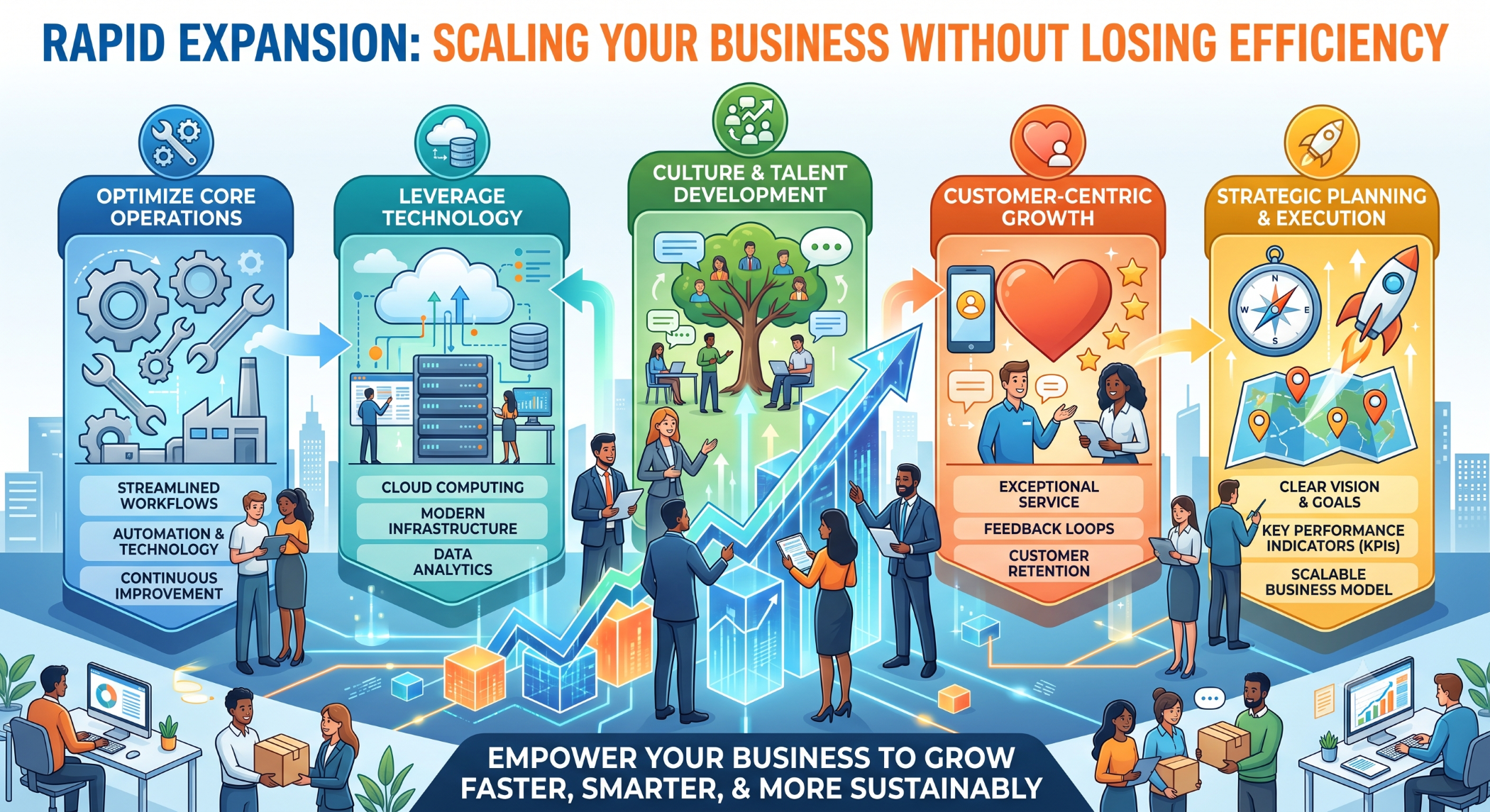
Rapid Expansion: Scaling Your Business Without Losing Efficiency
Rapid expansion is an exciting stage for any business. More customers, new markets, increased revenue, and growing teams can create significant opportunities. At the same time, fast growth can expose weaknesses in existing processes, technology, infrastructure, and resource management.
To expand successfully, businesses need systems that can grow with demand without creating unnecessary complexity.
What Is Rapid Expansion?
Rapid expansion occurs when a business grows significantly within a relatively short period.
Growth may involve:
More customers
New geographic markets
Larger teams
Increased transactions
Additional products or services
Higher operational demands
While expansion can accelerate business growth, it also requires organizations to adapt quickly.
Challenges of Rapid Business Growth
Fast-growing organizations may encounter problems such as:
Operational pressure: Existing processes may no longer handle increased workload efficiently.
Technology limitations: Older applications may struggle with increased traffic, users, or data.
Communication gaps: Larger teams can make collaboration and information sharing more difficult.
Resource management: Businesses may struggle to allocate people and resources effectively.
Customer experience: Service quality can suffer when growth happens faster than operational capacity.
Build Scalable Technology
Technology should be designed with future growth in mind.
A scalable application can support increasing users, transactions, and data without requiring a complete redesign.
Depending on the business, scalability may involve:
Efficient Application
↓
Database Optimization
↓
Caching
↓
Cloud Infrastructure
↓
Load Balancing
↓
Horizontal Scaling
The right architecture depends on actual business requirements and expected growth.
Automate Repetitive Processes
Manual processes that work for a small company can become bottlenecks during rapid expansion.
Businesses can automate tasks such as:
Lead assignment
Customer onboarding
Notifications
Invoice generation
Reporting
Data synchronization
Approval workflows
Automation helps teams handle increased workload while reducing repetitive effort.
Connect Business Systems
Rapidly growing organizations often adopt additional tools for sales, finance, customer management, operations, and marketing.
APIs and integrations can connect these systems so information flows automatically.
For example:
Website
↓
CRM
↓
Order Management
↓
Accounting
↓
Reporting
Connected systems can reduce duplicate data entry and improve operational visibility.
Cloud Infrastructure for Growth
Cloud infrastructure can provide flexibility as application demand changes.
Businesses can scale computing resources, storage, databases, and application services according to workload requirements.
However, cloud adoption should still be planned carefully around cost, security, performance, availability, and compliance.
Expand the Team Strategically
Rapid expansion often creates pressure to hire quickly. However, hiring without clear roles and processes can create additional management and productivity challenges.
Businesses should define responsibilities, establish workflows, document processes, and provide appropriate training as teams grow.
Technology can also support distributed teams through collaboration tools, project-management systems, centralized documentation, and automated workflows.
Protect the Customer Experience
Growth should not come at the expense of customer satisfaction.
Businesses should monitor:
Response times
Support requests
Product reliability
Service quality
Customer feedback
Scalable technology and well-designed processes can help maintain a consistent customer experience while the organization expands.
Monitor Performance During Expansion
Growth should be measured through both business and technology metrics.
Useful indicators may include:
Customer growth
Revenue growth
Operational efficiency
Application response time
System availability
Support volume
Resource utilization
Regular monitoring helps leadership identify bottlenecks before they become major problems.
Rapid Expansion at Solace Infotech
Solace Infotech works across web and mobile development, cloud, AI, automation, product engineering, e-commerce, APIs, and enterprise applications.
These capabilities can support businesses that need to modernize existing systems, automate operations, develop new digital products, or scale technology alongside business growth.
Best Practices for Rapid Expansion
Growth should be supported by scalable processes rather than temporary fixes.
Start by identifying operational bottlenecks, automate repetitive work, modernize systems that limit growth, and use data to measure performance.
Avoid over-engineering too early. Build for the growth you can reasonably anticipate, then scale individual components as actual demand increases.
Conclusion
Rapid expansion can create tremendous business opportunities, but growth without the right foundation can also increase operational complexity and technology debt.
Businesses that combine scalable technology, automation, connected systems, effective resource management, and continuous performance monitoring are better positioned to grow without sacrificing efficiency or customer experience.
The goal is not simply to grow faster. It is to build an organization capable of scaling sustainably and turning rapid growth into long-term success.