RDBMS: Understanding Relational Database Management Systems
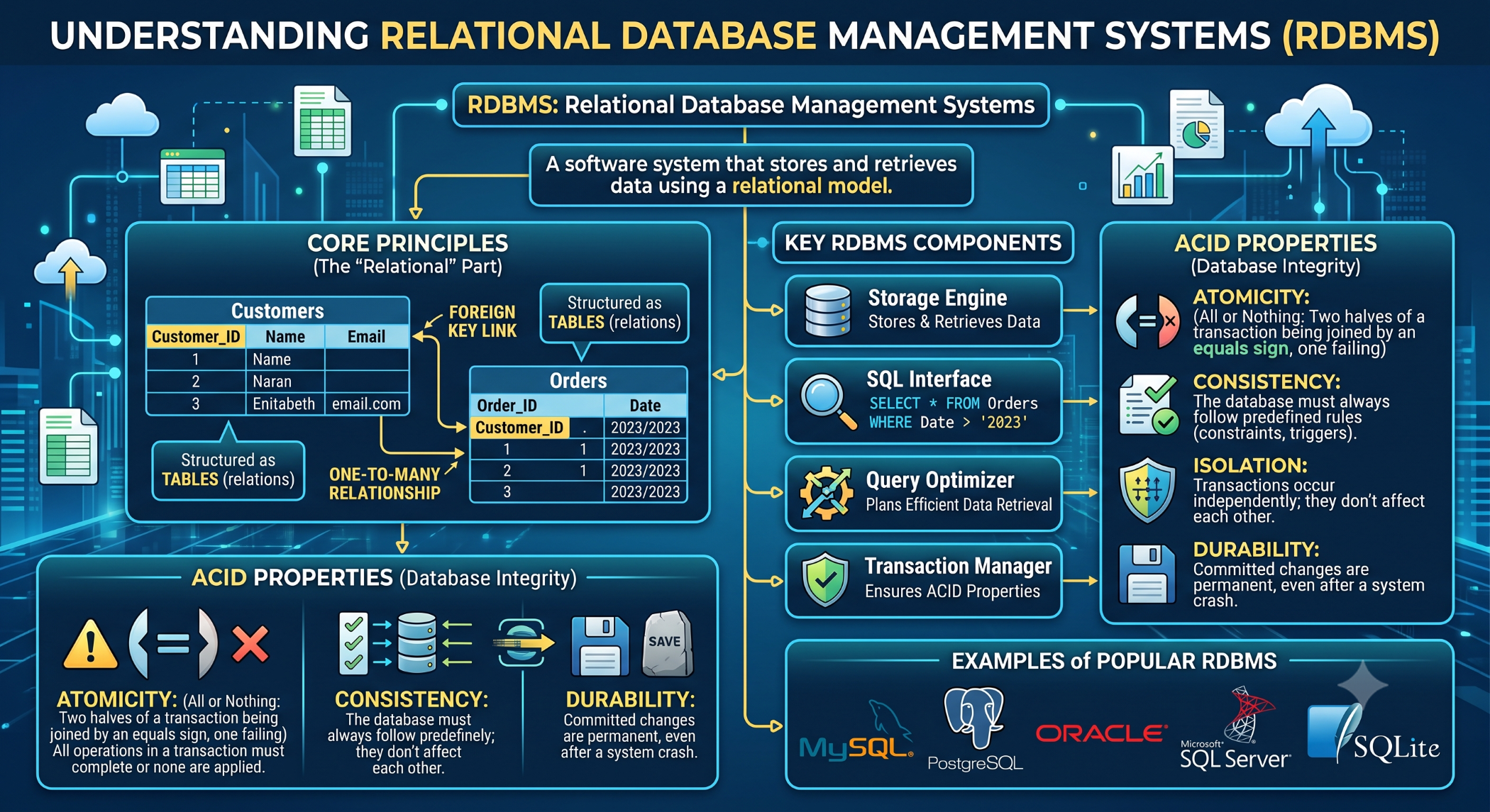
Applications depend on databases to store and manage information reliably. A Relational Database Management System (RDBMS) organizes data into structured tables and establishes relationships between them.
RDBMS technology is widely used for business applications, websites, e-commerce platforms, financial systems, customer management, and many other software solutions where data consistency and structured relationships are important.
What Is an RDBMS?
An RDBMS is a database management system that stores data in tables consisting of rows and columns.
For example:
Customers
--------------------------------
id | name | email
1 | John | john@example.com
2 | Sarah | sarah@example.com
Related information can be stored in other tables and connected using keys.
How Does an RDBMS Work?
A relational database typically consists of multiple tables connected through defined relationships.
For example:
Customers
↓
customer_id
↓
Orders
↓
order_id
↓
Order Items
Applications use SQL to create, retrieve, update, and delete information.
Primary Keys
A primary key uniquely identifies a record in a table.
CREATE TABLE customers (
id INT PRIMARY KEY AUTO_INCREMENT,
name VARCHAR(100),
email VARCHAR(150)
);
The id column provides a unique identifier for each customer.
Primary keys are essential for maintaining data integrity and establishing relationships with other tables.
Foreign Keys
A foreign key connects one table to another table.
For example:
CREATE TABLE orders (
id INT PRIMARY KEY AUTO_INCREMENT,
customer_id INT,
order_date DATETIME,
FOREIGN KEY (customer_id)
REFERENCES customers(id)
);
Here, customer_id connects the orders table with the customers table.
Relationships in an RDBMS
RDBMS platforms support different types of relationships.
One-to-One
One record in one table is associated with one record in another table.
One-to-Many
One record can be associated with multiple records.
For example, one customer can have multiple orders.
Many-to-Many
Multiple records in one table can be associated with multiple records in another table. This is generally implemented through a junction table.
SQL in RDBMS
SQL, or Structured Query Language, is commonly used to interact with relational databases.
For example:
SELECT id, name
FROM customers
WHERE status = 'active';
SQL can be used for:
Selecting data
Inserting records
Updating records
Deleting records
Creating tables
Managing indexes
Defining relationships
Advantages of RDBMS
Structured Data
Data is organized into clearly defined tables, making complex information easier to manage.
Data Integrity
Constraints such as primary keys, foreign keys, unique constraints, and other rules help maintain data consistency.
Powerful Querying
SQL provides extensive capabilities for filtering, joining, grouping, sorting, and aggregating data.
Transaction Support
RDBMS platforms support transactions that help applications perform related operations reliably.
For example, an e-commerce transaction may need to update inventory and create an order as part of a consistent business process.
Common RDBMS Platforms
Popular relational database technologies include:
MySQL
PostgreSQL
Microsoft SQL Server
Oracle Database
MariaDB
Each platform has its own features, tooling, licensing model, and technical characteristics.
RDBMS and MySQL
MySQL is a widely used relational database management system and is commonly used with PHP and other web technologies.
A typical web application architecture may look like:
User
↓
Web Application
↓
Backend
↓
MySQL / RDBMS
MySQL can store application data such as users, products, orders, transactions, and content.
RDBMS Performance
Database performance depends on several factors, including database design, SQL queries, indexing, hardware, memory, and application architecture.
Developers can improve performance through:
Proper indexing
Query optimization
Efficient table design
Appropriate data types
Connection management
Caching
Tools such as EXPLAIN can help analyze how queries are executed.
RDBMS vs NoSQL
RDBMS platforms organize information into structured relational tables and are well suited to applications with clearly defined relationships and transactional requirements.
NoSQL databases use other data models such as documents, key-value structures, graphs, or wide columns.
The choice between relational and NoSQL technology should depend on the application's data model, consistency requirements, query patterns, scalability needs, and development architecture.
RDBMS at Solace Infotech
Solace Infotech works with MySQL and database-driven web applications, using relational database concepts such as tables, relationships, indexing, transactions, and query optimization to support application development.
Database architecture is selected based on the application's business requirements, data structure, performance expectations, integrations, and future scalability.
Best Practices
Design tables around clear business entities, define appropriate primary and foreign keys, avoid unnecessary data duplication, and create indexes based on real query patterns.
Use transactions for operations that require consistency, protect database credentials, apply appropriate access controls, and maintain regular backups.
Database performance should be monitored continuously as application traffic and data volumes increase.
Conclusion
An RDBMS provides a structured and reliable approach to managing application data. Through tables, keys, relationships, SQL, constraints, and transactions, businesses can build systems that maintain data consistency and support complex application requirements.
MySQL and other relational database platforms remain important technologies for websites, e-commerce systems, enterprise applications, and business software.
A well-designed RDBMS provides not only a place to store data but also a strong foundation for reliable, scalable, and maintainable applications.