Real-Time Applications: Building Fast and Interactive Digital Experiences
Users increasingly expect applications to respond quickly and provide updated information without requiring a page refresh. Real-time applications are designed to deliver data and updates with minimal delay, making them ideal for communication, tracking, collaboration, and live business processes.
From instant messaging and delivery tracking to live dashboards and notifications, real-time technology can significantly improve the user experience.
What Is a Real-Time Application?
A real-time application is a software system that communicates updates to users or connected systems as events occur or with very low delay.
A traditional application may require a user to refresh the page to retrieve updated information.
A real-time application can work like:
Event
↓
Backend
↓
Real-Time Communication
↓
Connected Users
When an event occurs, the application can immediately communicate the change to relevant clients.
How Does Real-Time Communication Work?
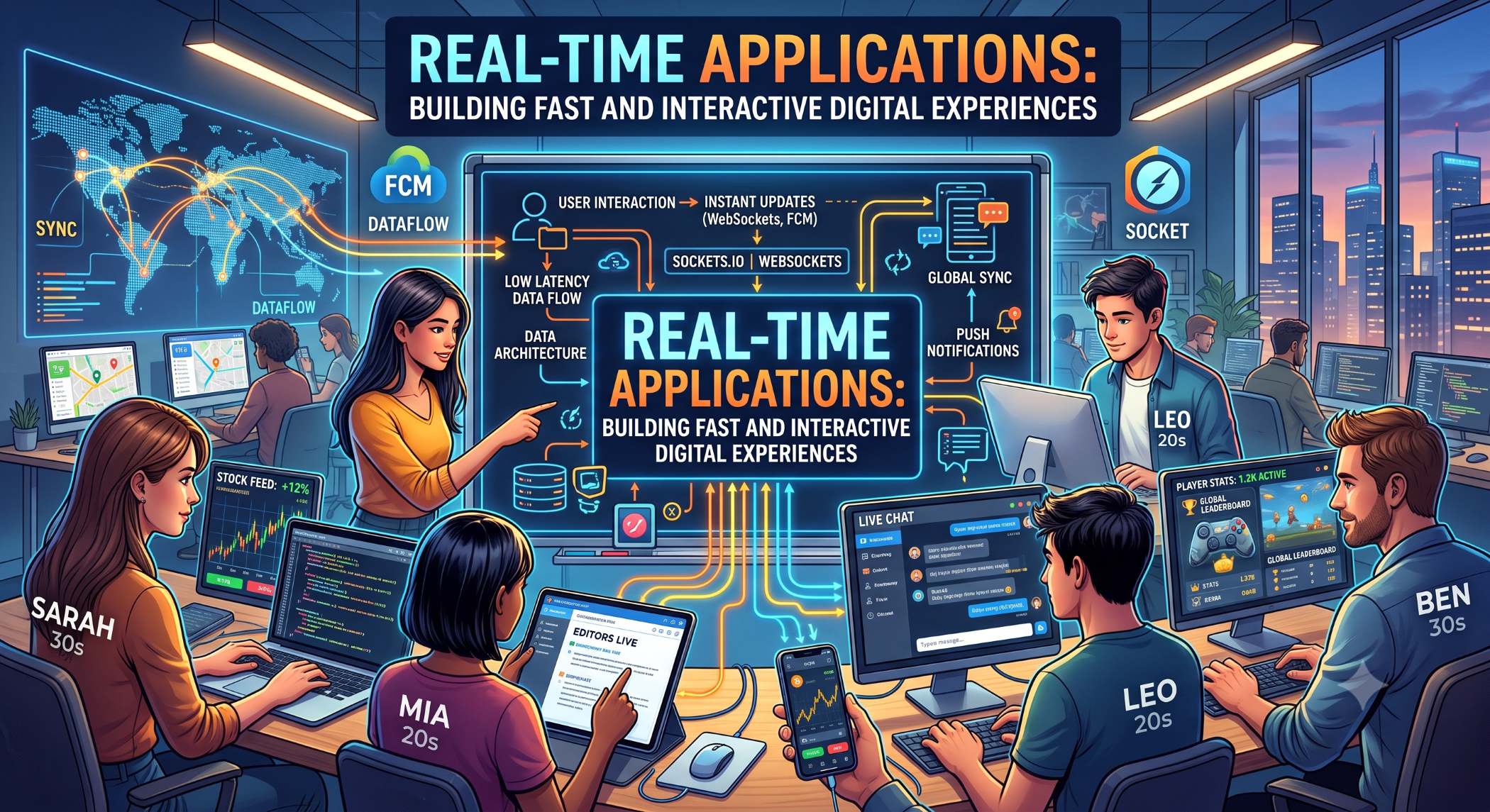
Real-time applications can use technologies such as WebSockets, Server-Sent Events, WebRTC, message brokers, and other event-driven communication mechanisms, depending on the use case.
WebSockets, for example, provide persistent two-way communication between a client and server.
Client A
↕
WebSocket Server
↕
Client B
This is useful when both sides need to communicate continuously.
Common Real-Time Application Examples
Instant Messaging
Chat applications need new messages to appear quickly without requiring users to refresh the conversation.
Live Tracking
Delivery, logistics, and transportation platforms can provide updated locations, statuses, or estimated arrival information.
Live Dashboards
Businesses can use real-time dashboards to display changing metrics, operational events, or system activity.
Notifications
Applications can notify users when important events occur, such as a new message, completed order, appointment reminder, or workflow update.
Collaboration
Collaboration applications can synchronize changes between users so that everyone sees updated information.
Real-Time Data Synchronization
Real-time applications often require multiple clients to stay synchronized.
For example:
User A Updates Data
↓
Backend
↓
Database
↓
Real-Time Event
↓
User B / User C
The application should define how changes are stored, distributed, and handled when multiple users modify the same information.
Technologies Used in Real-Time Applications
The technology stack depends on the application's requirements.
Common components can include:
WebSockets: Useful for persistent two-way communication.
REST APIs: Commonly used for standard application operations and data retrieval.
Message Brokers: Useful for distributing events between services.
Caching: Can reduce repeated database operations and improve response times.
Cloud Infrastructure: Can support scaling as the number of connected users increases.
Real-Time Applications and Mobile Devices
Mobile applications can combine real-time communication with push notifications.
For example, a delivery application can maintain a real-time connection while the application is open and use push notifications when the user is not actively using the application.
This provides a more complete communication strategy.
Challenges in Real-Time Development
Real-time applications introduce additional technical considerations.
Connection Management
Large numbers of simultaneous connections require careful server and infrastructure planning.
Network Reliability
Users may experience unstable or intermittent connections. Applications should handle reconnection and temporary network failures gracefully.
Data Consistency
When multiple clients receive and modify information simultaneously, the application needs clear synchronization and conflict-handling rules.
Scalability
A real-time system may need to support thousands or millions of connections depending on the product. Infrastructure and architecture should therefore be tested under realistic concurrent workloads.
Security in Real-Time Applications
Real-time connections should be secured and authenticated.
Important considerations include:
HTTPS and secure WebSocket connections
Authentication
Authorization
Input validation
Connection controls
Rate limiting
Secure message handling
Users should receive only the data they are authorized to access.
Real-Time Applications at Solace Infotech
Solace Infotech works across web applications, mobile development, APIs, cloud technologies, databases, notifications, and application integrations, which can be combined to build real-time business solutions.
Depending on the project, real-time functionality can support areas such as customer communication, delivery tracking, live dashboards, workflow systems, and notifications.
Best Practices
Start by defining how quickly information actually needs to reach users. Not every application requires a persistent real-time connection.
Choose the communication method based on the use case, design for reconnection and failure scenarios, secure real-time endpoints, and test the system with realistic numbers of concurrent users.
Monitor connection counts, message delivery, latency, server resources, and failures after deployment.
Conclusion
Real-time applications provide businesses with a way to deliver information quickly and create more responsive digital experiences.
From chat and live tracking to notifications, dashboards, and collaboration platforms, real-time technology can improve both customer engagement and operational efficiency.
A successful real-time application requires more than fast communication. It also needs secure connections, reliable synchronization, scalable architecture, and careful handling of network and data-consistency challenges.